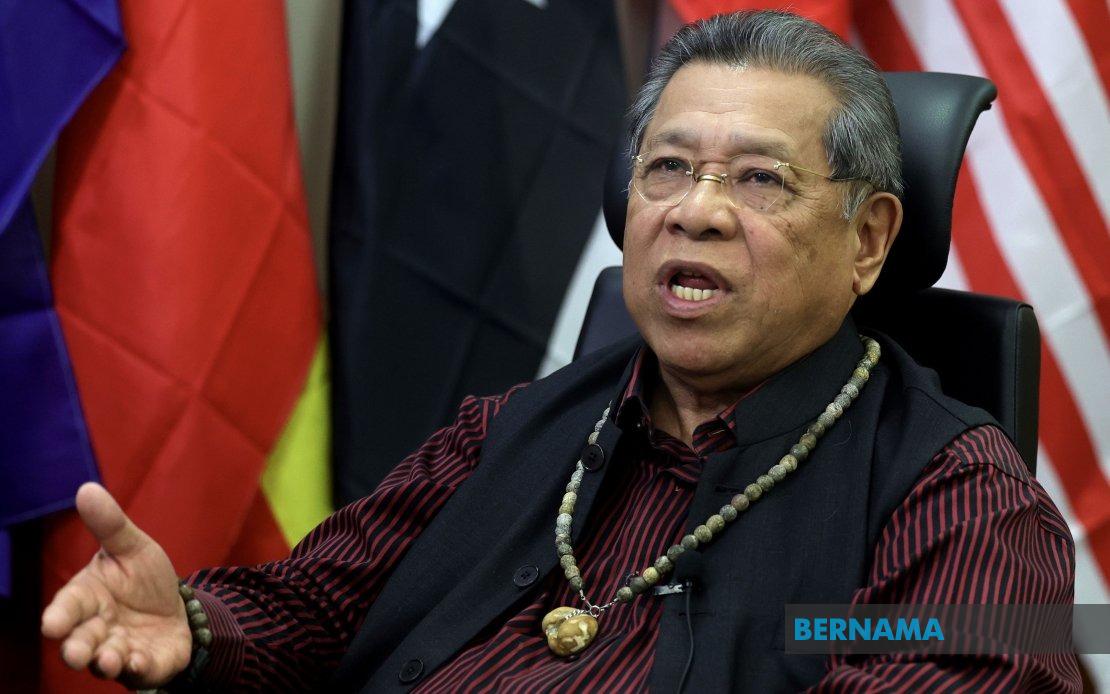
The substantial boost in federal funding directed toward Sabah signals a significant shift in the allocation of resources under the current administration, with the state poised to unlock fresh development opportunities that extend beyond its borders. Speaking at the 2026 PKR National Congress in Melaka on August 15, United Sabah National Organisation president Tan Sri Pandikar Amin Mulia underscored how this enhanced financial commitment would translate into tangible infrastructure improvements and economic initiatives benefiting Sabah's population.
The figures unveiled by Prime Minister Datuk Seri Anwar Ibrahim represent a notable financial reorientation. Federal allocations to Sabah have climbed from RM13 billion in 2022 to RM17.6 billion in 2026—a 35 percent expansion over four years. For a state historically vocal about its financial standing within Malaysia's federal structure, this represents a meaningful response to longstanding representation concerns. The trajectory reflects either a deliberate policy pivot or cumulative recognition of Sabah's development aspirations within the broader national framework.
Pandikar Amin's remarks at the gathering, held at the Melaka International Trade Centre in Ayer Keroh, stressed that accelerated spending would benefit not only Sabah's residents but contribute to Malaysia's collective economic progress. This positioning aligns development at the state level with national growth objectives, framing federal investment as mutually reinforcing rather than redistributive. The messaging carries political weight in a federation where centre-state financial relationships remain sensitive and frequently contested.
For Malaysian observers tracking resource allocation patterns, the Sabah funding increase arrives amid broader debate about balanced development across states. The MADANI Government has previously faced criticism from various quarters suggesting unequal treatment of certain regions. Anwar's clarification during his congress speech—that allocations vary according to priorities and have generally increased across the federation—attempts to contextualize these figures within a framework of differentiated needs rather than preferential treatment.
Sabah's geographical position and development challenges have historically justified elevated per-capita spending. The state's large land area, dispersed population centres, and infrastructure gaps relative to peninsular states create distinct budgeting requirements. Enhanced federal funding potentially addresses chronic shortfalls in connectivity, healthcare access, and educational facilities that have constrained economic participation in rural districts. These are areas where measurable improvements could significantly impact living standards.
Pandikar Amin's explicit endorsement of Prime Minister Anwar Ibrahim—stating that Malaysia "still needs" his leadership domestically and internationally—carries tactical significance beyond the funding announcement. For USNO, alignment with the federal administration translates into enhanced influence over implementation and potential additional support for initiatives aligned with the party's constituency interests. This backing also signals potential stability in Sabah's political alignment, a matter of consequence given the state's swing capacity in national electoral mathematics.
The timing of this announcement, presented at a PKR congress rather than a dedicated Sabah economic briefing, reflects the interplay between party politics and resource distribution in Malaysia. PKR's emphasis on this commitment during its national gathering suggests the party views Sabah funding as a policy achievement worth highlighting to its broader base. For readers across Southeast Asia observing Malaysian federalism, such moments illustrate how developmental priorities intertwine with coalition management and electoral positioning.
The practical impact of increased allocation will depend substantially on implementation efficiency. Federal funding commitments have occasionally experienced delays or reallocation pressures when fiscal conditions tighten. Monitoring actual disbursement patterns and project completion rates in coming years will reveal whether the 35 percent increase translates into proportional on-the-ground improvements. Sabah's capacity to absorb and efficiently deploy such investment at state and local government levels will also shape outcomes.
Regionally, Sabah's enhanced federal support carries implications for Malaysia's broader Southeast Asian standing. The state contains critical economic zones, maintains significant maritime interests, and serves as an important gateway between peninsular Malaysia and the eastern regions. Development improvements could enhance competitiveness relative to neighbouring jurisdictions in Indonesian Kalimantan and strengthen Malaysia's territorial presence along contested waters. Economic vitality in Sabah thus resonates beyond domestic politics.
The funding narrative also intersects with evolving patterns of political realignment in East Malaysia. Successive adjustments in federal support often reflect changing power equations and coalition stability. Pandikar Amin's USNO commands significant influence in Sabah politics, and federal generosity toward the state aligns with party interests. Whether this represents a sustainable commitment or cyclical support contingent upon continued political alignment remains an open question for observers monitoring Malaysian federalism.
Looking forward, the test of these allocations will centre on delivery. Infrastructure projects, service expansion, and economic incentives announced with federal backing must materialize within reasonable timeframes and meet stakeholder expectations. Political credit derives not merely from funding announcements but from visible improvements in transportation networks, digital connectivity, healthcare provision, and educational infrastructure. Sustained development momentum in Sabah could reshape perceptions of federal governance and state-centre relations.

