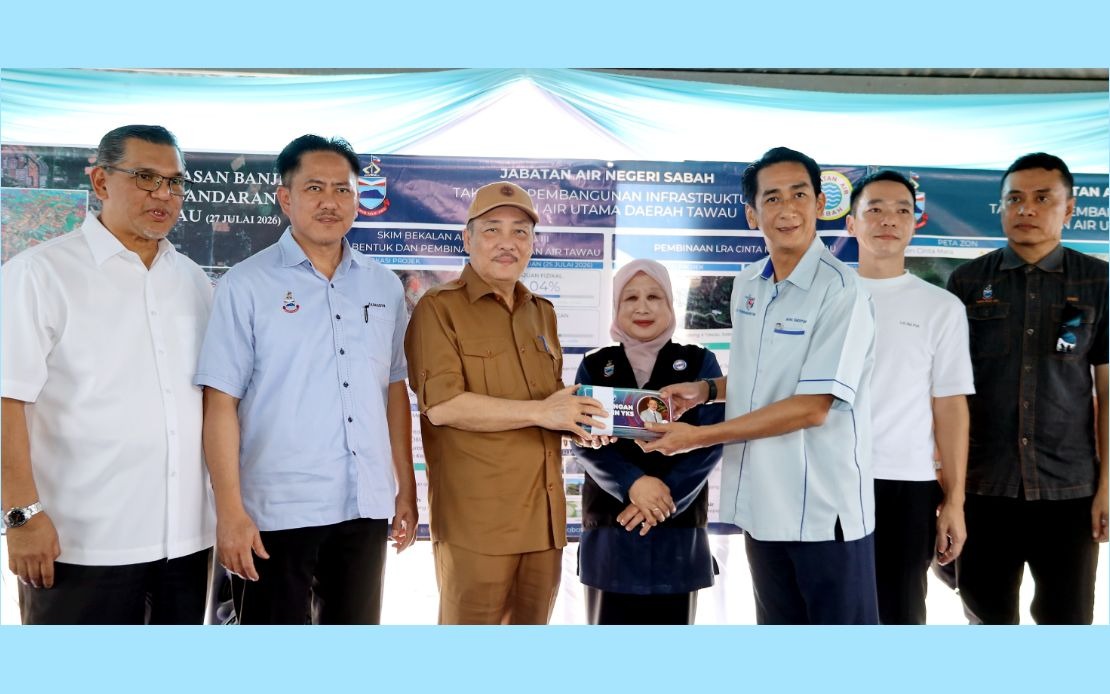
Sabah Chief Minister Datuk Seri Hajiji has presented RM30,600 in humanitarian assistance to residents of Tawau whose homes and livelihoods were devastated by flooding that struck the district on July 25. The donation, channelled through Yayasan Kebajikan Sabah, was formally handed to Tawau Municipal Council president Mohd Shoffian Mohd Said, with funds distributed among 102 affected household heads at RM300 per family to help them navigate the immediate financial pressures following the disaster.
The flooding event proved severe enough to necessitate large-scale evacuation operations, with 362 residents relocated to emergency shelter at Dewan Serbaguna Kompleks Sukan Tawau as waters inundated residential areas and displaced families from their homes. The scale of displacement underscores the intensity of the weather event and the rapid response required from local authorities to ensure public safety and prevent casualties during the crisis period.
In his statement, Hajiji acknowledged the critical coordination and sacrifice demonstrated by multiple emergency response agencies whose personnel worked under challenging conditions to protect residents and facilitate rescue operations. The Civil Defence Force, Royal Malaysia Police, Fire and Rescue Department, and Health Ministry personnel all contributed essential services during the emergency response phase, whilst the Tawau disaster management committee coordinated overall relief efforts across the municipality.
The RM30,600 relief package represents an immediate intervention designed to ease the financial strain experienced by households facing property damage, lost personal possessions, and disrupted economic activity during the recovery phase. For vulnerable families already operating with limited financial buffers, such targeted assistance proves instrumental in enabling them to purchase replacement household items, address urgent repairs, and maintain basic living standards whilst longer-term rehabilitation efforts proceed.
For Malaysian readers and policymakers observing regional disaster management patterns, Tawau's July flooding represents a recurring challenge affecting Sabah's coastal and low-lying districts during monsoon seasons. The town's geographic vulnerability to inundation reflects broader infrastructure and urban planning considerations that regions across Southeast Asia increasingly confront as climate variability intensifies seasonal weather patterns and rainfall intensity grows less predictable.
The swift deployment of humanitarian assistance by the Sabah state government demonstrates the operational protocols now embedded within Sabah's disaster response framework, wherein government-linked foundations activate relief distribution channels within days of major incidents. This approach, combining rapid needs assessment with coordinated fund disbursement, has become a standard feature of state-level disaster management responses across Malaysia's regions, balancing immediate relief with longer-term recovery planning.
The involvement of Yayasan Kebajikan Sabah in channelling assistance illustrates the expanding role of government-affiliated charitable entities in formalizing disaster response infrastructure, moving beyond ad-hoc relief mechanisms toward institutionalized frameworks capable of mobilizing resources efficiently when natural disasters strike. Such foundational structures enable state governments to supplement federal disaster management resources and provide supplementary assistance targeting specific vulnerable populations within affected communities.
Beyond the immediate financial relief, Hajiji's public recognition of emergency service personnel serves an important morale and accountability function, signalling state-level commitment to acknowledging the contributions of frontline workers whose efforts frequently proceed with minimal public visibility. This recognition reinforces expectations that disaster response excellence receives official validation, potentially encouraging sustained professionalism and dedication among personnel managing subsequent emergencies.
The Tawau flooding and subsequent relief response carry implications for Malaysian urban planners and infrastructure managers examining how climate-related disasters increasingly intersect with settlement patterns in coastal and riverine municipalities. As precipitation events grow more intense and unpredictable, municipalities across Sabah and throughout Malaysia face mounting pressure to evaluate drainage infrastructure adequacy, develop improved early warning systems, and implement land-use policies that reduce residential exposure to flooding hazards.
Looking ahead, the restoration of normalcy for Tawau's affected households requires extended support beyond the initial RM300 assistance, encompassing structural repairs, livelihood recovery programmes, and psychosocial support for traumatized residents. State and federal coordination in deploying comprehensive reconstruction assistance will determine how comprehensively affected families can rebuild their lives and restore economic productivity to flood-impacted areas, influencing both individual household recovery trajectories and the broader resilience of Tawau's economy.

