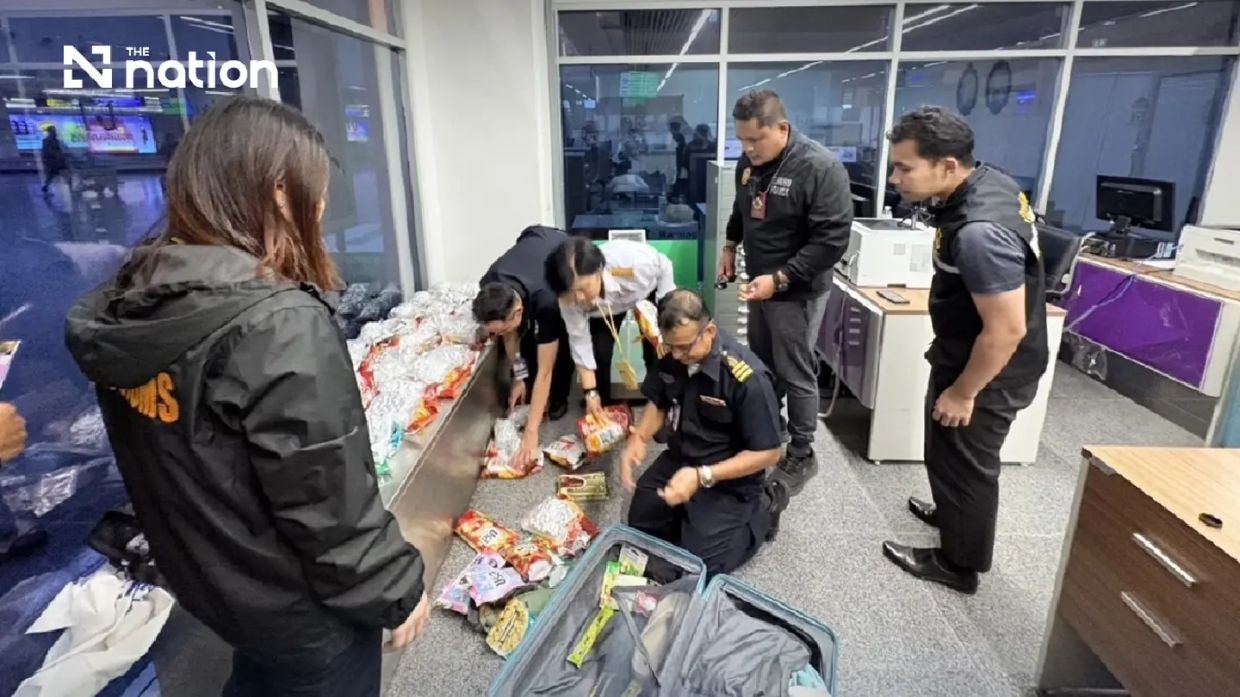
A 30-year-old Russian national has been taken into custody at Phuket International Airport following the discovery of a substantial quantity of cannabis hidden within his luggage, marking another significant narcotics seizure at Thailand's major international travel hub. Sergei Chalabari was intercepted by customs officials in the international departure terminal on Wednesday, July 8, as he prepared to leave the kingdom with two blue BP WORLD wheeled suitcases that contained cannabis flowers and resin with a combined weight exceeding 17 kilogrammes.
The interception occurred at Mai Khao subdistrict's departure facility, where customs officer Rawin Kanokakorn and a dedicated inspection team conducted a thorough search of Chalabari's luggage. The suitcases, which weighed approximately 8 kilogrammes collectively when empty, were subjected to routine screening procedures that ultimately revealed the concealed narcotics. Upon opening the cases, investigators discovered 35 vacuum-sealed packages of cannabis flowers totalling 11.4 kilogrammes, alongside 12 packages of cannabis resin weighing 6.2 kilogrammes in aggregate.
The deliberate concealment method employed suggests a degree of premeditation, with the drugs sealed in vacuum-packed portions designed to evade detection. During initial interrogation, Chalabari acknowledged ownership of both the suitcases and their contents, a confession that substantially simplified the investigative process and provided prosecutors with direct admission of possession. Officers subsequently informed him that he faced charges relating to attempted smuggling of goods across international borders without adhering to prescribed customs declaration protocols.
The arrest underscores the ongoing challenges that Thailand's customs authorities face in combating the transit of illegal substances through its primary airports. Phuket International Airport, serving as a major gateway for international tourism and commerce, presents attractive opportunities for traffickers seeking to exploit passenger volumes and the complexity of managing high-traffic departure zones. The seizure demonstrates the effectiveness of routine luggage inspections, though it also highlights the persistent efforts by individuals to exploit perceived vulnerabilities in security procedures.
The operation's chain of custody and investigative oversight involved multiple layers of administrative hierarchy, reflecting Thai law enforcement's structured approach to significant drug cases. Pol Col Salan Sankhisasanakun, superintendent of Sakhu Police Station, and his deputy Pol Lt Col Rattanawut Nukaew supervised the police aspect of the investigation. Customs leadership included Nucha Jeeradit, chief of the Phuket Airport Customs House, alongside Thanomjit Burirak from the customs control division and Charoenporn Jaengwansuk representing the investigation and suppression section. This multi-agency coordination reflects institutional recognition of the gravity surrounding large-scale drug smuggling attempts.
Following the seizure, Chalabari was transferred to Sakhu Police Station where he remained in detention pending further legal proceedings. Pol Capt Chaphinya Surithamkul, serving as deputy investigation inspector, assumed responsibility for managing the suspect's progression through the justice system. The procedural transfer ensured that evidence remained properly documented and that investigative continuity was maintained throughout the criminal process.
For Malaysia and other Southeast Asian nations, the incident carries implications regarding regional security cooperation and transnational drug trafficking patterns. Cannabis seizures at Thai airports increasingly reflect broader regional patterns in which narcotics flow through major transportation hubs destined for markets across Asia and beyond. The involvement of Russian nationals in such cases highlights the increasingly internationalised nature of Southeast Asian drug trafficking, with criminal networks recruiting couriers from diverse geographic backgrounds to lower detection risks associated with regional smuggling routes.
Thailand has maintained relatively strict penalties for narcotic trafficking, though enforcement and prosecution outcomes vary considerably depending on quantity seized and suspect cooperation. Cannabis falls under Thailand's Narcotics Act classification, with possession of quantities exceeding personal consumption thresholds typically triggering trafficking charges. The case reflects an apparent shift in enforcement priorities, as Thai authorities increasingly focus on interdicting contraband at international borders rather than exclusively targeting domestic consumption and retail operations.
The Phuket seizure coincides with sustained regional pressure from international drug control agencies, particularly the United Nations Office on Drugs and Crime, which has emphasised Southeast Asia's evolving role as both a consumption market and transit corridor for multiple drug classifications. Russia's emergence as a source country for individuals involved in trafficking operations within Southeast Asia remains a developing concern for regional law enforcement bodies that traditionally associated Russian criminal networks primarily with European and Central Asian markets.

