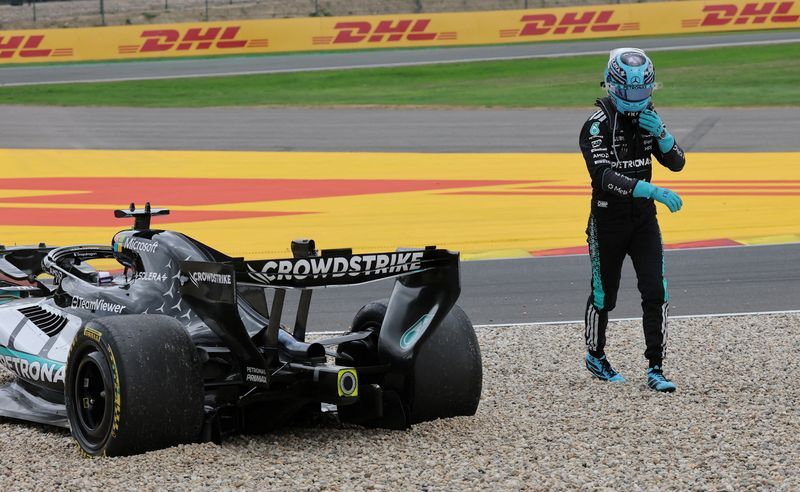
George Russell's championship campaign received another crushing blow at the Belgian Grand Prix on Sunday when the Mercedes driver collided with former teammate Lewis Hamilton's Ferrari on the opening lap and careened into the gravel trap at Spa-Francorchamps. The incident marked yet another points-scoring failure for Russell this season, extending his recent run of poor results and widening the gap to series leader Kimi Antonelli, who remains 25 points clear of Russell in the championship standings with nine of 22 rounds completed.
The collision unfolded under chaotic circumstances that revealed underlying technical troubles plaguing Russell's vehicle. Having qualified in third position, Russell initially made ground into the first corner and tracked closely behind Red Bull's Max Verstappen. However, the Mercedes driver quickly became a victim of his car's power-management system, which failed to recharge the battery unit exiting the opening turn. This mechanical failure cascaded into a broader performance degradation, leaving Russell's hybrid power unit unable to deliver the electrical boost from the turbocharger—a critical component of modern Formula One performance on high-speed straights.
Stranded with a depleted energy reserve, Russell found himself progressively outpaced and vulnerable to traffic as he climbed the circuit toward Eau Rouge, the series' most demanding corner sequence. By the time he reached the top of the climb, his battery indicator read zero percentage, a dangerous scenario that placed him in an extremely precarious position amid three pursuing competitors. Russell acknowledged that he should never have found himself battling with Hamilton in such a compromised state, and his frustration centered not on the British driver's actions but on the mechanical breakdown that precipitated the encounter.
The collision itself involved close-quarters racing typical of Formula One's opening-lap melee, with Russell and Hamilton running side-by-side before contact occurred. Following the impact, Russell spun off and abandoned his vehicle while Hamilton continued racing, prompting the deployment of the safety car. Series stewards subsequently investigated the incident and determined that Hamilton bore primary responsibility, issuing a five-second penalty to the Ferrari driver. Russell publicly stated that while Hamilton merited the greater share of blame, the incident constituted a racing accident rather than reckless behavior.
Russell's philosophical response to the collision reflected a deeper frustration rooted in accumulated disappointment. When asked about his emotional response, the 26-year-old suggested he had become emotionally desensitized to setbacks, noting that repeated incidents throughout the season had enured him to the pain of missed opportunities. This resignation points to broader reliability and performance management issues affecting the Mercedes vehicle, which have plagued Russell across multiple races and contrasted sharply with the dominant pace Antonelli has demonstrated with the Scuderia.
The battery management failure Russell described represents precisely the kind of technical gremlin that can derail title campaigns in modern Formula One. Unlike mechanical breakdowns that occur catastrophically and transparently, electrical system failures often manifest gradually and in ways that compromise performance without immediately alerting drivers. Russell's explanation of exiting the first corner 35% below normal power output illustrates how these marginal losses compound rapidly in competitive racing, where competitors gain positions and momentum while the affected driver struggles to maintain pace.
Russell had raised concerns about his car's behavior on the straights during Saturday's qualifying session, suggesting that the battery and power unit issues identified on race day were not entirely unexpected. This pattern of pre-race warnings followed by manifest problems during competition indicates inadequate diagnostic work or insufficient resolution of known issues before the event began. For Mercedes, traditionally regarded as a pinnacle of engineering excellence in Formula One, such technical oversights carry reputational implications beyond immediate championship implications.
The incident also underscores the vulnerability Russell faces in his title battle. With Antonelli establishing a commanding 25-point advantage and having secured six victories to Russell's tally, the Mercedes driver cannot afford consecutive non-scoring results. Three races without points accumulation represents a catastrophic trajectory, mathematically narrowing his path to the championship as the season progresses through its remaining rounds. The Italian driver's pole position and apparent pace advantage at Spa reinforced his position as the championship favorite heading into mid-season phases.
For Malaysian and Southeast Asian Formula One enthusiasts, Russell's struggles highlight the unforgiving nature of motorsport's highest level, where technical preparation, driver skill, and fortune must align perfectly to achieve success. The incident serves as a reminder that even elite drivers piloting world-class machinery cannot overcome fundamental engineering deficiencies. Russell's subsequent championship prospects hinge not merely on his considerable driving talent but equally on Mercedes' capacity to diagnose and resolve the power management and electrical issues that continue surfacing in competition.

