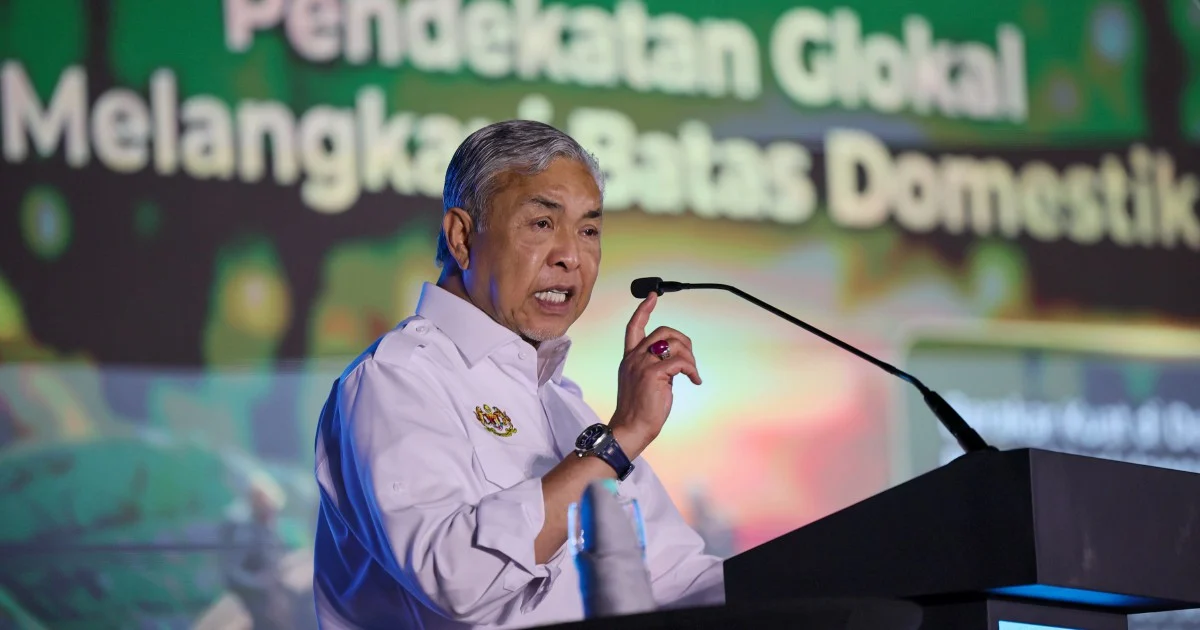
Deputy Prime Minister Datuk Seri Dr Ahmad Zahid Hamidi has called for Malaysia's rural development efforts to be calibrated carefully with international economic imperatives, arguing that the National Rural Economic Agenda must function as a comprehensive roadmap for a transformed countryside. Speaking in Maran, Zahid emphasised that rural expansion cannot be pursued in isolation from the broader global landscape, but must instead proceed as an integral component of Malaysia's wider economic vision.
The National Rural Economic Agenda represents a critical policy instrument at a time when many emerging economies struggle to reconcile localised development with international market demands. For Malaysia, where rural populations constitute a substantial proportion of the electorate and contribute significantly to primary sectors including agriculture, palm oil production, and forestry, ensuring that rural initiatives remain competitive and relevant to global standards has become increasingly urgent. Zahid's remarks suggest the government recognises that rural communities cannot thrive solely through domestic-focused programmes if they are to participate meaningfully in international trade and investment flows.
The alignment between rural policy and global frameworks reflects Malaysia's positioning within regional supply chains and multinational economic structures. Southeast Asia's integration into global commerce, particularly following trade agreements and digital economy expansions, means that Malaysian rural enterprises—whether agribusinesses, small-scale manufacturers, or service providers—must meet international standards for quality, sustainability, and efficiency. Without such calibration, rural workers and entrepreneurs risk remaining economically marginalised, unable to access lucrative export opportunities or attract foreign investment that could diversify their livelihoods beyond traditional activities.
Zahid's emphasis on a "new chapter" of development suggests dissatisfaction with previous approaches that may have prioritised immediate relief or welfare measures over long-term structural transformation. Modern rural development increasingly demands investment in digital infrastructure, skills training aligned with industry 4.0 requirements, and environmental sustainability measures that satisfy international certification standards. This shift acknowledges that rural Malaysia must transition from subsistence-oriented activities toward higher-value sectors that command premiums in global markets, whether through certified sustainable practices or technology-enabled services.
The timing of this statement is significant within Malaysia's broader economic policy debates. As the nation seeks to recover from pandemic-related disruptions and position itself competitively in Southeast Asia's evolving economic hierarchy, rural areas cannot remain peripheral to growth narratives. The Deputy Prime Minister's framing suggests that rural development is not merely a social welfare concern but a critical component of national competitiveness. By connecting the National Rural Economic Agenda to global standards, Zahid is articulating a vision where rural Malaysia becomes embedded within high-value international networks rather than relegated to traditional, low-margin production.
Implementing such an agenda presents substantial challenges. Rural infrastructure remains uneven across Malaysia, with disparities in broadband connectivity, transportation networks, and access to technical education creating barriers to global integration. Local enterprises often lack capital and market information necessary to participate in international trade, whilst skills gaps limit their capacity to adopt new technologies. The government's ability to furnish rural communities with resources matching these demands will largely determine whether the National Rural Economic Agenda succeeds in bridging the rural-urban economic divide that has persisted for decades.
Environmental considerations add complexity to balancing global alignment with rural development. International buyers increasingly demand proof of sustainable sourcing, reduced carbon footprints, and ethical labour practices. Rural producers accustomed to conventional methods may resist or struggle to adapt to these requirements. Yet compliance is increasingly non-negotiable for market access, particularly in premium segments targeting developed economies. Zahid's reference to global agendas likely encompasses not only economic frameworks but also environmental commitments Malaysia has made internationally, from carbon reduction targets to biodiversity conservation pledges.
The regional dimension cannot be overlooked. Rural development coordinated with global standards positions Malaysia competitively relative to neighbours pursuing similar strategies. Thailand, Vietnam, and Indonesia all pursue rural modernisation initiatives, and being perceived as offering higher-quality, certified products or services provides competitive advantage. Southeast Asian rural populations are increasingly integrated into regional value chains; Malaysian rural enterprises that fail to meet international benchmarks risk losing market share to better-positioned competitors in the region.
Successful implementation will require coordination across multiple government agencies, private sector engagement, and community participation. Zahid's speech likely signals the government's commitment to comprehensive rather than piecemeal rural initiatives, suggesting that upcoming policy announcements may detail specific investments in rural infrastructure, education, and enterprise development aligned with global standards. The extent to which budgetary resources reflect this commitment will reveal whether the National Rural Economic Agenda remains aspirational messaging or translates into substantive transformation of Malaysia's rural economy.

