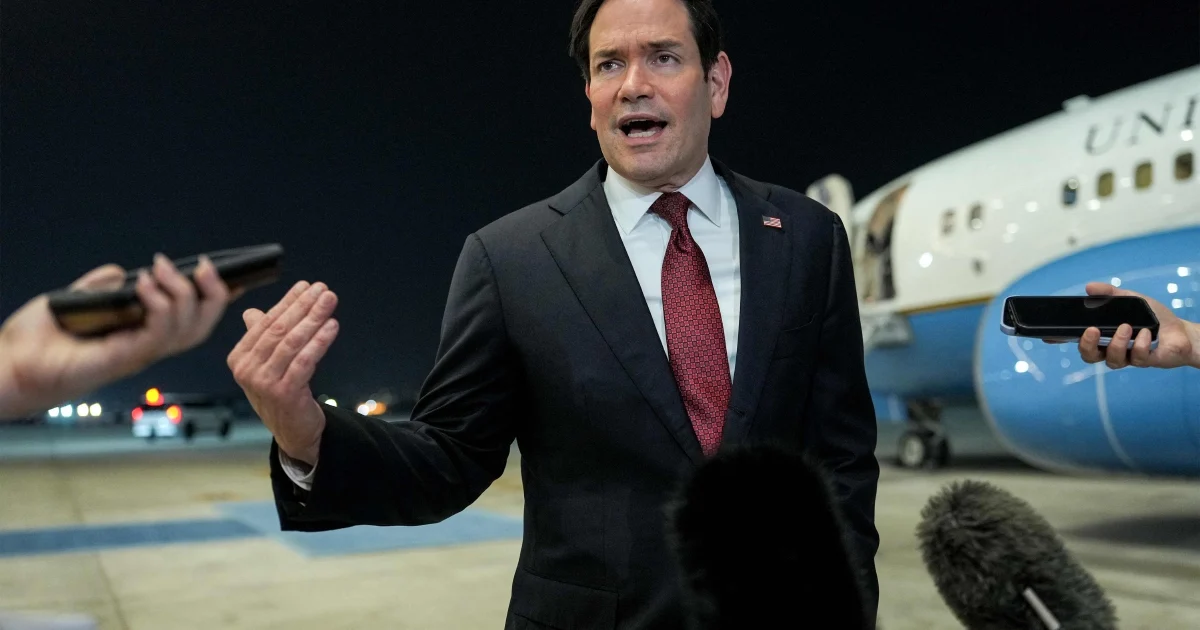
US Secretary of State Marco Rubio has rejected Iranian proposals to levy tolls or charges on vessels transiting the Strait of Hormuz, signalling that fundamental disagreements are already emerging in diplomatic discussions intended to resolve ongoing regional hostilities. Rubio's declaration came on Tuesday as representatives from both nations grapple with competing demands spanning nuclear inspections, ballistic missile programmes, and control over one of the world's most strategically important shipping corridors.
The rejection underscores how quickly negotiations have become mired in competing interests. Iran's suggestion that it should collect fees from international commerce passing through waters adjacent to its coastline reflects Tehran's determination to extract economic concessions and assert greater control over regional affairs. The United States, by contrast, views such a precedent as fundamentally incompatible with international maritime law and the principle of freedom of navigation that underpins global trade. This clash of perspectives demonstrates why even preliminary discussions are proving contentious.
The Strait of Hormuz represents far more than a symbolic battleground for both powers. Approximately 21 per cent of global petroleum exports transit these waters annually, making it indispensable to energy security across Asia, Europe, and beyond. Malaysia, as a major trader with substantial economic interests in sustained energy imports, has a direct stake in maintaining unobstructed passage. Any scheme that imposes additional costs on shipping would ultimately ripple through regional supply chains and consumer prices, making this more than a bilateral dispute between Washington and Tehran.
Beyond the maritime tolls controversy, disagreements over Iran's nuclear programme have resurfaced as a fundamental stumbling block. International atomic energy inspectors require unfettered access to suspected nuclear facilities and documentation, yet Tehran has historically resisted transparency measures that it views as violations of sovereignty. This tension between international security requirements and national autonomy remains unresolved despite multiple previous rounds of negotiations. The absence of progress on this front suggests that diplomatic momentum remains fragile.
Ballistic missile development constitutes the third major point of contention. Iran views its missile arsenal as a legitimate deterrent against regional rivals and foreign intervention, while Western powers contend that an unrestricted programme poses destabilizing threats to Middle Eastern stability. Finding common ground on acceptable parameters for missile development has proved elusive in past talks, and nothing in current discussions indicates a breakthrough is imminent. The technical specifications, warhead capabilities, and delivery ranges under discussion remain points of acute disagreement.
The early emergence of these disputes raises questions about whether either side entered negotiations with realistic expectations of compromise. Rubio's unambiguous rejection of tolls suggests the United States arrived at the table with pre-established redlines unlikely to shift. Iranian officials, meanwhile, appear determined to leverage negotiations for maximum economic and political advantage. When both parties prioritize maximalist positions over searching for middle ground, the prospects for substantive progress diminish considerably.
For Southeast Asian nations including Malaysia, the breakdown of these negotiations carries tangible consequences. Any military escalation in the Middle East typically drives oil price volatility, affecting import-dependent economies throughout the region. Port facilities in the Strait of Malacca, which carry roughly one-quarter of global maritime trade, would face increased insurance costs and shipping delays if tensions escalate further. Regional financial markets remain sensitive to Middle Eastern geopolitics, and unresolved conflicts perpetuate uncertainty that constrains investment and business planning.
Previous attempts at Israeli-Palestinian reconciliation and Iranian nuclear agreements have taught observers that early statements from negotiating teams often shift dramatically as talks progress and confidential discussions unfold. Rubio's public dismissal of Iranian proposals might represent hardline positioning designed for domestic consumption rather than a final word on Washington's negotiating stance. Conversely, Iran's toll proposals might constitute an opening gambit intended to establish baseline demands from which it retreats.
The international diplomatic community faces a critical juncture. Regional powers and global stakeholders including Malaysian policymakers will be watching whether these initial rifts widen into irreconcilable chasms or whether quiet backchannels produce movement toward compromise. The stakes are substantial, with energy security, maritime freedom, and regional stability hanging in the balance. Without visible progress within coming weeks, investor confidence may erode further, complicating economic conditions throughout Asia and beyond.