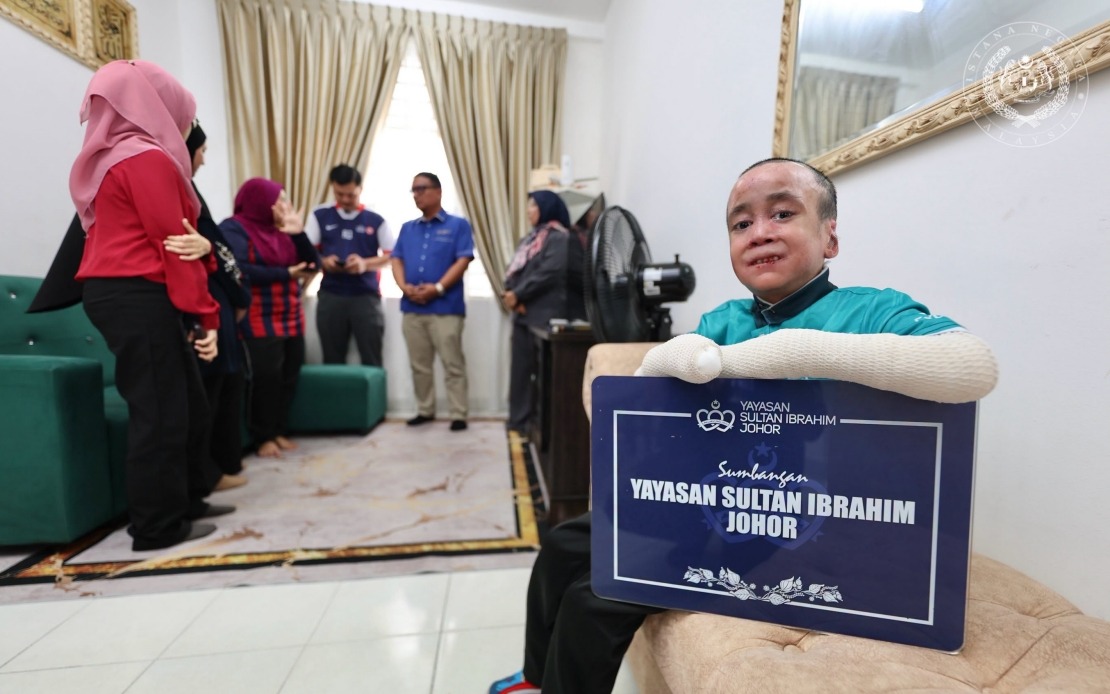
The Yayasan Sultan Ibrahim Johor (YSIJ) has stepped in to ease the financial burden on the family of Muhammad Hazreel Mikhail Hizar, a 15-year-old living with epidermolysis bullosa, a debilitating genetic skin disorder that has affected him since birth. The foundation channelled support through its Ziarah Kasih programme, delivering assistance directly to the teenager's home in the Sungai Tiram People's Housing Project in Johor Bahru on August 18.
Epidermolysis bullosa represents one of the most challenging chronic conditions to manage in a home setting. The disorder causes the skin to become extremely fragile, blistering and peeling in response to minor friction or trauma that would normally leave no mark on healthy skin. For Muhammad Hazreel, this translates into constant vulnerability to wound infections, necessitating meticulous daily cleaning protocols and ongoing medical monitoring. Beyond the clinical requirements, the condition demands environmental controls that many households struggle to maintain, particularly the need for continuously cool, air-conditioned spaces to prevent additional skin breakdown from heat and moisture accumulation.
The real burden, however, falls on Muhammad Hazreel's mother, Noor Halimaton Hashim, who manages his care while single-handedly supporting three children. Her situation exemplifies the hidden costs of paediatric chronic illness in Malaysia—the inability to maintain stable employment due to caregiving demands, the financial strain of specialised medical care, and the psychological weight of round-the-clock responsibility. As a single mother unable to work full-time, Noor Halimaton faces a precarious economic situation where her son's medical needs compete directly with basic household expenses like electricity for essential cooling systems and transportation to medical appointments.
The foundation's intervention arrives at a critical juncture for the family. Speaking through the Royal Press Office, Noor Halimaton expressed profound relief at the assistance, acknowledging that the timing proved instrumental in stabilising her household finances. Her statement underscores not merely gratitude for material support, but recognition of the psychological comfort that comes when a family's struggle receives institutional acknowledgement. For parents managing rare diseases, such recognition often matters as much as the financial component, signalling that their sacrifices are witnessed and valued by society's institutions.
Yayasan Sultan Ibrahim Johor's Ziarah Kasih programme represents a targeted approach to welfare that emphasises personal connection over impersonal bureaucracy. By delivering assistance through home visits rather than administrative offices, the foundation acknowledges that families like Muhammad Hazreel's often lack the capacity to navigate complex application processes while managing intensive medical needs. This model proves particularly valuable for rare disease support, where cases frequently fall through gaps in conventional healthcare and social welfare systems designed around more common conditions.
Epidermolysis bullosa itself remains poorly understood in Malaysia, where awareness campaigns have not reached the general public or many healthcare providers. Families managing the condition often face stigma and social isolation, compounded by the difficulty of explaining a disease that produces visible wounds and requires visible management strategies. Muhammad Hazreel's case, elevated through royal foundation involvement, potentially increases public awareness of this rare genetic disorder and legitimises the struggles of the estimated hundreds of Malaysians living with similar conditions.
The economic implications extend beyond the immediate household. Extended families often absorb care responsibilities and financial burdens when primary caregivers cannot manage alone, creating multi-generational poverty traps. Single-parent households managing chronic paediatric illness represent a particularly vulnerable demographic that conventional poverty alleviation programmes may overlook. Noor Halimaton's situation—unable to work full-time, managing complex medical needs, supporting multiple dependents on insufficient income—reflects a structural gap in Malaysia's social safety net despite expanding healthcare infrastructure.
For Malaysian policymakers and health administrators, cases like Muhammad Hazreel's illustrate the necessity of comprehensive support systems that address not only medical care but also the economic reality facing families with chronic disease burden. The costs of maintaining appropriate living conditions for epidermolysis bullosa patients—continuous air conditioning, specialised wound dressing materials, infection prevention measures—can consume substantial proportions of household income in lower-income communities. When families must choose between electricity bills and medication, the foundation's assistance becomes not merely charitable but essential.
Moving forward, Muhammad Hazreel's case demonstrates how royal and charitable foundations can complement government healthcare and welfare systems, particularly for rare diseases where patient numbers may not justify dedicated policy frameworks. Yet sustainable solutions require integration across multiple levels—medical provision, environmental support, income maintenance for caregivers, and public awareness. The Ziarah Kasih programme's direct engagement model offers a template for identifying and supporting families in crisis, but broader systemic change remains necessary to prevent cases of severe chronic illness from pushing families into destitution.

