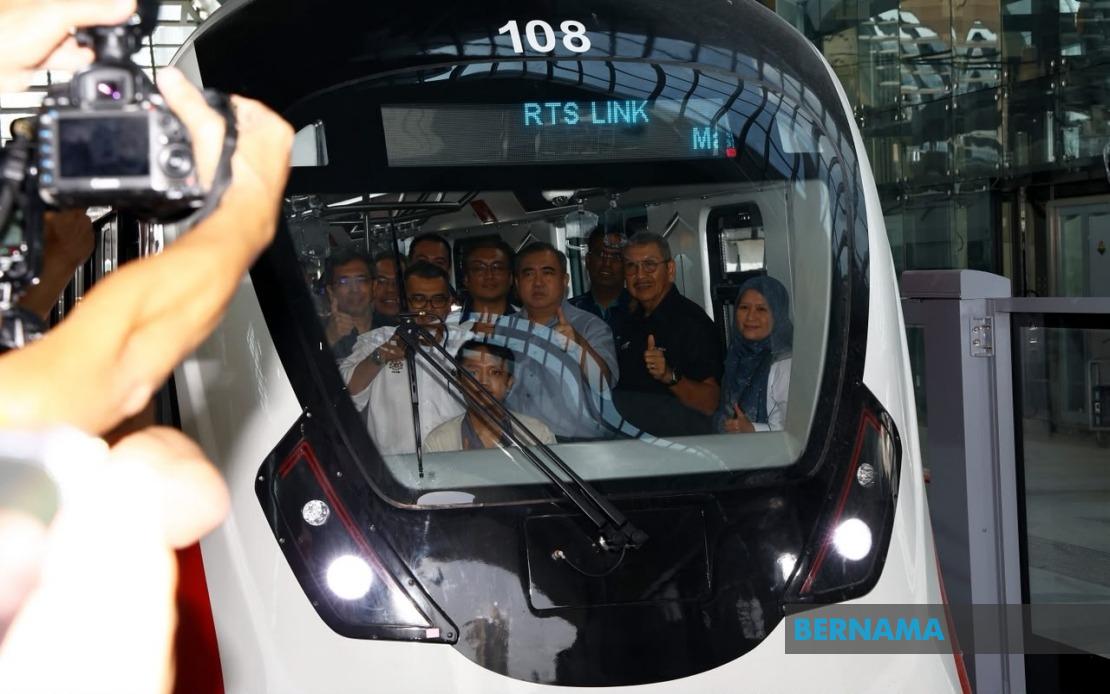
Malaysia's government has committed RM60 million to construct a dedicated bridge connecting the Bukit Chagar RTS Link Station with the nearby KTMB Komuter service terminus, a strategic move designed to eliminate friction in the public transport network and encourage seamless interchange between rail services. Transport Minister Anthony Loke unveiled the project during a site visit to the Bukit Chagar station in Johor Bahru, emphasising that the direct pedestrian link represents a significant shift in how the government approaches last-mile connectivity and modal integration along the country's rail corridors.
The rationale behind the RM60 million investment becomes clear when examining current passenger flow patterns at major transport hubs. Presently, commuters wishing to transfer between the KTMB Komuter network and the upcoming RTS Link must navigate through JB Sentral, adding time and distance to their journey. The new bridge will eliminate this detour by providing a direct, weather-protected pedestrian connection between the two stations, effectively collapsing what is currently a multi-step transfer process into a single, convenient crossing. This design philosophy reflects a broader regional shift toward passenger-centric transport planning, where ease of transfer has become a key competitive advantage in attracting users to public transit systems.
The Ministry of Economy has formally approved the bridge project, with implementation responsibility falling to the Ministry of Transport. Loke indicated that construction is projected to take approximately twelve months, positioning the completed structure to be operational well ahead of the RTS Link's anticipated January 1, 2025 commencement date. This timeline suggests planners have deliberately sequenced the bridge completion to coincide with the opening phase of the rapid transit system, recognising that first-impressions matter greatly in establishing public transport usage patterns among new users.
The bridge investment forms part of a broader multi-layered approach to maximising the RTS Link's utility and passenger capacity. Complementing the structural work, the government is simultaneously developing an expanded bus network through the Stage Bus Service Transformation (SBST) 2.0 initiative. This companion programme will introduce at least 200 additional buses serving residential areas across Johor Bahru and channelling passengers toward the Bukit Chagar interchange hub. The timing of bus service expansion to align with RTS Link operations reflects sophisticated demand management, ensuring that the system's theoretical capacity of 10,000 passengers per hour in each direction can be achieved without overwhelming any single access point.
Negotiations with the bus operator responsible for SBST 2.0 are in their final stages, with the Ministry of Finance expected to formally approve the operator award shortly. The deliberate coordination between the bridge project, bus network expansion, and RTS Link opening demonstrates a shift in how Malaysian transport planners approach infrastructure rollout—moving away from siloed project delivery toward integrated corridor development that considers the entire passenger journey rather than individual components in isolation.
The Bukit Chagar station itself represents an unprecedented concentration of transport modalities within a single interchange. Beyond the KTMB Komuter and RTS Link services, the precinct will incorporate connections to JB Sentral, e-hailing vehicle pickups, and other public transport options, effectively transforming Bukit Chagar into Malaysia's first genuinely multi-modal transport hub. This integration aspires to the standards established by successful Asian transport interchanges such as those in Singapore and South Korea, where seamless transfers between different service operators and transport modes have become a key selling point for public transit adoption.
The broader strategic context here is the imminent opening of the RTS Link, a cross-border rapid transit connection linking Bukit Chagar with Woodlands North in Singapore. This bilateral infrastructure project carries significant implications for regional labour mobility, commerce, and transport integration. By ensuring smooth internal connections at the Malaysian terminus, the government is positioning Bukit Chagar not merely as an endpoint but as a genuine transport interchange capable of distributing passengers efficiently across Johor Bahru's existing networks. This has downstream implications for urban development patterns along feeder routes, potentially catalysing residential and commercial growth in areas previously underserved by public transport.
From a passenger experience perspective, the bridge eliminates what would otherwise be a frustrating bottleneck during peak travel periods. The KTMB Komuter network already serves thousands of daily commuters, and the RTS Link is expected to rapidly attract additional users through its superior speed and cross-border connectivity. Without direct pedestrian access between the two systems, the Bukit Chagar interchange would create congestion at JB Sentral or force passengers to undertake detours that undermine the RTS Link's time advantage. The RM60 million bridge investment is therefore not simply a nice-to-have amenity but an essential piece of core infrastructure that determines whether the overall system can function efficiently at design capacity.
Construction of the Bukit Chagar RTS Link facility, including the CIQ complex and main station building, has been completed. The project has now entered its critical testing and commissioning phase, during which system integration tests will verify that all components—from ticketing systems to passenger information displays to emergency egress procedures—function flawlessly. This staged approach to project rollout reflects international best practice for complex rail infrastructure, where extensive trials under controlled conditions prevent service disruptions and safety incidents during public operations. The anticipated January 1 opening date provides a firm deadline by which all systems, including the future bridge connection, must be fully operational.
The RTS Link's projected capacity of 10,000 passengers per hour per direction represents an ambitious target that will place it among the highest-capacity cross-border rail services in Southeast Asia. Achieving this capacity requires not only adequate rolling stock and track infrastructure but also seamless connections at both termini. The Bukit Chagar bridge serves this capacity goal by ensuring that passengers can move fluidly from Komuter services into RTS Link platforms without creating bottlenecks. For Malaysian policymakers, the project exemplifies how careful attention to integration details can maximise returns on large infrastructure investments, a lesson with relevance across the country's expanding rail network.
For Johor Bahru commuters and businesses, the bridge represents a tangible improvement in transport accessibility that could reshape daily mobility patterns. Workers living in areas served by KTMB Komuter will gain faster access to Singapore employment markets, while Johor Bahru businesses may attract additional talent previously deterred by cross-border commute complexity. The expanded bus network supporting the same interchange will extend these benefits to residential areas not currently on the Komuter network. These cascading connectivity improvements illustrate how transport infrastructure investments generate value far beyond the physical facility itself, by enabling economic and social interactions that would otherwise be impractical. The RM60 million bridge, when viewed through this lens, functions as a catalyst for broader regional integration and opportunity creation.

