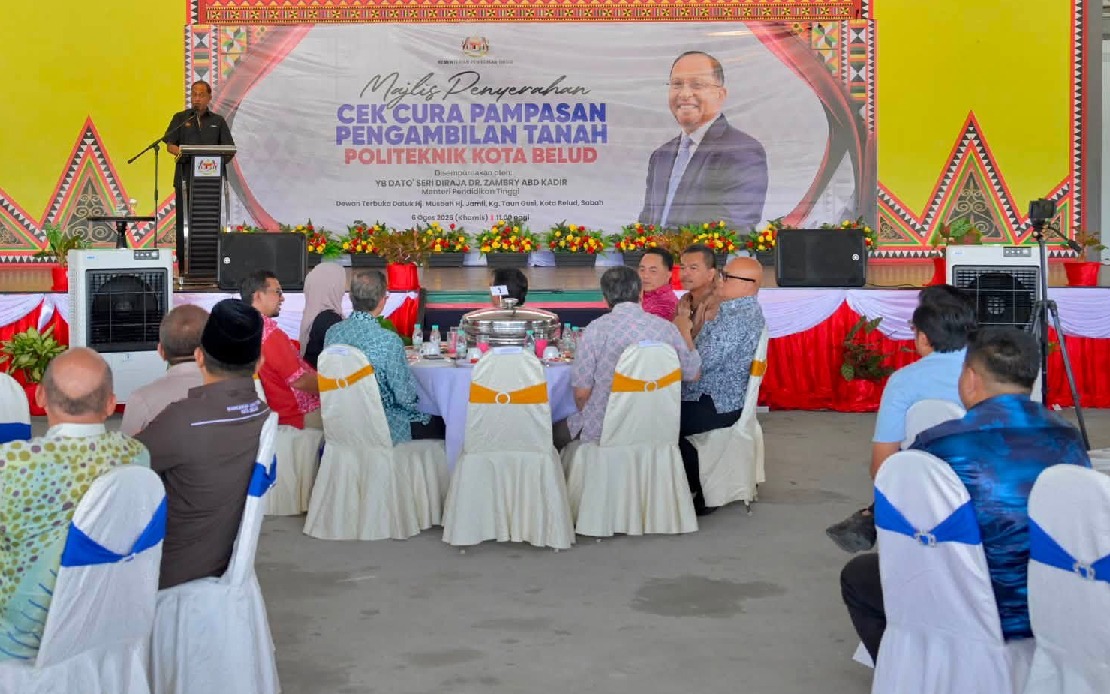
The long-awaited Politeknik Kota Belud, a RM250 million tertiary education facility, has formally entered its construction phase following the settlement of land compensation claims in Sabah. Higher Education Minister Datuk Seri Zambry Abd Kadir announced the milestone at a ceremony in Kota Belud, where affected landowners received payment for their properties. The minister confirmed that the polytechnic is on track to open by 2030, representing a significant investment in technical education for Sabah's rapidly developing economy.
The project's journey to this point spans more than six years, originating from a proposal put forward by then Kota Belud MP Datuk Seri Abdul Rahman Dahlan in 2017. What began as a local initiative has evolved into a government-backed priority development, reflecting the Ministry of Higher Education's commitment to expanding polytechnic infrastructure beyond the peninsula. The completion of land acquisition, celebrated through the formal presentation of compensation cheques to displaced landowners, signifies the transition from the planning and acquisition phase to active construction and detailed design work.
Zambry articulated an ambitious vision for the institution, emphasising that its curriculum will be calibrated to address both immediate and long-term labour market requirements in Sabah. Rather than offering generic vocational programmes, the polytechnic will specialise in sectors integral to the state's economic diversification strategy. This targeted approach reflects a broader shift in Malaysia's higher education policy toward aligning tertiary institutions more closely with regional economic priorities and global technological trends.
The minister outlined four strategic focus areas for the polytechnic's programmes: green energy, artificial intelligence, computer science, and smart technology-based agriculture. These disciplines represent the technological frontier for Sabah's future workforce. Green energy programming addresses the state's renewable energy ambitions and potential offshore wind and solar projects. Artificial intelligence and computer science curricula respond to digital transformation sweeping across both public and private sectors. The emphasis on smart agriculture reflects Sabah's agricultural heritage while modernising farming practices through precision technology, data analytics, and automated systems—a particularly relevant specialisation given the state's palm oil, cocoa, and coconut industries.
Capacity planning for the institution reveals a measured, growth-oriented approach to development. The initial intake is projected at approximately 500 students, allowing for operational stabilisation and quality assurance during the launch phase. Over time, enrolment will expand to accommodate between 1,000 and 1,500 students, positioning Kota Belud Polytechnic as a significant regional education hub. This expansion trajectory provides flexibility for the facility to scale operations as demand demonstrates itself and as industry partnerships crystallise around specific programme streams.
Implementation is expected to accelerate significantly from 2025 onward, when the polytechnic enters the Third Rolling Plan (RP3) period under Malaysia's 13th Malaysia Plan. This parliamentary framework provides the budgetary and regulatory foundation for comprehensive development activities. The transition from compensation settlement to formal planning and design work represents a critical juncture; the detailed architectural and engineering specifications developed during this phase will determine the facility's functionality, capacity, and adherence to international technical education standards.
For Sabah, the establishment of this polytechnic carries substantial economic and social implications. Currently, students from the state seeking technical qualifications often travel to peninsula-based institutions, incurring significant personal and family costs while potentially leading to brain drain as graduates remain in urban centres. A locally accessible polytechnic offering world-class programmes in emerging technologies could shift this pattern, retaining talent within the state and building human capital for Sabah's tech-driven economic agenda. Employers in oil and gas, manufacturing, renewable energy, and agriculture sectors will benefit from a pipeline of graduates trained in cutting-edge methodologies.
The polytechnic's positioning within Sabah's broader development landscape is also noteworthy. As the state pursues economic diversification away from traditional extractive industries, investing in technical skills development signals commitment to building a knowledge-based economy. The focus on artificial intelligence and computer science in particular aligns with Malaysia's National Digital Economy and Fourth Industrial Revolution initiatives, ensuring that Sabah's workforce develops competencies essential for participation in emerging sectors.
Regionally, the Kota Belud Polytechnic will strengthen Malaysia's technical education infrastructure in Borneo. Competition for skilled workers across Southeast Asia is intensifying, and investing in quality polytechnic facilities helps Malaysia retain competitive advantage. The institution will likely attract students from neighbouring Indonesian and Bruneian communities, enhancing Malaysia's reputation as a technical education destination and generating economic activity in Sabah's hospitality and services sectors.
The 2030 completion timeline, while ambitious, is not unprecedented for major tertiary infrastructure projects in Malaysia. However, success hinges on sustained budgetary commitment, timely acquisition of additional land if required, and robust project management structures. Construction of a modern polytechnic campus incorporating specialised laboratories, maker spaces, and technology-enabled learning environments demands sophisticated design and procurement processes. Any delays in design approval or construction logistics could push the timeline beyond 2030, making stakeholder communication and milestone tracking essential throughout implementation.
Zambry's public commitment to the project, coupled with the ceremonial formality of the land compensation settlement, suggests high-level political backing that should facilitate bureaucratic navigation. However, polytechnic development in Malaysia has occasionally faced resource constraints and competing institutional priorities. Maintaining focus on Kota Belud as a strategic investment, rather than treating it as ancillary to peninsula-based expansion, will be crucial for realising the minister's vision by the stated target date.

