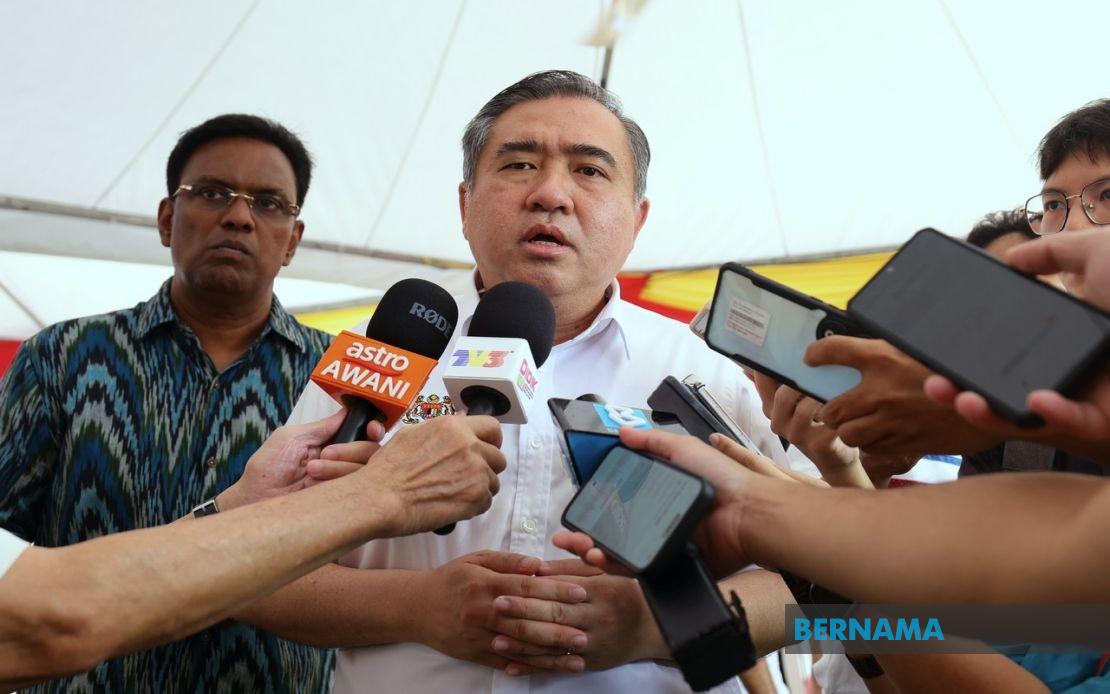
Transport Minister Anthony Loke has committed RM100,000 towards the systematic improvement of facilities and infrastructure in Kampung Bukit Temiang in Seremban, channelling the funds through the government's flagship MADANI Adopted Village Programme. The initiative demonstrates how federal resources are being directed to grassroots communities under a structured framework that prioritises resident input in determining development priorities.
The allocation breaks down into two equal components of RM50,000 each—one sourced from the Railway Assets Corporation (RAC), a statutory body within the Transport Ministry, and the other drawn from Loke's personal allocation as Member of Parliament for Seremban. This dual-source approach reflects the government's strategy of leveraging both institutional budgets and parliamentary funds to maximise financial reach at the village level. The consolidated package will be managed through the Federal Village Development and Security Committee (JPKK), which operates as the implementation mechanism for such grassroots initiatives across Malaysia.
The upgrading works have been structured to occur in phases rather than as a single concentrated project, allowing communities to benefit incrementally from improvements while managing financial resources efficiently. According to Loke's outline, residents identified several priority areas during consultation sessions, including renovation of the community hall, repairs to residential roofing structures, overhaul of drainage infrastructure, and other facility enhancements determined by community feedback. This consultation-driven approach stands in contrast to top-down development models, positioning the MADANI programme as inherently responsive to local need assessment.
The execution strategy permits flexibility in implementation methods. The JPKK may coordinate traditional gotong-royong (community self-help) activities to harness local labour and expertise, alternatively engaging local contractors for specific technical work requiring professional standards. This dual pathway acknowledges that not all repairs demand external expertise—many can be accomplished through organised community effort—while recognising that specialised work warrants professional intervention. The roof repair component, for instance, likely benefits from contractor involvement to ensure structural integrity and weatherproofing quality.
Loke framed the MADANI Adopted Village Programme as emblematic of the government's broader commitment to direct ministerial engagement with communities, creating institutional channels through which federal departments interact directly with villagers to comprehend localised challenges and formulate contextualised solutions. This represents a deliberate shift towards decentralised governance accountability, where ministry-level representatives bear responsibility for understanding constituent concerns rather than relying solely on intermediary structures.
Simultaneously, Loke announced that an additional RM10 million has been allocated to the National MADANI Taxi Renewal Programme, a parallel initiative addressing the transportation sector's modernisation. The funding aims to amplify awareness and uptake among taxi and hire-car operators of government schemes introduced to transform the industry. Prime Minister Anwar Ibrahim, also serving as Finance Minister, had previously announced this supplementary allocation on July 3, signalling administration confidence in the programme's trajectory following positive initial response to the RM10 million component within the 2026 Budget.
The taxi renewal initiative transcends simple vehicle replacement financing, operating instead as a comprehensive ecosystem designed to enhance driver welfare, strengthen road safety standards, and fortify the public transport sector's long-term viability. Through structured briefings, participating drivers gain access to information regarding driver-accommodating financing mechanisms, pathways to supplement earnings, social security protections, administrative procedures for permit acquisition, and incentive structures promoting industry modernisation. This multi-dimensional approach recognises that vehicle replacement represents merely one lever in broader sector transformation.
A significant aspect of the taxi programme involves recalibrating the relationship between traditional taxi operators and e-hailing platform companies. Rather than positioning these entities as competitors vying for passenger market share, the government frames them as complementary service providers whose cooperation generates mutual benefit. Taxis and ride-sharing platforms, from this perspective, serve distinct passenger segments and operational contexts—taxis remain essential for spontaneous street hailing and airport transfers, while platforms provide advance-booking convenience and surge-pricing flexibility. Strategic partnership rather than zero-sum competition becomes the operative framework.
The Transport Ministry, alongside the Land Public Transport Agency (APAD) and allied government bodies, has committed to sustained coordination with all stakeholder constituencies—taxi associations, financial institutions, vehicle manufacturers, and platform operators—to ensure smooth programme implementation and achievement of stated objectives. This multi-stakeholder approach acknowledges that transportation sector transformation cannot succeed through government mandate alone; it requires buy-in and collaboration from industry participants who understand operational realities. Loke's emphasis on strategic collaboration signals recognition that taxi drivers' economic resilience depends partly on industry-wide coordination rather than individual survival strategies.
For Malaysian readers, particularly those in smaller towns and rural districts like Seremban's villages, the MADANI initiatives represent tangible manifestations of development prioritisation at the grassroots level. The RM100,000 commitment to Kampung Bukit Temiang, though modest in absolute terms, demonstrates government responsiveness to village-level infrastructure deficits that frequently receive limited attention in media coverage dominated by urban megaprojects. This bottom-up attention allocation challenges assumptions that federal resources concentrate exclusively in city corridors.
The taxi renewal programme carries regional significance for Southeast Asia's transportation landscape. Malaysia's experience in mediating between traditional taxi services and digital disruption offers lessons applicable across the region, where ride-sharing platforms have similarly disrupted incumbent transport operators. The government's attempt to facilitate coexistence rather than displacement positions Malaysia as pursuing a measured modernisation path that prioritises livelihood preservation alongside technological advancement—a model potentially relevant for Thailand, Indonesia, and the Philippines as they navigate similar sectoral transitions.
Both initiatives reflect Prime Minister Anwar Ibrahim's stated vision of inclusive national development—the MADANI framework—wherein economic transformation reaches beyond urban economies to encompass village communities and informal sector workers. By allocating parliamentary resources to small villages and directing ministerial attention to taxi drivers' circumstances, the government attempts to demonstrate that development is not concentrated in affluent urban neighbourhoods or large formal enterprises but distributed across geographic territories and economic strata. Whether these allocations prove sufficient to meaningfully improve living standards and livelihoods will depend heavily on implementation consistency and community participation rates going forward.

