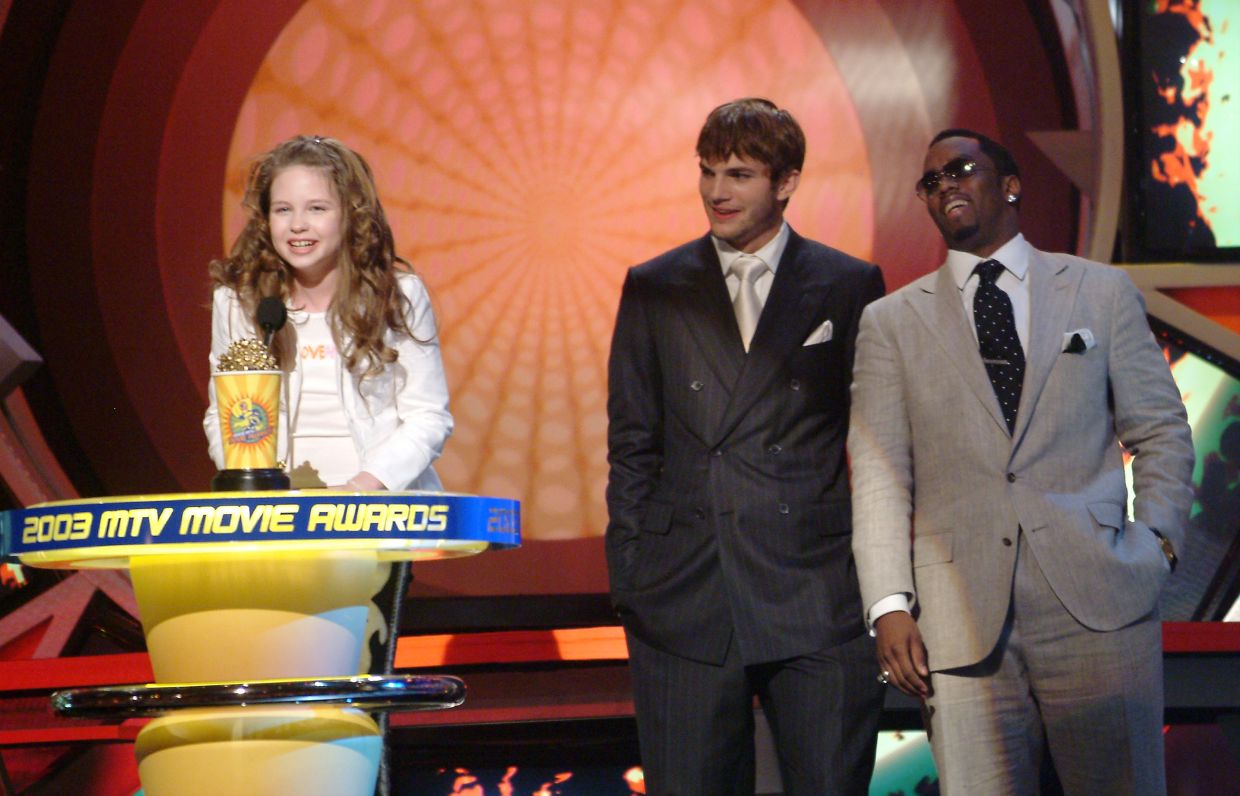
A video clip from the 2003 MTV Awards ceremony has resurfaced online, showing music executive Sean 'Diddy' Combs approaching a preteen actress Daveigh Chase and inviting her to attend an exclusive after-party. The brief exchange, which was filmed during the awards broadcast, has drawn renewed attention in light of recent developments in Combs' legal situation and Chase's passing earlier this year. The footage captures a moment that has taken on darker implications as allegations and convictions have mounted against the once-prominent music industry figure.
Daveigh Chase, best known for her chilling portrayal of supernatural antagonist Samara Morgan in the horror franchise The Ring, was only twelve years old when she won Best Villain at the 2003 MTV Awards. During the presentation of her award, Combs could be seen approaching the young actress with a beverage in hand. Video of the interaction shows him directly asking whether she planned to attend the exclusive after-party that typically follows major entertainment industry awards ceremonies. When Chase responded affirmatively, Combs enthusiastically encouraged her attendance, while fellow presenter Ashton Kutcher appeared to find the exchange amusing.
The tragic circumstances surrounding Chase's life in recent years have added considerable weight to the circulation of this video. Chase passed away on June 16 at a Los Angeles hospital at the age of thirty-five, with her father John Schwallier providing confirmation of her death. The underlying causes proved complex and devastating: she succumbed to complications stemming from bacterial meningitis paired with a serious blood infection, conditions that were compounded by severe malnutrition. Beyond the immediate medical factors, Chase had been struggling with substance addiction for an extended period and had spent considerable time living without stable housing near the vicinity of the hospital where she ultimately died.
Combs himself has become the subject of intense legal and public scrutiny over the past several months, with his parties gaining notoriety for their alleged excesses and illegal activities. The music executive was arrested in September 2024 at the Park Hyatt Hotel in Midtown Manhattan, marking the beginning of a cascade of legal troubles that would fundamentally alter his standing in the entertainment industry. The core allegations centre on what investigators and prosecutors referred to as 'freak-off' parties—described as elaborate, multi-day gatherings characterized by widespread drug use and sexual activity, frequently involving individuals engaged in commercial sex work.
The legal case against Combs escalated significantly throughout 2024 and into 2025. After a comprehensive federal sex trafficking investigation conducted in New York, he faced trial on multiple serious charges. In July 2025, Combs was found guilty on two counts of transportation to engage in prostitution, representing major convictions arising from the extensive trial proceedings. The guilty verdicts culminated in a substantial prison sentence: fifty months of incarceration, which he is currently serving at FCI Fort Dix, a federal correctional institution located in New Jersey.
Beyond the criminal convictions, the extent of civil litigation against Combs demonstrates the broad range of allegations that have emerged. The disgraced music mogul currently faces more than one hundred separate civil lawsuits, suggesting that numerous individuals have pursued legal action claiming various forms of harm or misconduct. These civil cases operate independently from the criminal trial and conviction, potentially exposing Combs to substantial financial liability in addition to his criminal penalty.
The resurfacing of the 2003 video assumes particular resonance within the context of Combs' documented history and the documented decline in Chase's circumstances. The clip serves as a historical artifact that appears innocuous on its surface—a brief celebrity exchange at an awards show—yet has become reinterpreted through the lens of subsequent revelations about Combs' personal conduct and the serious criminal charges he has faced. For Malaysian and Southeast Asian audiences, the case exemplifies how the entertainment industry's darker elements can remain hidden for extended periods, with warning signs potentially overlooked or dismissed in real time.
The connection between the video's circulation and Chase's death has prompted broader reflection on accountability within entertainment institutions. Chase's biography demonstrates a tragic arc from child star success to personal struggle, raising questions about industry responsibility toward young performers and the potential long-term psychological impacts of early fame. While no direct causal link has been established between her appearance at any industry gathering and her subsequent difficulties, the video's renewed prominence reflects public concern about how young entertainers have been protected—or failed to be protected—within professional environments.
For the broader entertainment ecosystem, particularly in regions like Malaysia where Western entertainment holds considerable cultural influence, the Combs case serves as a cautionary narrative about institutional accountability and the importance of industry standards for safeguarding participants. The convergence of Chase's passing with Combs' conviction has created a moment of reckoning that extends beyond individual criminal liability, touching on systemic questions about how power dynamics operate within entertainment spaces and what protections exist for vulnerable individuals.
The implications of this case continue to unfold as civil litigation proceeds and as the entertainment industry reckons with patterns of alleged misconduct that have come to light. The resurfaced video, while fleeting in duration, has become emblematic of larger questions about responsibility, oversight, and the human cost of unchecked power within one of the world's most influential cultural industries. As conversations about these issues develop globally, including within Malaysia's own entertainment sphere, the Combs case provides a stark reminder of the importance of transparency and protective mechanisms for all participants in the entertainment business.