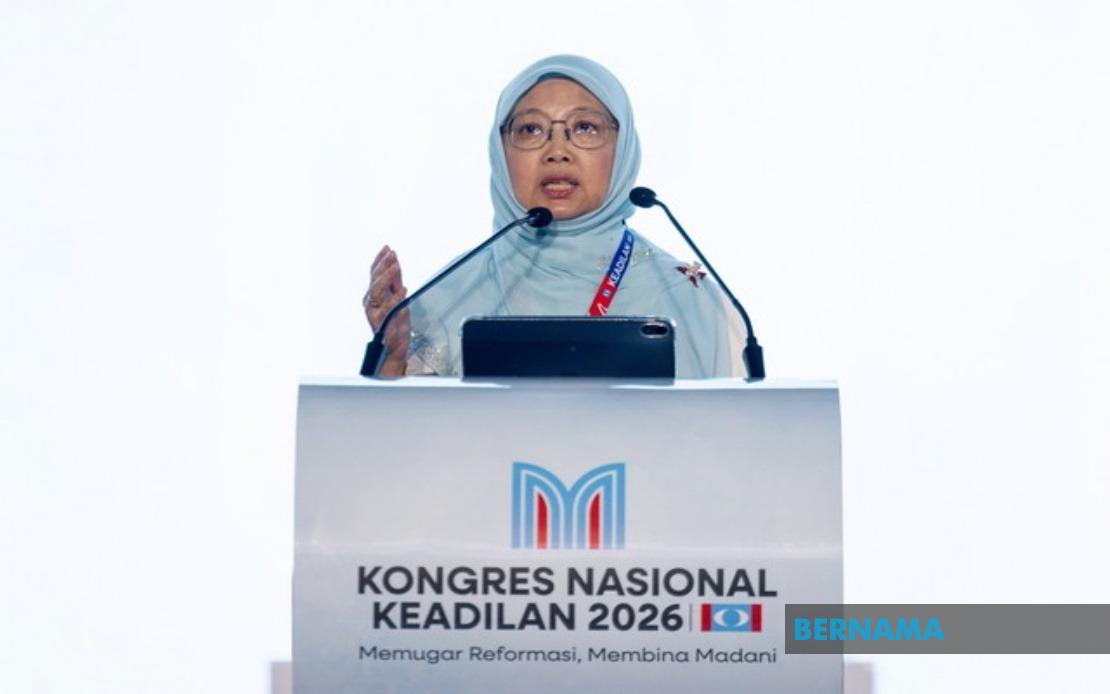
The true measure of Parti Keadilan Rakyat's quarter-century struggle for reform will not be determined by occupying Putrajaya, but by demonstrating the fortitude and judgment required to translate ideals into lasting institutional change. This sentiment, delivered by PKR vice president Datuk Seri Dr Zaliha Mustafa at the party's 2026 National Congress in Melaka on Saturday, signals a critical inflection point in Malaysian politics where the opposition-turned-governing coalition must shift from revolutionary rhetoric to pragmatic reform delivery.
Speaking at the Melaka International Trade Centre, Zaliha reframed the PKR narrative to distinguish between seizing administrative control and fundamentally transforming the machinery of state. The party's 27-year campaign, she stressed, has never been simply about determining who occupies the seat of government. Rather, it has consistently aimed at restructuring the very systems through which the nation is administered. This clarification matters deeply for Malaysian voters who have grown accustomed to political parties making sweeping promises during opposition years, only to compromise or abandon reform agendas once they attain ministerial portfolios.
The pathway toward implementing this reform agenda, according to Zaliha, encompasses several interconnected pillars that will test PKR's resolve and capability. Strengthening institutions and governance structures represents the foundational work—unglamorous but essential tasks that require technical expertise, sustained political will, and resistance to the temptations of patronage that have historically corroded Malaysian institutions. Simultaneously, the party must prosecute corruption and abuse of power with vigour and consistency, demonstrating that reform extends equally to all members regardless of rank or faction. This commitment to internal accountability carries particular significance; political parties often prove reluctant to discipline their own figures when doing so might invite criticism or weaken party unity.
Zaliha's emphasis on the necessity of internal correction reflects a sophisticated understanding of how reform movements lose credibility. Should PKR members witness the party protecting influential figures from accountability while pursuing external enemies, the broader reform project collapses in public perception. The party must be willing to reprimand and correct its own weaknesses—a stance that demands moral courage beyond what most political organisations typically exhibit. For Malaysian observers tracking the coalition government's performance, this principle serves as a crucial accountability metric.
The tension between speed and sustainability emerged as a central theme in Zaliha's address, exemplified through a historical reference to Khalifah Umar Abdul Aziz invoked by PKR president Datuk Seri Anwar Ibrahim at the congress opening. This analogy suggests that transformative change implemented precipitously may prove fragile or counterproductive, while measured implementation allows for institutional consolidation and public adjustment. The distinction Zaliha drew—that gradualism does not equate to delay, nor caution to cowardice—attempts to navigate between impatient reform advocates and those who advocate indefinite postponement. However, this framework requires PKR to maintain exceptional clarity regarding its reform direction and timeline, communicating precisely which changes are immediate priorities and which require extended preparation.
Communication strategy emerged as a surprisingly prominent concern in Zaliha's remarks, reflecting recognition that reform achievements remain invisible to citizens unless effectively articulated. Malaysian governments frequently struggle with this disconnect; ministries implement policies or launch programmes with considerable expenditure and effort, only to discover that public understanding and appreciation remain minimal. Zaliha explicitly rejected the notion that implementation alone generates awareness, arguing instead that political parties bear responsibility for explaining their work in language accessible to ordinary Malaysians. This represents a subtle but meaningful shift toward recognising that policy outputs and public perception require equally serious attention.
The Sekijang MP called for PKR to establish more structured, rapid, and accessible party communication channels as a post-congress priority. This imperative reflects broader Southeast Asian trends wherein political effectiveness increasingly depends on sophisticated communication strategies spanning both traditional and digital media. Malaysian parties have historically concentrated resources on campaign periods while neglecting consistent public engagement during governing periods. Zaliha's advocacy suggests PKR recognises this vulnerability and seeks to institutionalise communication practices that maintain public connection and understanding between electoral cycles.
The challenge of controlling political narrative on social media platforms represents perhaps the most contemporary dimension of Zaliha's reform vision. Opposition parties and competing political factions have demonstrated considerable facility in dominating digital discourse in Malaysia and across Southeast Asia, often through coordinated disinformation campaigns that shape public perception regardless of policy substance. Zaliha's warning that PKR cannot assume opposition parties will cede digital spaces reflects acute awareness that electoral dominance in parliamentary seats provides no guarantee of narrative supremacy in the information environment. The party must actively compete for digital space and the hearts of voters through compelling storytelling and rapid response capability.
Zaliha's argument that victory measured purely in numerical parliamentary terms and policy enactments does not guarantee public acceptance unless accompanied by emotional connection represents a sophisticated political psychology. Malaysian voters, like populations across the region, respond not merely to policy announcements but to narratives that resonate with their lived experiences and aspirations. PKR's success in translating reform into durable governance will ultimately depend not on technocratic competence alone but on whether citizens feel the party understands and advocates for their interests. This perception-building cannot be delegated; it requires consistent, authentic engagement that demonstrates the party's commitment to reform extends beyond elite circles.
As PKR consolidates its governing role within Malaysia's coalition government, the tensions Zaliha identified will intensify. The party must balance maintaining coalition partners' confidence with pursuing reform agendas those partners may resist. It must implement structural changes while managing bureaucratic resistance and entrenched interests. It must communicate achievements clearly without appearing propagandistic. Most fundamentally, it must prove that 27 years of struggle genuinely reflected commitment to systemic transformation rather than mere ambition for power. The 2026 National Congress appears designed to reset expectations toward these longer-term governance challenges, positioning PKR not as victorious revolutionaries but as architects of gradual, sustainable institutional renovation.

