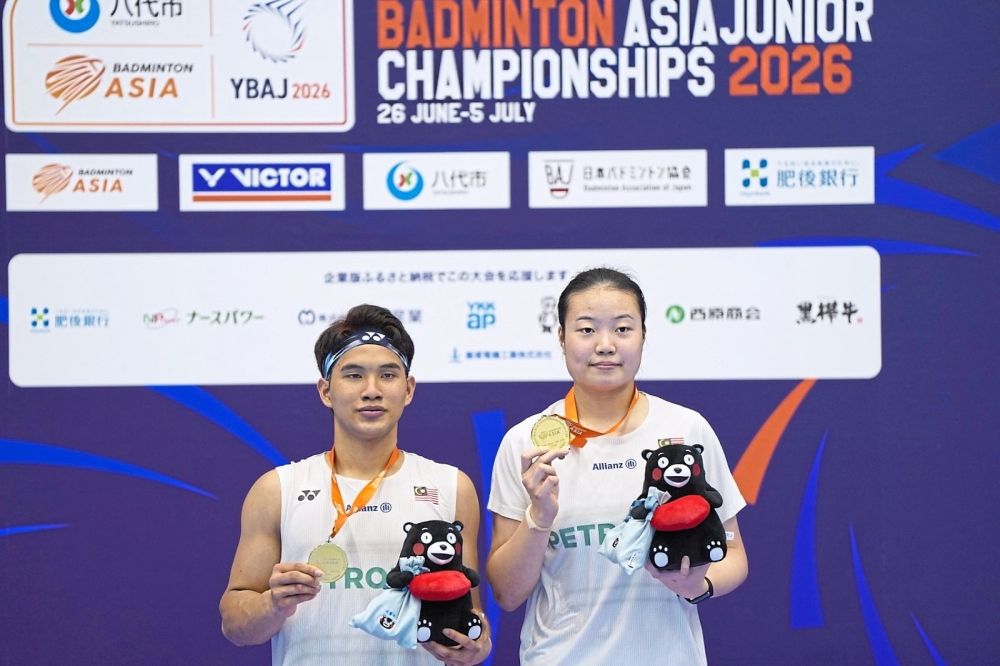
Ahmad Redzuan Zulwaqqarizal and Low Zi Yu have delivered Malaysia's most significant badminton triumph at the junior level in nearly two decades, capturing the mixed doubles crown at the Asian Junior Championships in Yatsushiro, Japan. The victory marks an emotional milestone for the national badminton program, bringing to an end a 19-year championship drought that dates back to Tan Wee Kiong and Woon Khe Wei's triumph on home soil in Kuala Lumpur during 2007. The final clash against China's Zheng Weigang and Li Menghan revealed the mental resilience that would ultimately separate the champions from their opponents, with the Malaysian pair securing a hard-fought 21-15, 22-20 victory in a contest that extended just beyond 40 minutes of intense rallies.
The path to victory proved far from straightforward, particularly as the match reached its climactic stages. Redzuan and Zi Yu found themselves positioned tantalizingly close to the title when they stood just two points from clinching the trophy, yet their Chinese rivals refused to surrender their aspirations. Through sheer determination and tactical adjustment, Zheng and Li forced the encounter toward a decisive third game, creating considerable pressure on the Malaysian challengers at the most critical juncture. Rather than succumbing to mounting tension, the Malaysian duo managed to recalibrate their focus and execution, ultimately prevailing through superior composure during the final exchanges. This capacity to maintain emotional equilibrium under duress proved decisive in separating champions from runners-up on the day.
Low Zi Yu reflected on the championship performance with characteristic modesty, emphasizing that patience had functioned as the essential differentiating factor throughout the encounter. She articulated her belief that maintaining composure and strategic discipline, particularly when the scoreline reached the decisive 20-20 stage, enabled the Malaysian pair to execute superior tennis while their opponents faltered under equivalent pressure. Beyond the technical aspects of their play, Zi Yu underscored the psychological contribution of their teammates, whose encouragement despite their own early eliminations from the tournament created an environment of collective support. This team atmosphere, she suggested, provided additional motivation precisely when the pressure intensified most acutely, demonstrating how badminton success at elite junior levels often transcends individual performances to encompass broader squad dynamics.
For Redzuan specifically, this breakthrough achievement carries profound personal significance rooted in his previous tournament experiences. The Terengganu-born shuttler endured an extended period of disappointment across three consecutive Asian Junior Championships editions. His initial appearance in 2023 in Yogyakarta saw him competing across both boys' doubles and mixed doubles categories, yet both ventures concluded prematurely through early-round exits. Rather than learning from that setback to achieve rapid improvement, Redzuan subsequently encountered comparable frustration during the 2024 edition held in Yogyakarta before experiencing a third consecutive disappointment at the 2025 championships in Surakarta. This pattern of persistent underperformance across three consecutive opportunities made his breakthrough particularly poignant, transforming years of accumulated disappointment into sudden triumphant vindication.
Despite his euphoria at finally breaking through to claim a championship title, Redzuan demonstrated mature perspective regarding his continuing development trajectory. He expressed satisfaction with his technical execution throughout the tournament, noting that his preparation had manifested in improved on-court decision-making that reflected his training regimen. Simultaneously, however, he articulated awareness that his current achievement represents merely a foundation rather than a culmination, emphasizing his requirement to pursue substantial improvements before attempting to establish success at progressively elevated competitive levels. This balanced assessment reflects the mindset required to sustain progress within elite badminton, where initial breakthroughs must be followed by consistent performance increments across successive competitive cycles.
Zi Yu's tournament contribution extended beyond the mixed doubles gold, as she simultaneously competed across the girls' doubles category alongside Genevie Lim. The 15-year-old ultimately concluded that competition with a bronze medal in girls' doubles after falling to Japan's second-seeded pairing of Aoi Banno and Yuzu Ueno in the semi-final stages. Their loss came through a competitive three-game affair that extended across 21-16, 17-21, 17-21, suggesting closely contested exchanges across all three contested sets. Despite not achieving gold in this secondary discipline, Zi Yu's dual-event participation and bronze medal finish demonstrates emerging prowess across multiple badminton categories at the junior international level.
Managing the physical and mental demands of competing across two distinct partnership combinations represents a substantial challenge for young shuttlers, yet Zi Yu suggested that her tactical approach to this dual responsibility has centered on compartmentalization of focus. She identified that both of her partners—Redzuan in mixed doubles and Lim in girls' doubles—possessed considerable individual capability and tactical maturity, thereby reducing her necessity to compensate for less experienced teammates. This strategic distribution of responsibility allowed her to concentrate primarily upon refining her individual technical execution rather than micromanaging partner performance. While she acknowledged offering occasional verbal encouragement when her partners encountered unforced errors, her fundamental approach involved trusting her partners' capabilities while maintaining singular focus upon her own performance contributions.
The broader context of Malaysian badminton excellence illuminates the significance of this championship breakthrough. The nation has historically established itself among Asia's badminton superpowers, yet recent years have witnessed concerning gaps in medal production across certain categories and competitive tiers. The emergence of talented junior players capable of competing effectively against Chinese and other regional powerhouses represents an encouraging signal regarding long-term sustainability of Malaysian badminton dominance. Senior program development often traces its roots to successful junior pathways, and Redzuan and Zi Yu's breakthrough provides tentative evidence that fresh talent continues filtering through developmental structures.
Other results from the championships reveal the continuing competitive parity and fierce competition characterizing Asian junior badminton. Hong Tianyue of China captured men's singles honors through a narrow victory over Indonesia's Fardhan Joe, while Chinese athletes also secured women's singles gold through Yin Yiqing. Taiwan's badminton system demonstrated continued vitality through success in men's doubles with Huang Tzu-yuan and Lin Sheng-ming prevailing, while Japanese shuttlers asserted dominance in women's doubles through Aoi Banno and Yuzu Ueno. This distribution of medals across multiple nations reflects the sophisticated development networks operating throughout East and Southeast Asia, each producing technical specialists capable of competing at championship standard.
The implications of this Malaysian victory extend beyond immediate celebration toward questions concerning sustained competitiveness and program development. Youth badminton competition serves as essential infrastructure for developing elite senior athletes capable of representing their nations at Olympic and world championship standards. Redzuan and Zi Yu's breakthrough provides evidence that Malaysian developmental pathways continue producing internationally competitive talent, yet whether this isolated gold translates into expanded medal successes across subsequent junior championships and ultimately transitions into consistent senior-level excellence remains the critical question confronting the national badminton federation. The 2007 mixed doubles champions eventually transitioned toward successful senior careers, and observers will monitor whether the current generation follows comparable trajectories toward sustained international prominence.

