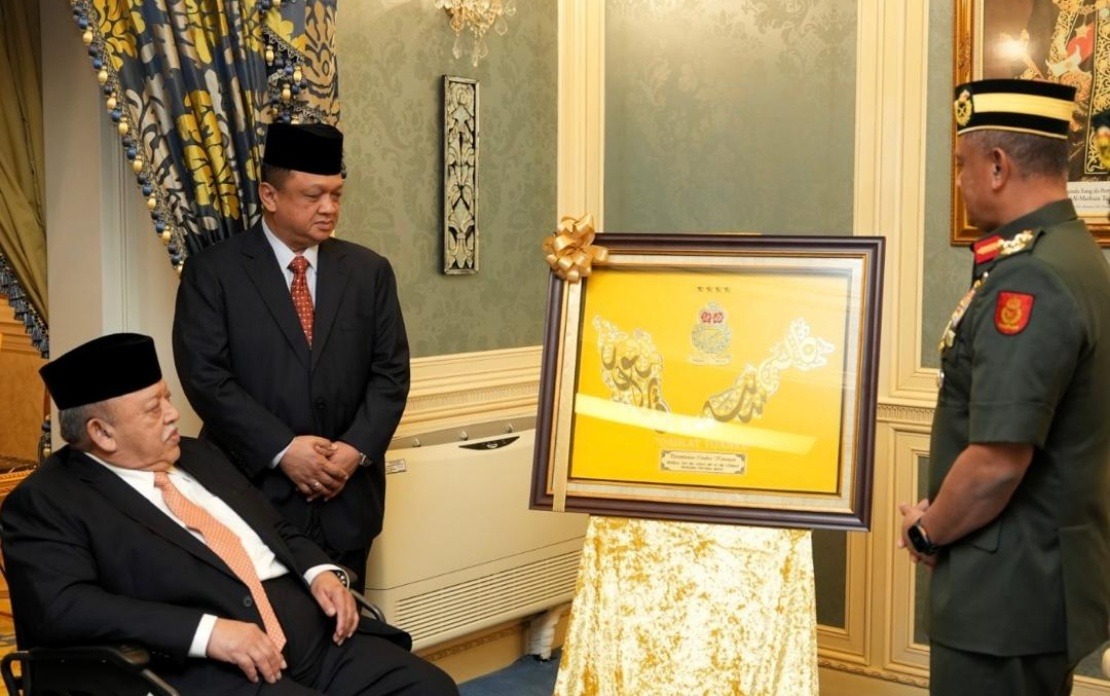
The Raja of Perlis, Tuanku Syed Sirajuddin Jamalullail, received the nation's top military commander at a formal ceremony held on July 29 at the Balai Menghadap Biru within Istana Arau. General Tan Sri Azhan Md Othman's visit to the northern state capital marked an important moment of engagement between Malaysia's defence establishment and one of the country's royal institutions, underlining the institutional relationships that shape governance at the state level.
The Raja Muda of Perlis, Brigadier General Tuanku Syed Faizuddin Putra Jamalullail, joined his father during the ceremony. The Raja Muda carries significant military credentials in his own right, serving as Commander of the 504th Territorial Army Regiment stationed at Kem Bukit Keteri near Padang Besar. This dual military and royal positioning within the state hierarchy demonstrates how Malaysia's defence structure integrates closely with the constitutional monarchy system across its constituent states.
According to a statement released by Istana Arau, the gathering was designed to further deepen existing bonds between Perlis's royal establishment and the Malaysian armed forces. The palace emphasized that such meetings serve a purpose beyond ceremonial protocol—they represent a tangible commitment to maintaining strategic alignment between the state's leadership and national defence priorities. This reflects a broader pattern across Malaysia's federal system, where state rulers maintain crucial consultation roles in matters of security and administrative coordination.
The timing and nature of the audience carried symbolic weight beyond the immediate gathering. By hosting the army chief, the Raja of Perlis publicly reaffirmed support for the military's institutional role in safeguarding the nation. The palace statement explicitly acknowledged the armed forces' ongoing efforts to protect Malaysian sovereignty and maintain public security—a recognition that carries particular resonance in northern Perlis, a border state with significant strategic importance due to its proximity to Thailand.
Tuanku Syed Sirajuddin's formal titles underscore the military dimensions of Malaysia's royal institution. As Colonel-in-Chief of both the Royal Ranger Regiment and the Royal Military Police Corps, the Raja holds ceremonial command positions that connect the monarchy directly to specific military units. These honorary positions are not merely symbolic; they represent constitutional relationships that have endured throughout Malaysia's independence, reflecting the founding architects' intention to embed the monarchy within the nation's defence architecture.
The palace elaborated that the audience functioned as a platform for discussing strategic cooperation across multiple areas of governance. Security matters naturally formed a central component of the discussion, but the statement also highlighted concerns relating to public welfare and broader national development initiatives. This multifaceted approach reflects how modern state administration requires coordination between traditionally separate institutional domains—the ceremonial and constitutional role of the monarchy intersecting with practical governance challenges affecting ordinary Malaysians.
Border security and regional stability have particular relevance for Perlis, which shares a significant frontier with Thailand across several districts. The state's geographical position along major transportation corridors and its role as a transit zone for goods and people moving between Malaysia and Thailand give it strategic importance that extends beyond its relatively modest population and land area. Regular engagement between state leadership and the military high command helps ensure that security considerations remain integrated with state development planning.
The emphasis on preserving national peace and stability through institutional cooperation reflects deeper constitutional principles embedded in Malaysia's system of governance. The framers of the Malaysian Constitution envisioned a strong ceremonial monarchy working in partnership with elected government and appointed defence forces to maintain the three-pillar structure supporting national cohesion. Visits such as General Tan Sri Azhan's to Istana Arau exemplify how these institutional relationships continue functioning across different political administrations and changing security environments.
The palace's statement avoided specific details about operational or policy matters discussed during the meeting, maintaining the conventional discretion surrounding high-level military-royal consultations. However, the formal documentation of the event serves an important function in demonstrating continuity of institutional engagement at a time when Malaysia faces various security challenges ranging from transnational threats to regional geopolitical shifts. Such visible coordination between military and state leadership helps reinforce public confidence in institutional stability and effective governance.
For Perlis specifically, the audience represented an opportunity for the state's royal household to interface directly with national defence leadership on matters affecting the state's security and development. Northern Malaysian states frequently advocate for federal attention to their particular challenges, from smuggling pressures to cross-border criminal activities. A direct channel between the Raja and the army chief facilitates this advocacy while ensuring that state-level security concerns receive consideration within national defence planning frameworks.
The inclusion of the Raja Muda in the ceremony carried additional significance for continuity of institutional relationships. As the heir to Perlis's throne and an active military officer, Tuanku Syed Faizuddin's participation signals that engagement between the royal institution and defence establishment extends across generational lines. This suggests that the patterns of coordination evident in the meeting are expected to persist and develop further as succession transitions occur across Malaysia's various state offices.
Moving forward, such audiences remain valuable mechanisms for maintaining the institutional networks that underpin Malaysia's constitutional governance. In an increasingly complex security environment affecting Southeast Asia broadly, the reinforcement of partnerships between state rulers and military leadership helps ensure that national defence capabilities benefit from regional knowledge and political legitimacy that state institutions uniquely provide. The ceremony at Istana Arau, while apparently routine in nature, therefore represents part of the broader institutional fabric supporting Malaysian governance.

