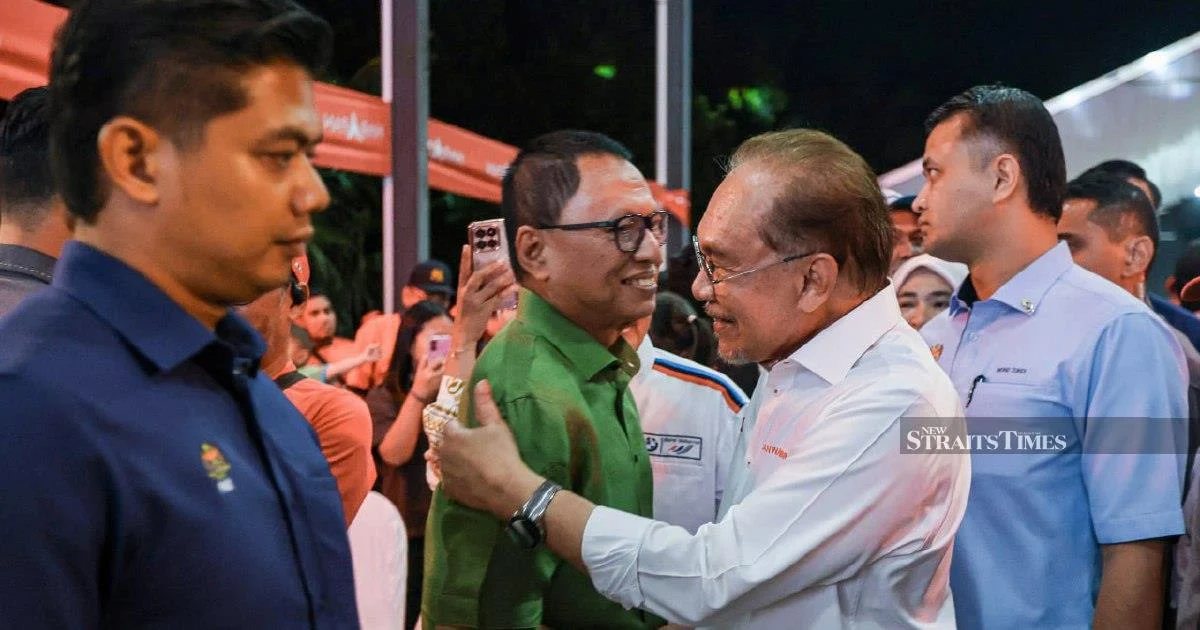
Datuk Seri Rafizi Ramli, the Bersama party leader, has taken a pointed yet humorous dig at Datuk Dr Mohd Puad Zarkashi, following what observers describe as a notable gesture of political alignment. The jibe emerged in Johor Baru after Dr Puad was photographed in a public embrace with Prime Minister Anwar Ibrahim on Saturday, an interaction that appears to reflect broader realignment within Malaysia's coalition politics.
The comment highlights the fluid nature of Malaysia's political landscape, where public displays of camaraderie between leaders often carry significant symbolic weight. In Malaysian politics, such moments are rarely coincidental and typically signal shifts in party dynamics or coalition negotiations. Rafizi's tongue-in-cheek remark suggests that Dr Puad's warm interaction with Anwar represents more than mere cordiality—it indicates a potential deepening of ties between his faction and the PKR-led administration.
Dr Mohd Puad Zarkashi, a prominent figure whose political trajectory has drawn attention from observers tracking UMNO's internal factional disputes, has previously maintained complex relationships across Malaysia's political spectrum. His embrace with Anwar could indicate either a personal warming of relations or a strategic repositioning ahead of forthcoming political developments. Such gestures in Malaysian politics often precede policy shifts, coalition adjustments, or preparations for electoral contests.
Bersama itself has evolved significantly since its formation, positioning itself within the broader political coalition supporting Anwar's government. Rafizi's organization has sought to establish itself as a distinct voice within the administration, distinct from traditional UMNO structures. His barb at Dr Puad therefore carries implications about how various political actors are aligning themselves within the current governing framework.
The timing of this exchange reflects ongoing negotiations and repositioning within Malaysia's political machinery. As the country navigates between state elections, potential federal political shifts, and factional realignments within major parties like UMNO, leaders and their supporters constantly assess who benefits most from various political arrangements. Rafizi's quip serves both as commentary on Dr Puad's movements and as an implicit statement about Bersama's positioning.
UMNO, despite remaining a component of the governing coalition, continues to experience internal tensions between various factions and individual ambitions. When figures with UMNO backgrounds or connections draw closer to PKR leadership, it often triggers questions about loyalty, political future positioning, and the shifting balance of power within government. Rafizi's remark capitalizes on this existing tension by framing Dr Puad's gesture humorously.
The public nature of both the embrace and Rafizi's subsequent comment demonstrates how Malaysian politics operates through symbolic actions and their public interpretation. Unlike formal announcements or press statements, these informal exchanges allow politicians to signal intentions, stake claims, and influence perceptions without the formality of official mechanisms. For readers following Malaysian politics, such moments serve as important indicators of brewing changes.
For Southeast Asian observers and international commentators monitoring Malaysia's political stability, these realignments carry broader significance. A government that successfully maintains coalition discipline across multiple parties and factions demonstrates greater stability than one fractured by constant internal conflict. Conversely, excessive maneuvering and defection signals potential weakness or upcoming transformations.
The Anwar-led administration continues to navigate the delicate balance of maintaining support from UMNO, PKR, DAP, and numerous smaller parties including Bersama. Each gesture of solidarity or hint of friction between coalition components carries weight in this equation. Dr Puad's public warmth toward the Prime Minister, whether spontaneous or calculated, contributes to the ongoing narrative about government cohesion and the Prime Minister's ability to maintain crucial relationships.
Rafizi's comment also reflects Bersama's continuing efforts to establish distinct political identity and relevance. By positioning his party as observer and occasional critic of other coalition members' maneuvers, he attempts to maintain visibility and influence. This strategy allows Bersama to avoid direct confrontation while signaling that it maintains independent perspectives on coalition politics.
For Malaysian voters and those concerned with political stability, these exchanges offer insights into how their government functions behind public ceremonies and formal statements. The substance of governance—legislative action, policy implementation, and administrative effectiveness—ultimately matters more than symbolic gestures. However, understanding the political currents reflected in remarks like Rafizi's provides context for anticipating future policy directions and governmental priorities.
Looking forward, observers should note whether Dr Puad's apparent warming toward Anwar and PKR translates into concrete political action, policy alignment, or formal repositioning. Similarly, Rafizi's willingness to publicly comment on such developments suggests Bersama intends to remain actively engaged in coalition politics rather than fade into passive participation. These dynamics will likely continue shaping Malaysia's political trajectory through coming electoral cycles and policy debates.

