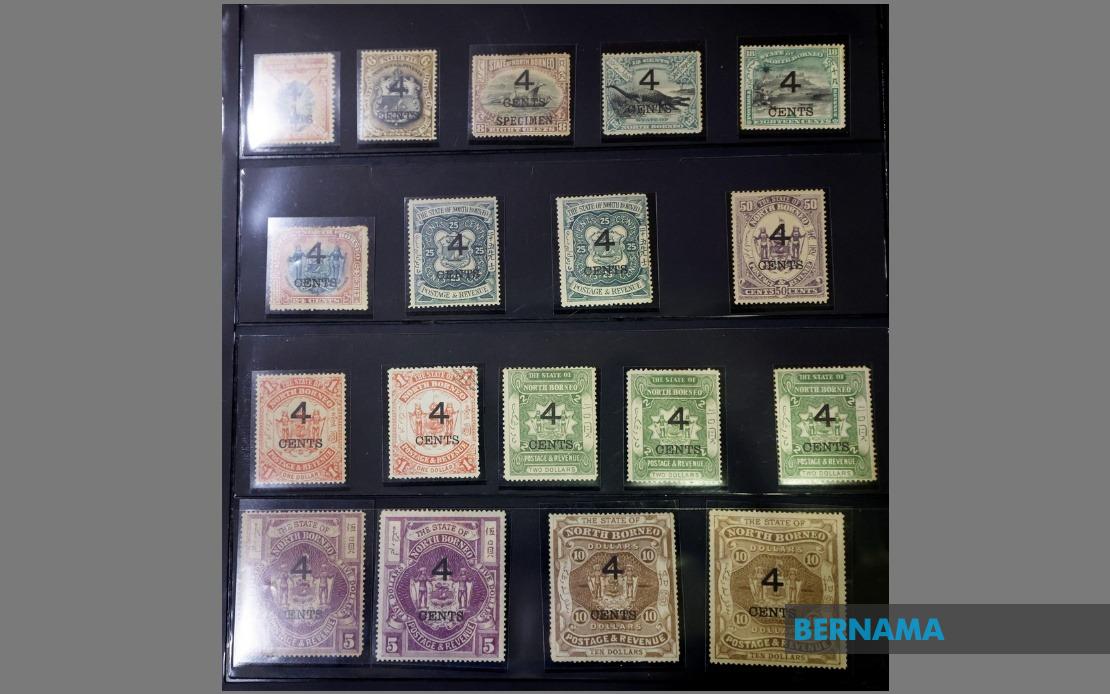
In Kota Kinabalu, a quiet campaign is underway to rescue one of Sabah's most tangible links to its colonial past. Dr Shari Jeffri, 56, founder and president of the Borneo History Association, is leading the charge to preserve North Borneo stamps issued between 1883 and 1963, artifacts he describes as a "living archive" that connects modern Malaysians to their heritage. With these stamps now over a century old, becoming harder to locate, and increasingly expensive when they do surface at auction, the urgency of his mission has grown acute. The stakes are high: without active preservation efforts, the visual and material records of Sabah's transformation across multiple eras risk fading into obscurity.
The British North Borneo Chartered Company introduced the region's first postage stamps in 1883, launching what would become a 52-year tradition of postal history documented on paper and ink. What began as mere functional commodities for letter-posting have evolved into historical documents that chronicle the territory's political status, economic activities, and cultural identity. The stamps themselves functioned as miniature billboards for empire and progress, reflecting the priorities and aesthetics of each successive decade. As traditional mail has surrendered ground to email and messaging applications, these physical artifacts have gained retrospective significance they never possessed in their working lives. They now stand as irreplaceable witnesses to how colonial administrators, merchants, and ordinary residents of North Borneo communicated and conceptualised their world.
Dr Shari's personal connection to this archival mission runs deep into family memory. He inherited much of his collection from his grandfather, who worked at the Recreation Club Jesselton during the 1920s and developed a passion for stamps after observing British officers engaged in the hobby. This generational transmission of collecting knowledge and artifacts demonstrates how philately served as a vehicle for cultural and intellectual exchange across colonial hierarchies. When Dr Shari's grandfather began gathering stamps and postal ephemera, he was participating in a form of historical documentation that, while amateur and personal in origin, now possesses institutional value. The family's inheritance became the foundation for a lifelong scholarly pursuit that has consumed nearly four decades of careful research and curation.
Introduced to stamp collecting at age seven, Dr Shari only became a serious collector during secondary school, when he and his friends bonded over the hobby. His youthful enthusiasm matured into rigorous scholarship, propelling him to research the evolution of stamp design and the territorial history it reflected. Among his most prized possessions are two two-cent stamps from the 1883 inaugural issue, featuring a brown sailing boat motif and bearing authentic postmarks. For any serious philatelist, the 1883 issue represents a non-negotiable milestone; without examples from this founding year, a collection lacks foundational credibility and completeness. These early stamps, in their physical deterioration and postal markings, encode information about the postal infrastructure and usage patterns of the 1880s that cannot be reconstructed from administrative records alone.
The aesthetic evolution of North Borneo stamps mirrors the region's changing self-representation under colonial administration. Initially, the designs featured imperial symbols—lions, boats, and tigers—projecting an image of exotic wilderness and British dominion. Around 1892, the imagery began shifting toward local flora and fauna, a subtle but significant move toward representing Borneo's distinctive natural environment rather than generic colonial imagery. By 1935, the designs had crystallised into representations explicitly claiming Sabah's cultural identity, moving beyond simple wildlife depictions to incorporate elements that spoke to the territory's indigenous character. The denominations expanded from two sen to one dollar, reflecting an economy sufficiently developed to support varied postage rates. This visual chronology, readable across a properly curated collection, tells a story of institutional evolution and changing ideological priorities that historians might otherwise struggle to access.
Critical to the preservation challenge is the material science of stamps themselves. Dr Shari emphasises that proper storage in acid-free albums is essential to prevent fading and degradation—a seemingly mundane detail that proves decisive for long-term survival. The chemical composition of stamp paper, including the adhesive layer applied during manufacture, becomes a determinant of both authenticity and value. Stamps bearing complete postal cancellations command premium prices because these markings preserve comprehensive documentation: the exact date, the specific post office, and the time the letter was processed. These details constitute a form of archival metadata that enriches the historical record far beyond what a uncancelled mint stamp can provide. In authentication and valuation, therefore, seemingly minor material properties become gateways to historical knowledge.
The market reality underscores the scarcity of these artifacts. A recent Bernama survey of antique dealers in Kota Kinabalu revealed that genuine North Borneo stamps have become difficult to procure and command steep prices proportional to age, condition, and rarity. The survey did locate one remarkable album containing a six-cent stamp from the 1954-1961 series depicting Queen Elizabeth II alongside a Dusun woman, alongside a ten-cent denomination illustrating logging operations. These mid-twentieth-century stamps document the post-war reconstruction period and the economic activities that defined Sabah's place in the regional economy. Their presence in the marketplace, even at high prices, indicates that serious collectors and institutions are still willing to invest in preservation, but the trajectory suggests declining availability as collections age and heirs lack expertise or interest to maintain them.
Dr Shari has invested considerable effort in deepening his technical knowledge of philatelic authentication and valuation. He has consulted with regional experts including Voon Kyam Foh and Tan Chun Lim in Singapore, and familiarised himself with specialised reference works such as the Commonwealth & British Empire Stamps catalogue. This transnational scholarly network reflects how philately, despite its amateur origins, has developed sophisticated methodologies for verification and interpretation. The expertise required to authenticate a 140-year-old stamp, distinguish genuine postmarks from forgeries, and assess historical significance mirrors the standards applied in archival studies and material culture research. By grounding his collecting practice in this professional framework, Dr Shari has elevated what might have been a personal hobby into a form of historical scholarship.
The intergenerational transmission of collecting enthusiasm presents perhaps the most acute challenge facing stamp preservation in Malaysian society. Dr Shari observes that today's younger generation has far less exposure to stamp collecting than previous cohorts, and active enthusiasts are dwindling in number. Digital communication has rendered postal stamps functionally obsolete in most contexts, removing the tactile familiarity that once made collecting a natural extension of everyday experience. Without this organic pathway into the hobby, institutions and passionate individuals like Dr Shari must deliberately cultivate interest among youth through education and outreach. The Borneo History Association's work thus carries an implicit pedagogical mission: demonstrating that stamps function as historical documents, not merely as collectible curiosities, and that their preservation serves the broader scholarly goal of maintaining accessible records of Sabah's past.
The implications of this preservation work extend well beyond the stamp collecting community. North Borneo's postal history encodes information about territorial administration, economic development, indigenous representation, and cultural change that enriches the historical record available to researchers and citizens seeking to understand Sabah's trajectory. As Malaysia increasingly emphasises cultural heritage and local history, these century-old stamps deserve recognition as material artifacts of national significance. Regional institutions, museums, and archives might consider whether systematic collecting and conservation represents a worthy investment in cultural infrastructure. For Malaysian readers, particularly those with connections to Sabah, these stamps offer a tangible point of contact with their own past—a way to hold history literally in their hands and decode the visual language through which previous generations understood their world.

