Sudden cardiac arrest remains a leading killer in Malaysia, yet the nation's survival rates lag dangerously behind developed economies, sitting between just 0.5 and 8.5 per cent. This alarming statistic reflects a systemic gap in emergency preparedness—not because medical expertise is unavailable, but because victims often lack rapid access to lifesaving equipment or immediate CPR intervention. Sunway Medical Centre Velocity (SMCV) has now launched an ambitious initiative to address this critical gap by strategically deploying automated external defibrillators (AEDs) across Kuala Lumpur's busiest locations, recognising that in cardiac emergencies, every second determines whether someone walks away or does not walk away at all.
The severity of the problem cannot be overstated. Without CPR administered within 8 to 10 minutes of collapse, survival rates plummet almost to zero. Malaysia's current performance suggests that most cardiac arrest cases exceed this window before reaching definitive care, a consequence of both delayed bystander response and insufficient access to AEDs in public spaces. Many developed nations now achieve survival rates exceeding 50 per cent through widespread AED availability and trained responders, making Malaysia's figures a sobering indictment of gaps in emergency infrastructure and public preparedness.
SMCV's initiative, operating under the hospital's corporate social responsibility framework and building on its earlier "Save A Number, Save A Life" campaign, takes a dual approach. The first pillar involves installing AEDs at strategically selected high-traffic locations where cardiac events are statistically more likely to occur. These include multiple MRT stations—Tun Razak Exchange (TRX), Bukit Bintang, Ampang Park and Muzium Negara—as well as major commercial landmarks such as Aquaria KLCC, Menara Public Bank, Menara Public Bank 2, and the National Heritage Building within the Merdeka 118 Precinct. By positioning defibrillators in spaces where large numbers of people converge, the initiative maximises the likelihood that trained or untrained bystanders will be present to intervene.
The physical installation of equipment, however, represents only half the battle. Each AED unit will be accompanied by a clearly visible standee designed to ensure the device can be spotted and accessed quickly during emergencies. More innovatively, QR code stickers will link users and passers-by to SMCV's digital guidance resources, providing immediate access to instructional materials and contact information for medical emergencies. These measures reflect a sophisticated understanding that emergency response depends not merely on equipment availability but on reducing the cognitive load faced by untrained individuals in moments of panic.
Dr Wee Tong Ming, SMCV's Medical Director and Consultant Emergency Physician, emphasises that sudden cardiac arrest often strikes without warning and that the critical determinant of survival is not the availability of doctors but the speed at which bystanders can initiate basic life support. "When an emergency occurs, lives are not lost due to lack of help, but because of delays in response and the lack of access to life-saving tools," he noted. This formulation reframes the cardiac arrest survival question away from hospital capacity—which Malaysia arguably possesses—toward community readiness, a domain where significant deficiencies remain.
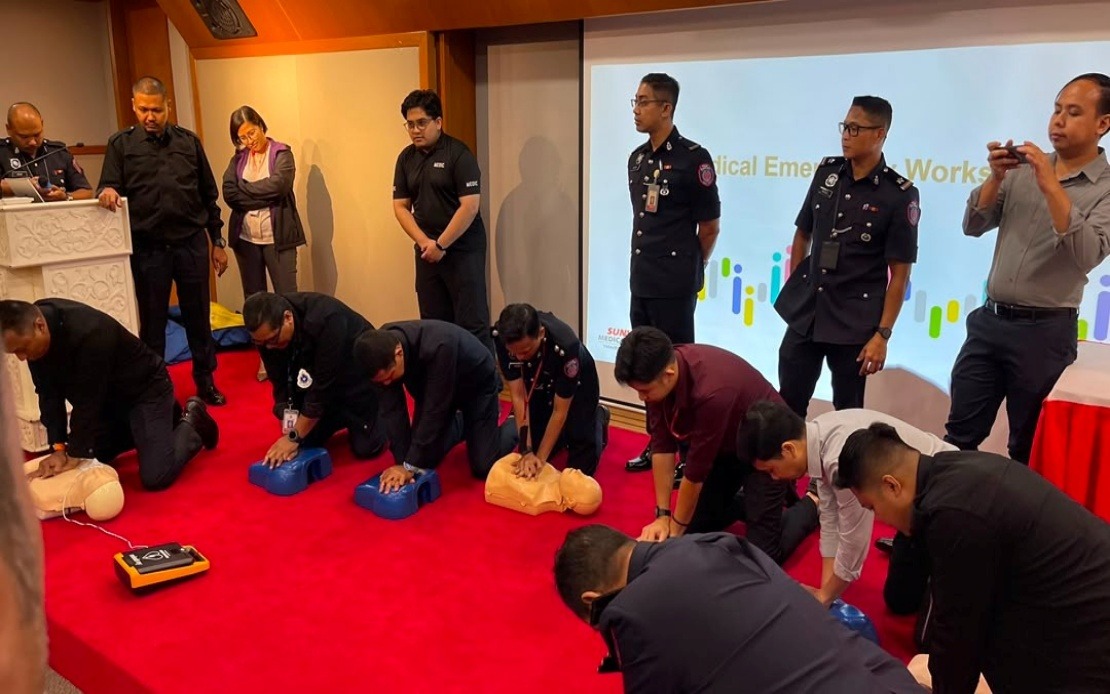
The second pillar of SMCV's initiative addresses public knowledge gaps through systematic training and awareness campaigns. The hospital has already conducted on-site training sessions and accident and emergency awareness talks across participating locations, teaching bystanders to recognise cardiac arrest symptoms, perform cardiopulmonary resuscitation correctly, and operate AEDs safely. This educational component is essential because untrained individuals often hesitate to use AEDs or perform CPR, fearing legal liability or causing harm. Training and repeated public messaging help overcome such psychological barriers and create a culture where emergency response feels like a civic responsibility rather than a medical privilege.
Susan Cheow, SMCV's Chief Executive Officer, articulates a broader vision underpinning the initiative: ensuring that no one should feel helpless in a medical emergency due to either lack of knowledge or unavailable equipment. She emphasises that emergency preparedness must be embedded into everyday planning for shared spaces, not treated as an afterthought. This perspective represents a significant cultural shift in how Malaysian institutions approach public health, moving from reactive hospital-based systems toward proactive community-based resilience.
The selection of installation locations reveals strategic thinking about where cardiac events occur and where bystanders cluster. Transport hubs like MRT stations and commercial buildings attract high concentrations of people with diverse age profiles, including older individuals at elevated cardiac risk. Corporate premises such as banking headquarters and IT training centres house employees who may already possess some health consciousness and can be mobilised as trained responders. Cultural institutions like Aquaria KLCC draw family groups and visitors who linger, creating longer windows for intervention if collapse occurs. Each location selection reflects epidemiological and logistical analysis rather than arbitrary placement.
For Malaysian readers, this initiative carries specific implications. If successful, it could establish a replicable model for other diseases requiring rapid intervention—from stroke to severe trauma—and could inspire similar programmes in other Malaysian cities. The emphasis on public empowerment and education also aligns with growing global recognition that healthcare quality depends not solely on hospital excellence but on community participation and preparedness. Citizens who understand basic life support become force multipliers for the formal healthcare system, extending its reach into moments and spaces where physicians cannot be present.
The programme also demonstrates how corporate social responsibility can address genuine public health gaps rather than serving merely as public relations. By focusing on sudden cardiac arrest—a condition where survival depends almost entirely on immediate bystander intervention—SMCV targets a domain where hospital-based solutions have inherent limitations. The initiative thus sidesteps the common criticism that CSR in healthcare merely supplements existing services; instead, it tackles a problem that healthcare systems alone cannot solve.
However, the initiative's success will ultimately depend on sustained maintenance, public awareness, and periodic retraining. AED devices require regular battery and pad replacement, and public knowledge of their locations and operation can fade without reinforcement. SMCV will need to establish clear protocols for device maintenance and ongoing community education campaigns to ensure that the infrastructure translates into lives saved. Early results from pilot locations will be crucial for determining whether the model justifies expansion to other Malaysian cities.
Looking forward, Malaysia's approach to sudden cardiac arrest preparedness stands at an inflection point. With survival rates between 0.5 and 8.5 per cent, even modest improvements driven by wider AED access and training could translate to dozens of additional survivors annually in Kuala Lumpur alone. The Sunway Medical Centre initiative thus represents not merely a hospital programme but a test case for whether Malaysia can transition toward the community-based emergency preparedness systems that characterise high-performing health systems globally.

