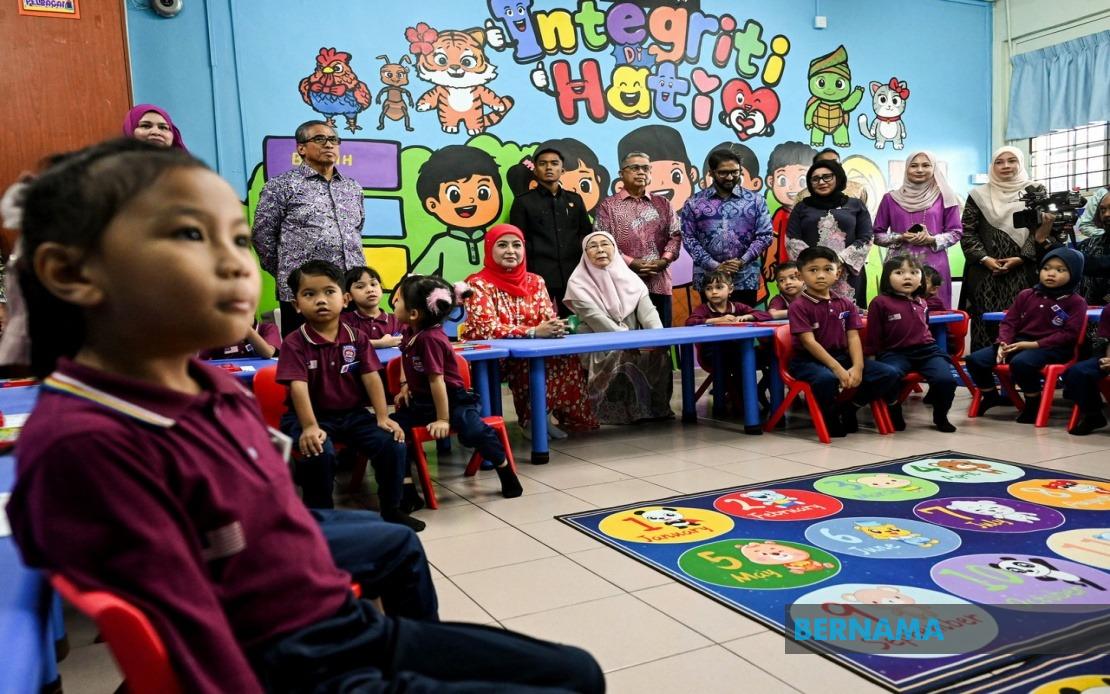
Her Majesty Queen Raja Zarith Sofiah formally inaugurated the Children's Integrity Module, known as MIKa, at Tabika Perpaduan Taman Bukit Cheras in Kuala Lumpur on August 27, underscoring the government's commitment to embedding moral foundations in Malaysia's youngest learners. The launch, attended by National Unity Minister Datuk Aaron Ago Dagang, Chief Secretary to the Government Tan Sri Shamsul Azri Abu Bakar, and Bandar Tun Razak Member of Parliament Datuk Seri Dr Wan Azizah Wan Ismail, reflects a strategic pivot toward preventive ethics education rather than remedial integrity enforcement.
Upon arrival at 9.45 am, Her Majesty participated directly in the programme's demonstration, observing a classroom simulation and engaging with the pupils firsthand. This hands-on involvement signals royal endorsement for what officials describe as a cornerstone initiative in reshaping Malaysian civic culture from its earliest stages. The module's design acknowledges a fundamental premise: that character formation during early childhood creates lasting behavioural templates that prove far more resilient than late-stage interventions.
Tan Sri Shamsul Azri, who chairs the Malaysian Institute of Integrity (IIM) alongside his chief secretary role, articulated an ambitious timeline for MIKa's expansion. The government envisions comprehensive nationwide rollout by 2030, penetrating Malaysia's fragmented early childhood landscape of more than 31,000 registered facilities ranging from informal childcare centres to formal kindergartens and preschools. This scale of ambition reflects recognition that early childhood education in Malaysia remains decentralised and uneven in quality, creating both operational challenges and significant opportunity for standardised values-based curricula.
The module's development process itself demonstrates collaborative governance architecture. Since its inception in 2024, MIKa has involved thirty-five early childhood education specialists representing diverse expertise across child psychology, pedagogy, and moral development. Crucially, the initiative has secured backing from multiple government ministries, statutory agencies, and higher education institutions, suggesting either genuine interagency consensus or at least surface-level alignment around integrity as a policy priority. This breadth of institutional support may prove essential for navigating the competing interests that typically obstruct implementation of national early education standards.
Tan Sri Shamsul Azri's public remarks reveal the philosophical underpinning of this initiative. He contended that integrity cannot rely exclusively on legal frameworks and regulatory enforcement, instead requiring deep cultural embedding through habit formation beginning in infancy. His framing positions ethical behaviour not as compliance with external rules but as internalised practice—a distinction carrying significant implications for how Malaysian schools might reorganise curricula and teacher training. This philosophical stance echoes international best practices in moral development theory, particularly attachment-based and character education models emphasising intrinsic motivation over external reward systems.
The choice to launch MIKa in a Taman Bukit Cheras childcare facility carries symbolic weight. This area of Kuala Lumpur, while less affluent than some central precincts, represents precisely the demographic that benefits most from standardised integrity frameworks—children from diverse socioeconomic backgrounds whose exposure to formal values education might otherwise depend on parental capacity and educational privilege. The location thus communicates inclusive intent, though implementation success will depend substantially on resource allocation to lower-income childcare operators.
Malaysia's investment in early childhood integrity education must be contextualised within Southeast Asian governance trends. Regional peer nations including Singapore and Thailand have similarly emphasised character development in early years curricula, driven partly by concerns about institutional corruption and ethical lapses in public administration. MIKa positions Malaysia within this emerging consensus while acknowledging local realities: a multicultural population requiring values frameworks that transcend religious or communal particularism, and an education ecosystem where early intervention remains significantly more cost-effective than corrective measures later in the criminal justice system.
The 31,000-facility target carries substantial implementation risk. Many Malaysian childcare centres operate with minimal regulatory oversight and employ staff lacking formal pedagogical qualifications. Scaling MIKa equitably across this fragmented sector demands unprecedented coordination between federal education authorities, state governments controlling some regulatory levers, and private operators whose profit margins leave limited space for curriculum innovation or staff retraining. The government's success in navigating these institutional complexities will likely determine whether MIKa becomes transformative policy or another well-intentioned initiative that fragmentizes across implementation tiers.
Tan Sri Shamsul Azri's comments regarding parental role modelling pointedly acknowledge that school-based initiatives cannot compensate for family dysfunction or households where ethical values remain dormant. This recognition distinguishes MIKa from naive faith in educational institutions as moral laboratories insulated from broader social realities. For Malaysian policymakers, this framing suggests future complementary initiatives targeting parent engagement and community reinforcement of integrity norms, addressing the well-documented challenge that early childhood curricula produce limited lasting behavioural change without family ecosystem alignment.
The timing of MIKa's launch carries political significance as well. National anticorruption efforts under agencies including the IIM have faced cyclical political pressures and public scepticism regarding selective enforcement. Investing in preventive early childhood ethics education arguably represents a strategy to reframe the integrity agenda away from punitive measures toward generational value transformation. Whether such reframing effectively mobilises public confidence or merely diverts resources from investigating systemic institutional failures remains contested terrain among Malaysian policy analysts.
Looking forward, MIKa's success metrics will determine its institutional trajectory. Administrators should establish robust baseline measures of integrity-related behaviours and longitudinal tracking mechanisms assessing whether MIKa cohorts demonstrate sustained ethical advantage as they progress through primary education and beyond. Without rigorous evaluation frameworks, MIKa risks becoming ceremonial policy—frequently referenced in political speeches yet producing negligible measurable outcomes. The royal imprimatur provides political insulation, but only genuine efficacy data will sustain buy-in across Malaysia's fragmented early education sector.
The broader stakes for Malaysia extend beyond childhood formation. Societies that successfully embed integrity norms across their institutional ecosystems—from childcare centres to corporate governance—demonstrate measurably stronger economic performance, higher institutional trust, and enhanced social cohesion. MIKa represents an implicit wager that Malaysia's governance challenges cannot be solved through adult-focused accountability mechanisms alone, but require long-term cultural investment. Whether this generational perspective proves politically sustainable amid shorter-term pressures for corruption prosecutions and institutional reform will ultimately determine MIKa's legacy within Malaysian governance architecture.

