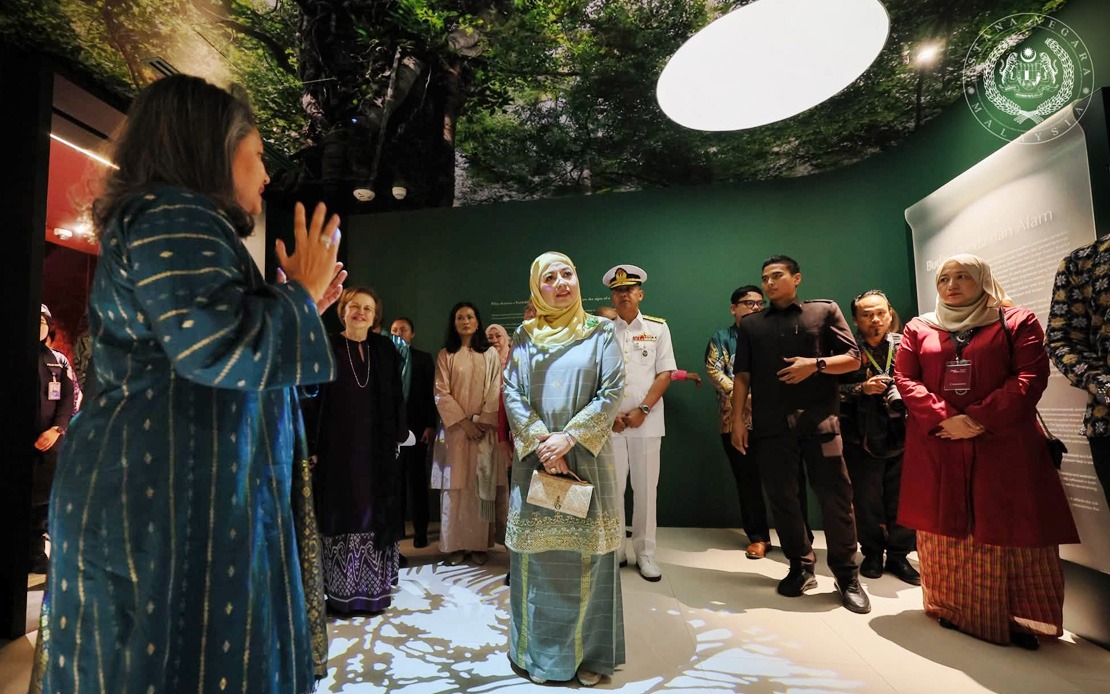
Her Majesty Raja Zarith Sofiah, Queen of Malaysia, has officially inaugurated the Merdeka Textile Museum at the Menara Merdeka Maybank compound in Kuala Lumpur, marking a significant milestone in the nation's efforts to safeguard its rich cultural legacy. The state-of-the-art facility, developed by PNB Merdeka Ventures Sdn Bhd—a subsidiary of the investment holding company Permodalan Nasional Berhad—represents an ambitious initiative to document and celebrate the textile traditions that have defined Malay and Malaysian identity across centuries.
In her remarks delivered through an official statement, the Queen emphasised the fundamental importance of recognising and preserving the cultural heritage that distinguishes each nation. She articulated a vision of custodianship, noting that every country bears the responsibility of maintaining its distinctive traditions and ensuring that successive generations remain connected to their roots. This message underscores a broader recognition within Malaysia's leadership that heritage conservation extends beyond merely safeguarding artefacts; it involves fostering a living relationship between contemporary society and its historical foundations.
Raja Zarith Sofiah further contextualised the museum's significance by framing cultural practices as mirrors reflecting the principles and worldviews embedded in Malaysian society. Her comments suggest that textile traditions function as more than decorative or functional objects—they embody the values, aesthetic sensibilities, and social structures that have shaped Malaysian communities. By establishing this museum as a repository for such knowledge, the initiative positions textiles as legitimate subjects of scholarly inquiry and public appreciation, elevating their status from craft to cultural document.
The Queen expressed particular hope that the museum would inspire Malaysian women and appeal to younger audiences who may lack familiarity with traditional garments and weaving techniques. This gendered emphasis reflects historical realities in which women have played central roles in textile production, design, and transmission of knowledge across generations. The institution thus carries implicit potential to celebrate female contributions to Malaysia's cultural evolution while providing educational pathways for contemporary and future generations to engage meaningfully with heritage practices.
The museum's collection draws its foundational strength from a substantial donation assembled by the Azah Aziz family. This personal assemblage comprises 240 distinct pieces of clothing alongside 69 traditional jewellery items, encompassing significant examples of regional dress including songket sarongs, the Limar Baju Kurung, and Tekat Emas garments. The materials originated from the personal collection of the late Sharifah Azah Syed Mohammed Alsagoff, whose family connections to prominent figures in Malaysia's financial and institutional spheres—including the late Prof Diraja Ungku Abdul Aziz Abdul Hamid and the former Bank Negara Malaysia governor Tan Sri Dr Ungku Zeti Akhtar Aziz—underscore the collection's historical significance and the family's commitment to cultural stewardship.
The physical infrastructure supporting the museum reflects contemporary approaches to heritage preservation and public education. Eight distinct gallery spaces provide thematic organisation of the textile collections, allowing visitors to navigate displays according to chronological, regional, or functional categories. Beyond the exhibition areas, the institution incorporates a dedicated study centre housing a conservation laboratory equipped for professional restoration and preservation work, a specialised fabric library cataloguing textile samples and technical documentation, and a textile knowledge centre designed to facilitate research among scholars, designers, and students.
This comprehensive facility positioning acknowledges that meaningful heritage preservation requires infrastructure supporting both public access and specialised scholarly work. The conservation laboratory represents a commitment to professional standards in maintaining fragile materials, while the fabric library and knowledge centre serve researchers seeking deeper understanding of textile production techniques, dyeing methods, regional variations, and historical contexts. Such facilities position the museum as more than a display venue; it functions as a research institution contributing to academic knowledge production regarding Asian textile traditions.
The inauguration event drew attendance from several high-ranking government officials and institutional leaders, reflecting the museum's status as a significant cultural and national initiative. Minister in the Prime Minister's Department (Federal Territories) Hannah Yeoh, Chief Secretary to the Government Tan Sri Shamsul Azri Abu Bakar, and PNB group chairman Raja Tan Sri Arshad Raja Tun Uda participated in the opening ceremony, signalling government support for the project and its integration within broader cultural policy frameworks.
For Malaysian and Southeast Asian audiences, the Merdeka Textile Museum represents a timely institutional response to growing recognition that traditional material cultures warrant contemporary investment and expertise. The museum's emphasis on interactive and immersive experiences positions it competitively within the regional cultural institution landscape, offering alternatives to passive display models. Its focus on Malay textile heritage simultaneously acknowledges Malaysia's diverse cultural composition while asserting the historical significance of particular traditions within the nation's foundational narrative, a balancing act relevant to how multiethnic societies manage cultural memory and institutional resources.

