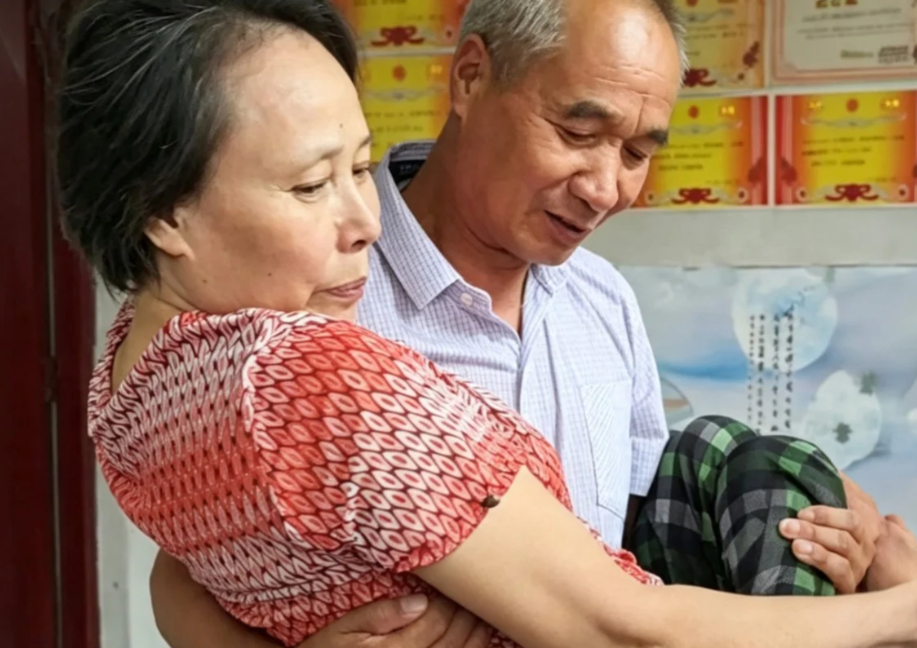
In the heartland of China, a story of unwavering commitment has resonated deeply with millions of people scrolling through social media feeds. The couple at the center of this narrative reside in Pingdingshan, a city in Henan province, where their relationship has become a testament to the enduring power of marital devotion in the face of overwhelming adversity. What began as a catastrophic accident more than two decades ago has evolved into a compelling daily reality that challenges conventional understandings of marriage, responsibility, and human resilience.
The turning point in their lives came in 2001 when Jia Fang, then 36 years old, experienced a life-altering tragedy. While riding a pedicab, she fell from a cliff with such force that the injury resulted in paralysis affecting her entire body from the chest downward. The accident fundamentally transformed not only her physical capacities but also the trajectory of her family's existence. Her husband, Li Junliang, one year her senior, found himself confronting a new reality that would demand everything he possessed—physically, emotionally, and spiritually—for the remainder of his life.
When the accident occurred, their children were still young, aged just 10 and 13 at the time. Rather than succumbing to despair or seeking institutional solutions, Li made the deliberate choice to become Jia's primary caregiver while simultaneously maintaining his parental responsibilities toward their two children. This dual commitment required navigating the complex demands of household management, child-rearing, and intensive medical care without apparent institutional support or extended family assistance. The decision reflected both practical necessity and a profound commitment to keeping his family unit intact.
The physical demands of Li's caregiving routine illustrate the magnitude of his sacrifice. In those early years, he would reposition Jia's body every two hours throughout the day and night to prevent bedsores, a serious complication that could prove fatal for someone in her condition. As time progressed and his understanding of her needs deepened, he adjusted this demanding schedule to every four hours. Yet this seemingly minor modification masks a crucial reality: for two full decades, Li has essentially surrendered the possibility of uninterrupted sleep. Night after night, he has maintained vigilance, rising regularly to attend to his wife's physical needs with the consistency and devotion typically reserved for newborn infants.
Beyond preventing complications, Li has developed an intricate care regimen that addresses Jia's overall wellbeing. He regularly massages her limbs to combat the inevitable muscle deterioration that accompanies prolonged paralysis. He transfers her to a wheelchair, enabling her to experience life beyond the confines of a bedroom—to feel sunshine on her skin, breathe fresh air, and maintain some connection to the world around her. These seemingly simple acts require significant physical strength and patient attention to detail, reflecting a commitment to preserving not just her life but her dignity and quality of existence.
Meanwhile, their children matured within this household environment shaped by extraordinary circumstances. The walls of their home bear testament to the academic and personal achievements of both offspring, now adults with families of their own. The certificates and mementos adorning these walls represent not merely childhood accomplishments but evidence of Li's ability to provide emotional support and encouragement to his children despite the overwhelming demands of caring for their mother. His capacity to nurture both his disabled wife and his developing children reveals a multidimensional strength that extends beyond physical caregiving.
Jia herself has become a voice in celebrating the partnership they have maintained. Speaking to media representatives, she acknowledged the visible toll that two and a half decades of relentless caregiving has exacted on her husband. While her hair has retained much of its original darkness, Li's has turned completely grey, a physical manifestation of stress and the passage of difficult years. Yet rather than dwelling on sacrifice, Jia chose to express profound gratitude, thanking Li publicly for his quarter-century of devotion and implicitly acknowledging that many spouses would have made different choices.
Li's response to his wife's gratitude reveals the philosophical foundation underlying his actions. He reminded her that his commitment reflects not mere obligation but a fundamental promise made on their wedding day—that their home could only be complete with her presence. This reframing transforms his caregiving from burden into fulfillment, from self-sacrifice into the living out of vows made under vastly different circumstances. When those vows were exchanged, neither could have anticipated the trials ahead, yet Li asserts that knowing what he knows now, he would willingly extend his care for another 25, 35, or even 45 years.
Their community has taken note of this exemplary partnership. Neighbors have observed not only Li's tireless physical care but also the cleanliness and orderliness of their home—a detail suggesting that domestic life continues to function with dignity and organization despite the extraordinary challenges involved. For those living in proximity to the couple, Li has become a living demonstration that commitment can transcend the breaking points where most would reasonably surrender. In a society where caring for disabled family members often falls upon women, Li's role challenges gender expectations about caregiving responsibilities and demonstrates that devotion knows no gender boundaries.
The viral response to their story across mainland Chinese social media reflects a hunger for narratives that affirm faith in human goodness and enduring love. In an era characterized by rapid modernization and sometimes fractured family bonds, the example of Li and Jia Fang offers something increasingly rare: proof that profound commitment can persist through genuine hardship. Their narrative resonates because it exists at the intersection of everyday domestic life and extraordinary moral courage, requiring no dramatic gestures but rather the accumulation of countless small acts of care repeated across thousands of days.
For Malaysian and Southeast Asian readers observing this story, it invites reflection on caregiving responsibilities within extended family systems and the cultural values that inform these deeply personal decisions. Across Southeast Asia, where family interdependence remains a stronger cultural norm than in many Western contexts, the example of Li Junliang's commitment carries particular resonance. His story underscores how caregiving—whether for aging parents, disabled spouses, or vulnerable children—remains fundamentally a matter of personal choice and values, shaped by cultural inheritance but ultimately reflecting individual character and commitment to those we love.

