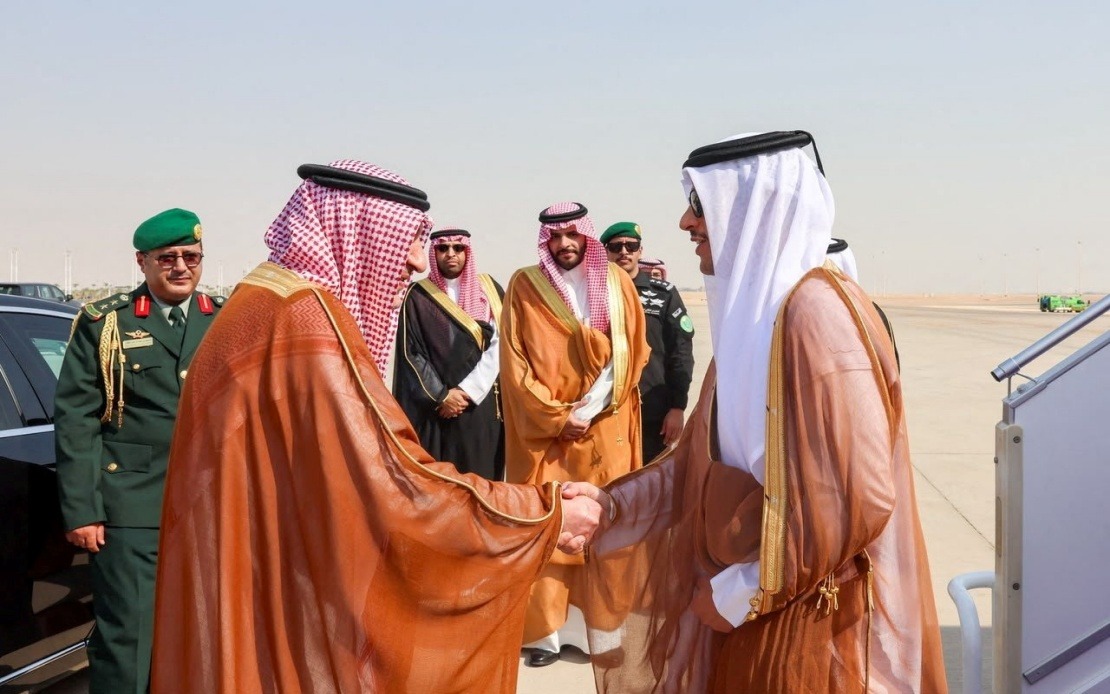
A significant diplomatic engagement unfolded in Saudi Arabia this week as Qatari Prime Minister Sheikh Mohammed bin Abdulrahman bin Jassim Al Thani arrived in Riyadh for formal state consultations aimed at addressing mounting tensions across the Arabian Peninsula and wider Middle East. The visit represents an important moment for coordinated gulf leadership amid the complex geopolitical challenges confronting the region, particularly the escalating friction between Iran and the United States that has reverberated throughout regional capitals and altered the strategic calculus for major players.
During his time in the Saudi capital, Sheikh Mohammed—who carries the dual portfolio of Prime Minister and Foreign Minister—engaged in substantive discussions with Saudi Foreign Minister Faisal bin Farhan Al Saud. Their talks centred on strengthening the bilateral relationship between the two Gulf nations while addressing the deteriorating security environment that has prompted urgent diplomacy across Arab leadership. The focus on de-escalation mechanisms reflects a shared concern that uncontrolled tensions could spiral into broader conflict, threatening both countries' economic interests and regional standing.
Both governments have committed themselves anew to pursuing diplomatic channels as the preferred avenue for resolving disputes rather than military confrontation. This reaffirmation carries particular weight given that the Gulf region has witnessed repeated cycles of tension and military posturing over recent years. By publicly endorsing dialogue-based solutions, Qatar and Saudi Arabia are positioning themselves as voices for stability within a region where military options have historically dominated policy discussions.
A critical component of their deliberations involved safeguarding crucial maritime passages that remain vital to global commerce and energy supplies. The Arabian Gulf and Red Sea represent chokepoints through which enormous quantities of oil, liquefied natural gas, and other commodities transit daily. Ensuring these waterways remain open and secure is not merely a regional concern but has profound implications for global supply chains, affecting economies from Asia to Europe. Both nations underscored that protecting navigation corridors and maintaining uninterrupted trade flows are essential prerequisites for sustainable regional prosperity.
The timing of Sheikh Mohammed's visit carries significance within the broader context of Middle Eastern geopolitics. The intensifying Iran-United States rivalry has forced regional actors to carefully calibrate their diplomatic positions, seeking to prevent their territories from becoming proxy battlegrounds while maintaining important international relationships. Saudi Arabia's long-standing alliance with Washington places it in a particular position, yet the kingdom has also demonstrated interest in managing relations with regional actors like Iran through careful diplomacy.
Shakh Mohammed's arrival was formally acknowledged by Saudi Deputy Foreign Minister Waleed bin Abdulkarim Al-Khereiji, signalling the importance both governments attached to the engagement. Such protocol details, while seemingly procedural, reflect the weight placed on these discussions within official circles. The delegation-level reception underscored that this was not a routine courtesy call but rather a substantive diplomatic initiative requiring high-level attention.
For Southeast Asian observers and particularly Malaysian policymakers, this Gulf engagement carries indirect but meaningful implications. Malaysia's economic prosperity depends substantially on stable energy markets and secure maritime passages through the Indian Ocean and beyond. Disruptions to Gulf stability invariably ripple outward, affecting energy prices, shipping insurance costs, and broader regional confidence. The willingness of Qatar and Saudi Arabia to prioritise diplomatic solutions offers reassurance that major regional actors recognise the costs of escalation.
The absence of specified duration for Sheikh Mohammed's visit may itself prove significant, allowing flexibility for extended discussions should breakthrough moments emerge. Such open-ended diplomacy sometimes permits deeper exploration of contentious issues compared to tightly scheduled state visits. The Qatari Prime Minister's visit demonstrates that despite occasional friction within the Gulf Cooperation Council, member states continue engaging directly on critical security matters affecting their shared interests.
The emphasis on coordinating regional and international efforts represents an acknowledgment that no single state can effectively manage Middle Eastern instability unilaterally. The involvement of international partners—whether through the United Nations, regional organisations, or bilateral relationships—becomes essential when tensions involve global powers like the United States. Qatar and Saudi Arabia's commitment to international coordination suggests they recognise that sustainable solutions require buy-in from multiple stakeholders and cannot rest solely on bilateral agreements.
As geopolitical tensions remain elevated and economic uncertainties persist globally, diplomatic initiatives such as this Qatar-Saudi engagement carry outsized importance. The region's leaders face mounting pressure to prevent miscalculation and to establish mechanisms that allow for communication even amid deep disagreements. Whether these discussions translate into concrete mechanisms for preventing escalation or merely represent procedural diplomacy remains to be seen, but the very fact that top-level officials are meeting signals that diplomatic channels remain operational.

