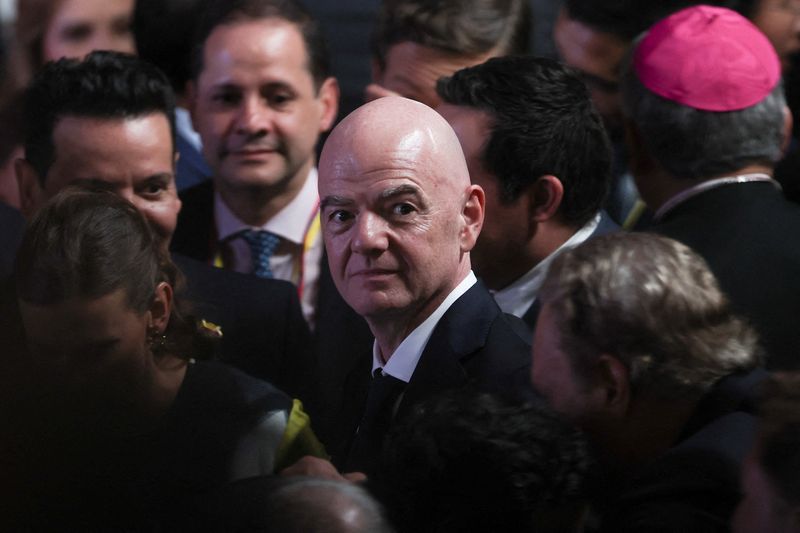
A significant fault line has emerged within Asian football governance as Qatar publicly disputes the legitimacy of the AFC's decision to align itself with European and North American confederations in a coordinated assault on FIFA President Gianni Infantino. The dispute lays bare the complex and often fractious internal politics of continental football bodies at a moment when Infantino's position is under unprecedented pressure following his failed attempt to secure private investment in FIFA competitions.
Qatar Football Association President Hamad bin Khalifa Al-Thani has written directly to AFC President Sheikh Salman bin Ibrahim Al Khalifa, contesting the confederation's right to issue a collective statement without first securing explicit agreement from its membership. In his letter, Al-Thani emphasised that neither he nor the QFA received advance notice, saw draft versions, or had any opportunity to provide feedback before the AFC joined UEFA and CONCACAF in their public rebuke of the FIFA president. The intervention is significant because Al-Thani himself sits on both the AFC Executive Committee and FIFA Council, placing him in a uniquely informed position to challenge the confederation's procedural authority.
The core of Qatar's objection centres on governance and legitimacy. Al-Thani argues that any position purporting to represent 47 member associations cannot be legitimately assumed or imposed unilaterally. His phrasing—that "a collective view must first be ascertained; it cannot be presumed, and it cannot be brought into existence by declaration"—strikes at the heart of institutional procedure, suggesting that the AFC exceeded its authority by speaking in the name of members who had not been consulted. This legalistic framing reflects broader tensions about whether continental confederations should require unanimous or super-majority consent before taking positions on matters affecting FIFA's governance and structure.
The AFC has maintained silence since Reuters first reported the challenge, declining to comment on the substance of Al-Thani's allegations or to detail what consultation, if any, preceded the confederation's statement. This reticence itself may signal discomfort within the confederation's leadership regarding how the decision was handled, or alternatively, a desire to de-escalate the public dispute. The absence of an official response leaves the procedural question unresolved in the court of public opinion, where governance credibility matters significantly for international sporting organisations.
Context from the broader FIFA leadership crisis illuminates why this procedural dispute carries such weight. Infantino has faced open rebellion following his attempt to carve out commercial rights from World Cup competitions, proposing to sell a 20 percent stake to private investors for approximately $4.2 billion. The proposal provoked such significant backlash that FIFA abandoned it, yet the damage to Infantino's standing persisted. With his reelection campaign looming in the coming year, the FIFA president has become an increasingly polarising figure, with confederations and member associations dividing over whether his leadership should continue.
Six Arab football association heads—including representatives from Qatar and Morocco, a 2030 World Cup co-host—recently threw their weight behind Infantino despite the broader crisis. Their endorsement carried particular symbolic weight because four of the six signatories hold positions on FIFA Council, the sport's most influential governance body. These leaders praised Infantino's efforts to develop football globally and credited him with expanding opportunities across regions. The statement represented a meaningful counter-narrative to the coordinated criticism emanating from UEFA, the AFC as an entity, and CONCACAF, suggesting that support for the FIFA president remained intact in certain quarters despite the public perception of universal condemnation.
The divide within Asian football specifically reflects deeper geopolitical and economic interests at play in international sports governance. The AFC encompasses nations with vastly different relationships to FIFA investments, to the commercial globalisation of football, and to international regulatory frameworks. Wealthier Gulf states like Qatar, which has invested substantially in football infrastructure and international competitions, may view Infantino's modernisation agenda differently from associations in less developed football markets. This divergence of interests makes the confederation particularly vulnerable to fragmentation on major FIFA issues.
Qatar's intervention also raises questions about transparency standards in international sports organisations. If the AFC did indeed issue a major statement without consulting its membership, the practice suggests that continental confederations may operate with greater autonomy from member associations than their governing structures theoretically permit. Conversely, if some consultation did occur but Qatar was excluded or overlooked, that raises concerns about selective representation within AFC decision-making. Either interpretation underscores governance challenges affecting football's institutional structures.
The timing of Qatar's challenge matters as well. By confronting the AFC publicly rather than through private channels, Al-Thani has escalated the dispute and ensured it reaches media audiences and FIFA Council members considering Infantino's future. The move signals that certain football leaders view the procedural impropriety as sufficiently serious to warrant public correction, not merely confidential discussion. This escalation mirrors broader patterns in FIFA politics where member associations increasingly resort to public statements and media pressure to influence outcomes rather than relying solely on behind-the-scenes negotiation.
Looking forward, this episode establishes a troubling precedent regarding confederal authority and member consent within Asian football. If major positions on global football governance can be adopted by confederation leadership without explicit consultation, then member associations have limited recourse beyond public objection after the fact. The AFC faces pressure to clarify its consultation procedures and explain the reasoning behind its decision to join the UEFA-CONCACAF coalition. Without satisfactory answers, the confederation risks appearing captured by particular interests rather than genuinely representative of its diverse membership.
For Malaysian observers and policymakers monitoring regional sports governance, the Qatar-AFC dispute offers an instructive case study in institutional fragmentation. Southeast Asian football associations that are part of the AFC must consider how confederation positions are formulated and whether their interests receive adequate representation in major FIFA-related decisions. The controversy underscores that international sports organisations are not insulated from the political and economic tensions characterising their member nations, and that procedural legitimacy remains contested even within established institutional frameworks.
The broader implications extend to questions about Infantino's trajectory and the future of FIFA governance. If continental confederations cannot maintain internal cohesion on fundamental matters, then any mandate they claim to possess becomes questionable. Infantino, paradoxically, may benefit from these divisions, as they prevent a united opposition from crystallising against his leadership. Yet institutional fragmentation ultimately weakens FIFA itself, reducing its ability to speak with clarity and authority on matters affecting global football.

