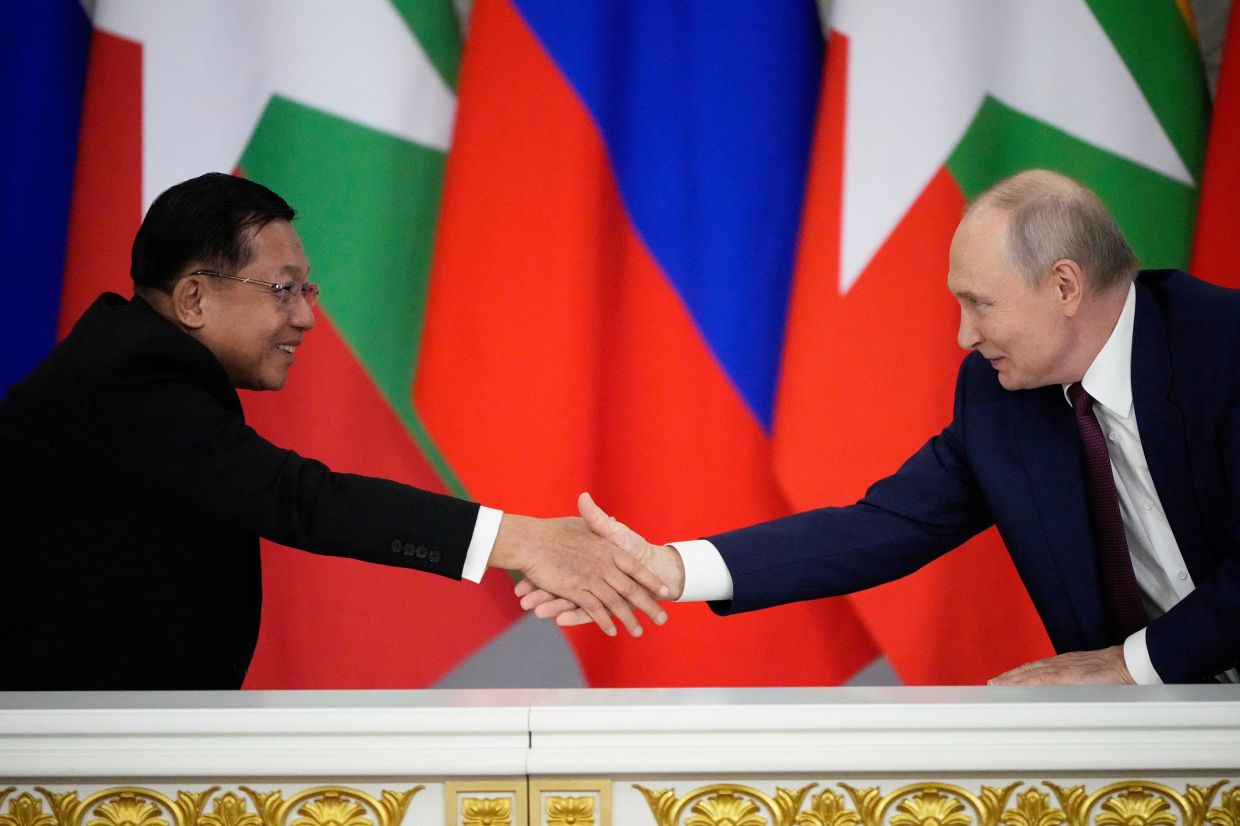
Russian President Vladimir Putin has signalled Moscow's commitment to deepening its strategic partnership with Myanmar during high-level talks with the country's leader Min Aung Hlaing in Moscow this week. The meeting, held at the Kremlin on Tuesday, marks the first formal visit by Min Aung Hlaing to Russia since he formally assumed the presidency in April following a controversial election, underscoring how crucial the Russian connection remains for Myanmar's military-dominated government as it navigates international isolation.
Putin characterised the relationship between the two nations as having grown "especially trusting" in recent times, a diplomatic formulation that reflects the depth of Russian engagement with Myanmar at a moment when most Western democracies and their allies have distanced themselves from the country's military rulers. The Russian president's emphasis on trust signals Moscow's confidence in Myanmar's leadership and suggests a willingness to deepen commitments that extend far beyond traditional diplomatic courtesy.
The economic dimension of the partnership looms large in Russia's strategic calculus. Moscow has ambitious infrastructure plans in Myanmar, including the construction of a power plant and oil refinery in the country's southern regions. Beyond these major projects, Russia is positioning itself to participate in geological surveys and the extraction of hydrocarbons, moves that would integrate Myanmar more tightly into Russia's energy ecosystem. Putin also flagged promising prospects for cooperation on liquefied natural gas exports, suggesting that energy trade could become a cornerstone of bilateral economic relations.
The composition of the Russian delegation at these talks underscores how seriously Moscow views the partnership. Alongside Putin were senior officials spanning foreign policy, finance, energy, and defence portfolios, a show of institutional commitment that reflects the multifaceted nature of the bilateral relationship. This broad-based engagement demonstrates that Russia's interest in Myanmar extends well beyond symbolic gestures into substantive areas of mutual strategic concern.
Military and security cooperation represents perhaps the most enduring pillar of the Russia-Myanmar relationship. Putin openly acknowledged what analysts have long documented: Moscow has established "close military and military-technical cooperation" with Myanmar's armed forces. A UN report from May 2023 documented that Russia supplied more than US$400 million in advanced weaponry to Myanmar since the 2021 coup, making Moscow a critical source of military capability for a nation facing diplomatic and economic sanctions. This weapons relationship gives Russia considerable influence over Myanmar's defence establishment and its strategic orientation in the region.
Nuclear technology cooperation adds another significant dimension to the partnership. Myanmar is collaborating with Russia's Rosatom State Corporation to develop a small nuclear power plant, framed as an initial foray into applying nuclear technology for civilian purposes in healthcare, agriculture, and industry. This cooperation represents a long-term commitment that ties Myanmar's technological development to Russian expertise and creates dependencies that extend well beyond traditional defence relationships.
Moscow's willingness to maintain and deepen ties with Myanmar stands in sharp contrast to the policy of most Western nations and their regional allies. Since Myanmar's military coup in 2021 and particularly following the disputed 2023 election, Myanmar's military rulers have faced sustained diplomatic pressure and economic sanctions from Western democracies, ASEAN partners, and international institutions. Russia, however, has positioned itself as a reliable partner willing to engage substantively when others have retreated, a strategic posture that enhances Moscow's leverage in Southeast Asian politics.
Min Aung Hlaing's visit comes as he undertakes a broader regional diplomatic offensive aimed at securing international legitimacy for his government following the contested election that Western democracies and the United Nations criticized as fundamentally flawed. In recent months, the Myanmar leader has travelled to China, India, Laos, and Thailand, attempting to rebuild diplomatic relationships and demonstrate that his government enjoys support from major regional powers. The Moscow visit fits this pattern, providing Min Aung Hlaing with evidence that significant global powers continue to engage with his administration despite Western disapproval.
The delegation accompanying Min Aung Hlaing to Moscow was substantial, including multiple cabinet ministers and the head of Myanmar's Space Agency, indicating that the visit addressed a comprehensive range of governance and development issues. Beyond his formal talks with Putin, Min Aung Hlaing held meetings with Prime Minister Mikhail Mishustin and Vyacheslav Volodin, the speaker of Russia's lower legislative chamber, further broadening the official engagement. The Myanmar leader also participated in the Myanmar-Russia Business Forum, underscoring the commercial dimensions of the relationship.
This visit represents at least the fourth meeting between Min Aung Hlaing and Putin since Russia's 2022 invasion of Ukraine, a sequence of encounters that has continued despite the dramatic shifts in international relations triggered by the war. The persistence of this dialogue despite Ukraine-related geopolitical turbulence highlights how Russia and Myanmar have compartmentalized their relationship, maintaining military and economic cooperation even as Russia faces unprecedented Western sanctions and diplomatic isolation. For Myanmar's part, closer Russian ties offer a counterweight to potential pressure from other regional actors and Western powers concerned about the country's governance trajectory.
The implications for Southeast Asia are substantial. Russia's deepening engagement with Myanmar reinforces Moscow's broader strategy of maintaining influence in regions where Western influence has traditionally been strong. For Myanmar, the Russian partnership provides economic opportunities, military capability, and diplomatic support that partially offset the costs of international isolation. However, for ASEAN and regional stability more broadly, the intensification of Myanmar-Russia ties raises questions about how Myanmar's foreign policy orientation may shift as these partnerships deepen, particularly regarding alignment on regional issues where ASEAN consensus has traditionally been crucial.

