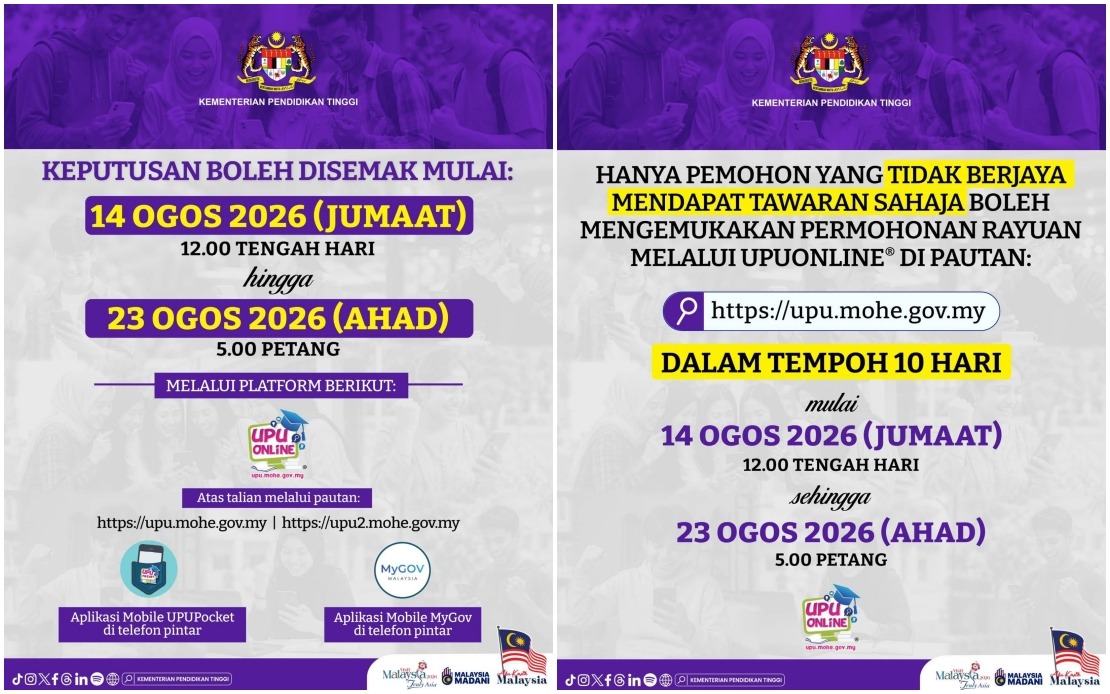
Prospective university students holding STPM or equivalent qualifications will receive their public university admission outcomes on August 14, marking a crucial milestone in Malaysia's tertiary education pathway. The Ministry of Higher Education has confirmed that the Bachelor's Degree level results for the 2026/2027 academic session will become accessible starting at noon on that date, with the application portal remaining open until 5 pm on August 23. This announcement provides clarity for the thousands of students who submitted applications through the centralised UPUOnline® system earlier this year.
Candidates seeking their results have multiple convenient access points to retrieve their outcome information. Beyond the traditional web-based portals at https://upu.mohe.gov.my and https://upu2.mohe.gov.my, applicants can utilise mobile platforms including the dedicated Mobile UPUPocket application or the broader Mobile MyGov service available on smartphones. This multi-channel approach recognises the digital preferences of today's student population and reduces barriers to accessing critical information during the result announcement window.
The confirmation phase commences immediately after results release, with successful candidates having between August 15 and 23 to formally accept or reject their university placements. Prospective students must navigate to their assigned university's website to complete this acceptance procedure, a process that represents their commitment to enrolling at that particular institution. The Ministry has stressed that official offer letters will only be issued by universities following candidate confirmation that they intend to accept their placement within the stipulated timeframe.
For those who receive disappointing news, the appeal mechanism provides a structured second opportunity to gain admission to public universities. Unsuccessful applicants have precisely ten days—from August 14 through August 23—to submit an appeal application via the UPUOnline® portal. This appeal window is deliberately compressed to maintain administrative efficiency and allow universities to complete their registration processes within reasonable timeframes. However, prospective students should understand that the appeal process operates within strict parameters governed by available vacancies.
The appeal selection methodology depends fundamentally on remaining vacant places within specific programmes and institutions after successful candidates have completed their registration. This means that appeals cannot guarantee admission and will only be considered where capacity exists. Universities will evaluate appeal applications based on their established criteria and the availability of spots in programmes aligned with applicants' academic profiles and preferences. This transparent allocation system prevents overcrowding whilst maintaining institutional quality standards.
A significant restriction accompanies this year's admission cycle: the Ministry has explicitly prohibited programme and institution changes after offers have been made. Candidates who receive placements are bound to their assigned university and course of study, with no opportunity to swap to alternative preferences even if such spaces become available. This policy aims to streamline administrative processes and prevent delays in student registration, though it underscores the importance of careful programme selection during the initial application phase.
For Malaysian students, this admission timeline carries particular significance as it represents the formal conclusion of their pre-university education journey. The STPM examination system remains the predominant pathway to university entry for students completing the traditional secondary school stream, though international baccalaureate and other equivalent qualifications are also processed through this unified system. Understanding these critical dates and procedural requirements is essential for candidates and their families as they navigate the transition to higher education.
The timing of result announcements during mid-August allows universities approximately one month to complete registration processes before the academic session commences, providing a functional but compressed timeline for administrative operations. Students should prepare necessary documentation and clarify any queries with their assigned universities before the confirmation deadline to avoid inadvertent rejection of offers through missed deadlines or procedural oversights.
For those pursuing appeals, the decision to challenge unsuccessful outcomes requires honest self-assessment regarding academic competitiveness and genuine interest in alternative programmes and institutions. Appeals based on emotional disappointment rather than substantive grounds are unlikely to succeed given the structured nature of the selection process. Prospective students should consult with education advisors or university liaison officers to understand realistic appeal prospects within their specific circumstances.
The entire admission process underscores Malaysia's commitment to providing accessible pathways to quality higher education through its public university system. By establishing clear timelines, multiple access channels, and transparent selection procedures, the Ministry of Higher Education demonstrates institutional accountability to students and families invested in tertiary education. However, the finality of placement decisions once confirmed also places responsibility on candidates to make considered choices during initial application submission.

