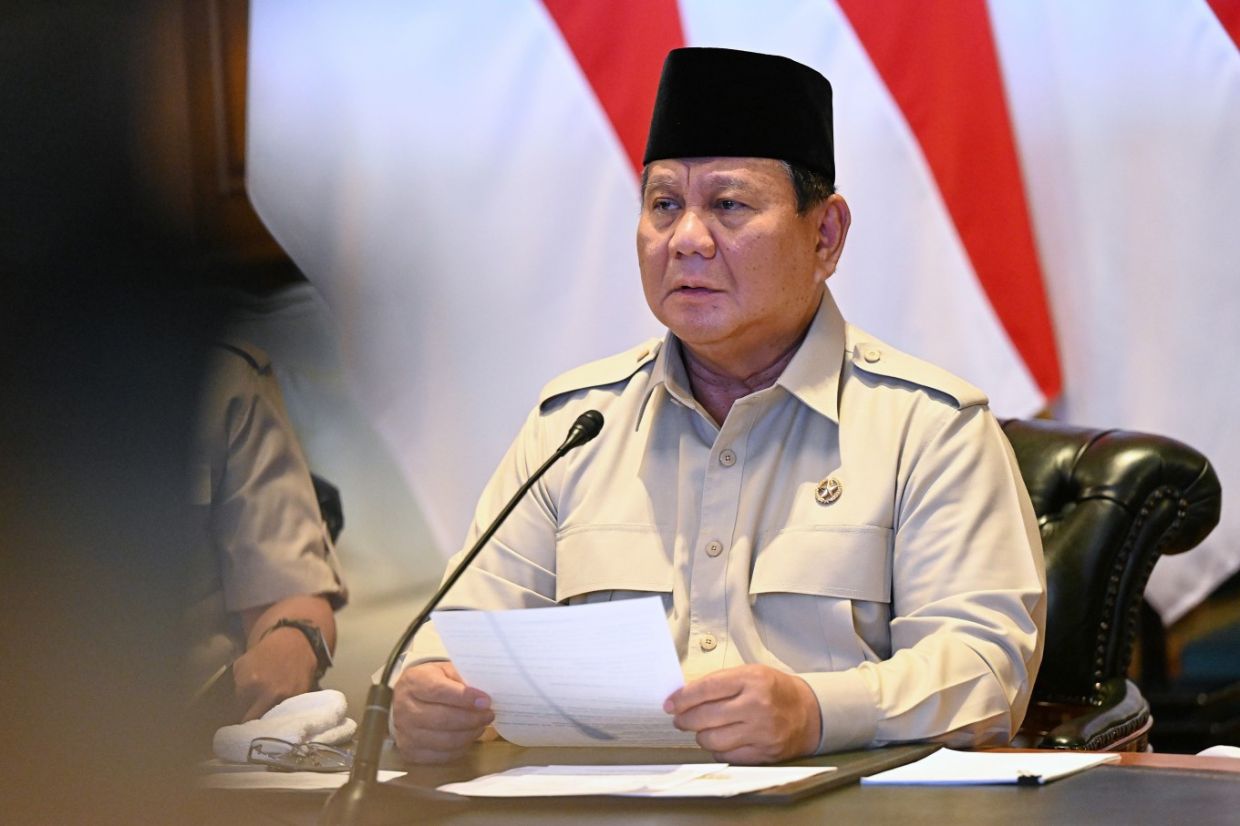
President Prabowo Subianto's extraordinary popularity has finally succumbed to the grinding pressures of governing. Once enjoying approval ratings that rivalled the most fortunate world leaders, the Indonesian president now confronts the hard reality that sustained goodwill depends on delivery, not rhetoric. Data from Saiful Mujani Research and Consulting (SMRC) released this month show his satisfaction rating at 51.1 percent for July 2026, a precipitous drop from 81.2 percent just eight months earlier. The shift marks a dramatic reversal in Indonesia's political landscape and raises urgent questions about the government's capacity to meet its ambitious economic pledges.
Prabowo's initial run of public support proved exceptionally durable compared to his predecessors and contemporary global counterparts. Unlike Joko "Jokowi" Widodo, whose inauguration approval of around 62 percent crumbled quickly following a contentious fuel price hike, Prabowo sustained ratings in the 70s and 80s throughout 2025. His predecessor ultimately achieved his career-high approval of 81.7 percent only deep into his second term, in May 2023, whereas Prabowo reached comparable numbers almost immediately. The comparison with recent American presidents—Donald Trump began his second term at 47 percent in January 2025, while Obama and Biden both experienced steeper early declines—underscores just how exceptional Prabowo's plateau proved to be.
Social policy initiatives, particularly the free nutritious meal programme launched in January 2025, deserve substantial credit for extending this unusually generous political grace period. The flagship welfare initiative created tangible benefits that resonated across Indonesian households and postponed the customary erosion of approval that typically accompanies the transition from campaign optimism to administrative reality. SMRC's tracking data reveal that public satisfaction remained remarkably sticky throughout the first half of 2025, hovering consistently above 70 percent even as underlying economic performance gave limited grounds for such sustained confidence. This suggests that the government's early focus on visible social spending proved more durable than conventional political science would predict, at least temporarily insulating Prabowo from the immediate consequences of his administration's economic management.
The July 2026 survey, conducted over a two-week period and based on 749 respondents, simultaneously recorded a sharp spike in dissatisfaction to 46.9 percent, up dramatically from approximately 16 percent in November 2025. This nearly threefold increase in negative sentiment mirrors the decline in approval ratings and indicates a fundamental shift in public mood rather than mere survey noise. The reversal became statistically impossible to dismiss when Indikator Politik Indonesia, an independent polling organization, released its own findings from July 14-24. Indikator's substantially larger sample of 4,250 respondents reported satisfaction at 49.5 percent, down from 68 percent in April and 81 percent in December 2025. The convergence between two credible but wholly independent pollsters on nearly identical trajectories effectively eliminates claims of methodological bias or partisan skewing.
Deni Irvani, SMRC's executive director, identified three specific domains of deteriorating public perception that explain the approval collapse. Economic sentiment has turned notably pessimistic, with only 15.7 percent expressing positive views of economic conditions in the latest survey. Political sentiment fell even more sharply, plummeting from 35.8 percent approval in November 2025 to just 13.5 percent by July 2026—a staggering 22-point contraction that suggests public confidence in the government's political management has fractured almost entirely. Public confidence in law enforcement, meanwhile, registered at only 26.4 percent, indicating that one of Prabowo's flagship anti-corruption agenda items has failed to generate meaningful improvements in citizen perception. Together, these three metrics paint a portrait of public disillusionment spreading across multiple dimensions of governance simultaneously.
The underlying economic headwinds driving this sentiment shift remain substantial and difficult for any administration to navigate. The Indonesian rupiah has weakened considerably, eroding purchasing power and raising import costs in an economy heavily dependent on foreign goods. The stock market has languished, signalling investor uncertainty about medium-term prospects. Most painfully for ordinary households, food prices and general inflation have accelerated, directly contradicting Prabowo's campaign commitment to raise GDP growth from the current 5 percent to an ambitious 8 percent annually. These tangible daily experiences—the cost of feeding a family, the value of savings, employment prospects—ultimately determine public sentiment far more definitively than presidential visibility or rhetorical forcefulness.
Prabowo has not remained passive in responding to declining approval numbers. His administration has invested considerably in maintaining a high public profile, with frequent televised addresses, a well-resourced communications apparatus designed to keep the president constantly before the public eye, and a willingness to directly confront critics and journalists who question government performance. This approach functioned reasonably well when underlying economic conditions remained sufficiently favourable to permit rhetoric to fill substantive gaps. Yet the latest polling suggests that this communications strategy has reached its ceiling. Public judgement, ultimately, rests not on how often citizens see their president on screen but on tangible weekly experiences: whether prices remain manageable, whether wages stretch far enough, whether the free meal programme functions reliably, and whether employment opportunities actually materialize.
Fair-minded observers must acknowledge that Saiful Mujani, SMRC's founder, has emerged as an outspoken government critic in recent months, a fact that administration supporters have legitimately raised when questioning survey credibility. However, the existence of a pollster's personal political views neither constitutes evidence of methodological compromise nor explains away consistent findings from alternative sources. SMRC maintains a lengthy track record of methodologically sound surveys, including several years when its published numbers favoured Jokowi's administration. The organization's credibility rests on systematic data collection rather than favorable findings for any particular government. More persuasively still, Indikator Politik Indonesia's independent convergence on nearly identical numbers across both organizations provides external corroboration that transcends any individual pollster's supposed biases.
Government responses to the approval decline are already underway, albeit tentatively. Officials from Prabowo's inner circle have consulted with the National Economic Council (DEN) to devise strategies for improving economic policy performance, the domain where public dissatisfaction has grown most pronounced. According to a source with knowledge of these discussions, the administration is considering an expansion of social assistance programmes and has maintained fuel prices at their current levels despite inflation pressures, partly to prevent the politically explosive backlash that typically follows energy price increases. The government's internal forecasting anticipates potentially significant climate-related disruptions ahead, including possible El Niño effects that could further compress household purchasing power and disrupt agricultural supply chains, creating additional economic pressure points that could accelerate the approval decline further.
Beyond immediate economic measures, Prabowo's closest advisers have separately engaged polling firms that contributed to his successful 2024 presidential campaign. These consultants have reportedly counselled the president to fundamentally overhaul his public communication strategy and conduct comprehensive reviews of government programmes experiencing implementation difficulties. The free nutritious meal initiative, despite its early popularity, has encountered logistical problems in certain regions, while the Red and White Cooperatives programme has struggled to establish meaningful economic impact. One pollster involved in these advisory discussions suggested that presidential approval could potentially recover if the administration demonstrates genuine improvement across these implementation challenges, indicating that the recovery pathway remains open but requires tangible administrative competence rather than merely rhetorical refinement.
Historically, a 30-point approval decline across nine months would ordinarily signal serious political jeopardy. However, Indonesian and global precedent suggests that such drops need not prove permanently catastrophic if governments can demonstrate genuine policy improvements. Jokowi recovered from his severe early plunge to reach historically high approval ratings during his second term. What distinguishes recoverable from terminal declines is whether the underlying policy performance actually improves in ways citizens directly experience. For Prabowo, the critical months ahead will determine whether social spending expansion, economic stabilization efforts, and programme implementation improvements can generate tangible benefits before further erosion occurs. The honeymoon's end need not signal the beginning of terminal decline, but reversing current trajectories demands concrete results rather than heightened visibility.

