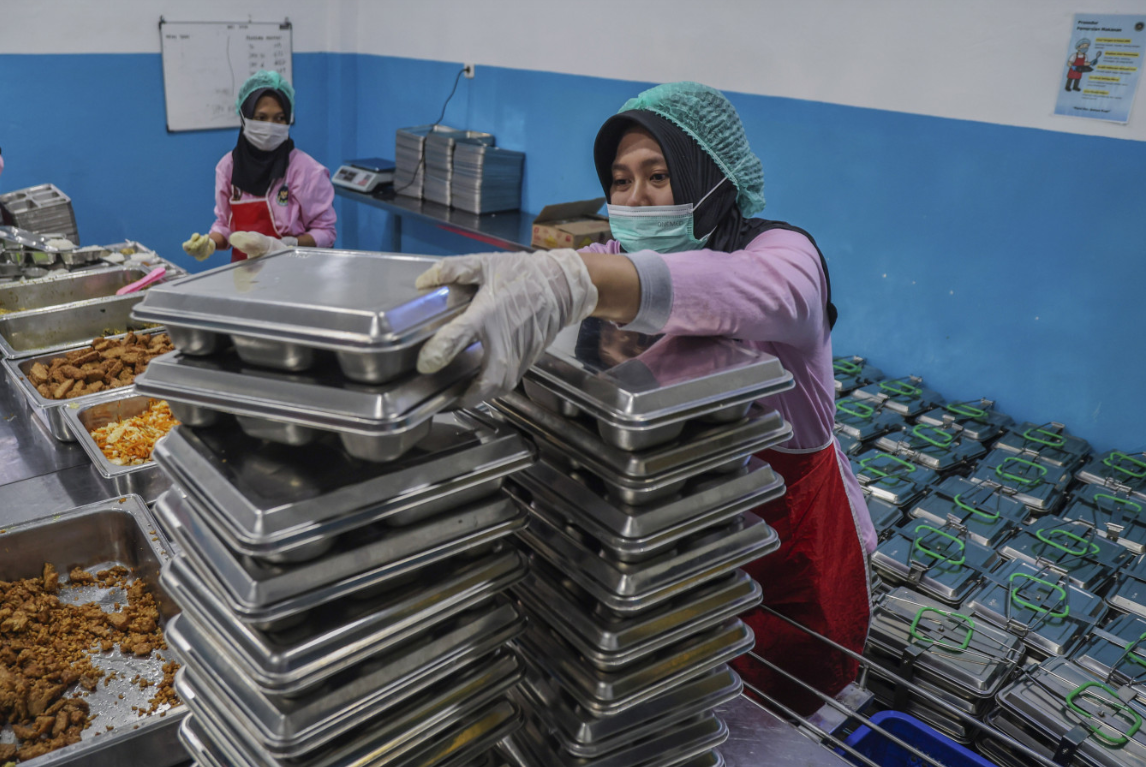
Indonesia's President Prabowo Subianto is undertaking a fundamental reassessment of two cornerstone initiatives that have become lightning rods for public controversy and fiscal scrutiny. During a four-hour closed-door session at the Presidential Palace on Wednesday, the leader convened senior cabinet members responsible for implementing the free nutritious meal scheme and the Red and White cooperative project, two programmes that have consumed considerable budgetary resources yet generated mounting criticism regarding their execution and sustainability.
The decision to conduct formal reviews represents a significant recalibration for an administration that entered office with ambitious social welfare ambitions. Deputy Chief Agustina Arumsari of the National Nutrition Agency, which oversees the meal distribution initiative, disclosed that the President has demanded a thorough and methodical examination of how the programme currently functions within educational institutions. The comprehensive assessment must be completed within a single month, establishing a concrete deadline for what could prove consequential policy modifications affecting millions of beneficiaries across the archipelago.
At the heart of the meal programme review lies the question of eligibility thresholds and income-based targeting. Presently, the initiative aims to provide meals to approximately 83 million recipients, encompassing schoolchildren and pregnant women nationwide. Officials are now contemplating whether to implement income caps that would exclude higher-income households from participation, a move that could significantly narrow the programme's scope while potentially improving fiscal efficiency. However, such restructuring presents complex implementation challenges, particularly in mixed-income school environments where some students would receive meals while classmates do not, creating social dynamics that administrators must carefully evaluate before proceeding.
The psychological and social implications of such targeting decisions weigh heavily on government deliberations. As Arumsari emphasised, President Prabowo has instructed officials to consider the emotional and developmental consequences for students who might find themselves excluded from meal provision in shared learning spaces. This sensitivity to implementation complexities distinguishes the current review from hasty policy implementation, suggesting a more measured administrative approach than initially anticipated. The government is simultaneously exploring alternative delivery mechanisms, including redirecting meal provision through existing school canteen infrastructure rather than maintaining parallel meal-preparation systems.
The financial scale of this programme underscores the stakes involved in its redesign. With a budgetary allocation of at least Rp 268 trillion rupiah—approximately US$19.5 billion—earmarked for 2026, the free meals initiative represents one of Indonesia's most expensive social programmes. Beyond pure fiscal considerations, the scheme addresses critical public health objectives, combating childhood malnutrition and stunting that continue to constrain human capital development across rural and lower-income communities. The programme's fundamental aims remain legitimate, yet questions persist regarding whether current implementation models represent optimal allocation of scarce national resources.
Understanding the political context illuminates why such scrutiny has intensified. The initiative has catalysed sustained public protests, with demonstrations last month demanding programme suspension or fundamental restructuring. More damaging still, corruption investigations have ensnared senior National Police and Indonesian Military officials, undermining public confidence in administrative integrity. Isolated food poisoning incidents further eroded confidence in operational safety and quality control mechanisms, combining to create a credibility crisis for the administration despite the programme's laudable underlying objectives.
Parallel developments affecting the Red and White cooperatives introduce additional dimensions to this broader policy reassessment. Coordinating Food Minister Zulhas Hasan announced intentions to expand these cooperatives' institutional roles, positioning them as central distribution channels for diverse government assistance programmes spanning social welfare payments and subsidised commodities. This expanded mandate would substantially enhance their economic footprint within rural areas where cooperative networks operate. Additionally, the cooperatives are being tasked with agricultural stabilisation functions, purchasing commodities including rice and corn when market prices descend below government-determined thresholds, thereby providing price floors that protect farmer livelihoods during periods of market weakness.
Yet the cooperative initiative has generated its own operational controversies that prompted governmental recalibration. Military-style mandatory training programmes for cooperative managers resulted in at least four deaths, provoking public outrage and demands for programme suspension. These fatalities transformed what was intended as capacity-building and institutional discipline into a public relations catastrophe that undermined support for what might otherwise be viewed as economically beneficial rural development initiatives. The deaths highlighted how poorly calibrated programme design can undermine legitimate policy objectives through problematic implementation methodologies.
For Malaysian observers and policymakers, these Indonesian developments offer instructive lessons regarding the complexities of scaling ambitious social programmes. Large-scale interventions addressing poverty and malnutrition command moral legitimacy, yet their execution demands meticulous attention to administrative capacity, fiscal sustainability, and social acceptance. Indonesia's experience demonstrates that worthy policy objectives require robust institutional frameworks, transparent accountability mechanisms, and sensitivity to implementation externalities that can inadvertently create public backlash. The current reassessment, while prompted partly by political crisis management, represents an opportunity for more thoughtful programme design that could enhance both effectiveness and public legitimacy.
The timing of these reviews also reflects broader challenges confronting Indonesia's fiscal position and resource allocation priorities. As the region's largest economy navigates moderate growth conditions and mounting infrastructure demands, the opportunity cost of maintaining expensive programmes with questionable cost-effectiveness becomes increasingly salient. A more targeted approach to meal provision, concentrating resources on the most nutritionally vulnerable populations, could potentially deliver superior health outcomes while reducing budgetary pressure. Similarly, clarifying the cooperative programme's role and establishing safety protocols could transform an initiative that currently generates reputational damage into a genuine engine for rural economic development.
Moving forward, the outcomes of these month-long reviews will significantly shape Prabowo's second-term credibility as an administrator capable of learning from implementation difficulties and adjusting course accordingly. Southeast Asian governments increasingly recognise that ambitious social agendas require constant recalibration based on operational feedback and public response. Indonesia's willingness to transparently acknowledge shortcomings in flagship programmes, while maintaining commitment to their underlying objectives, demonstrates pragmatic governance that may ultimately prove more effective than rigid adherence to initial implementation models regardless of demonstrated difficulties or public concern.

