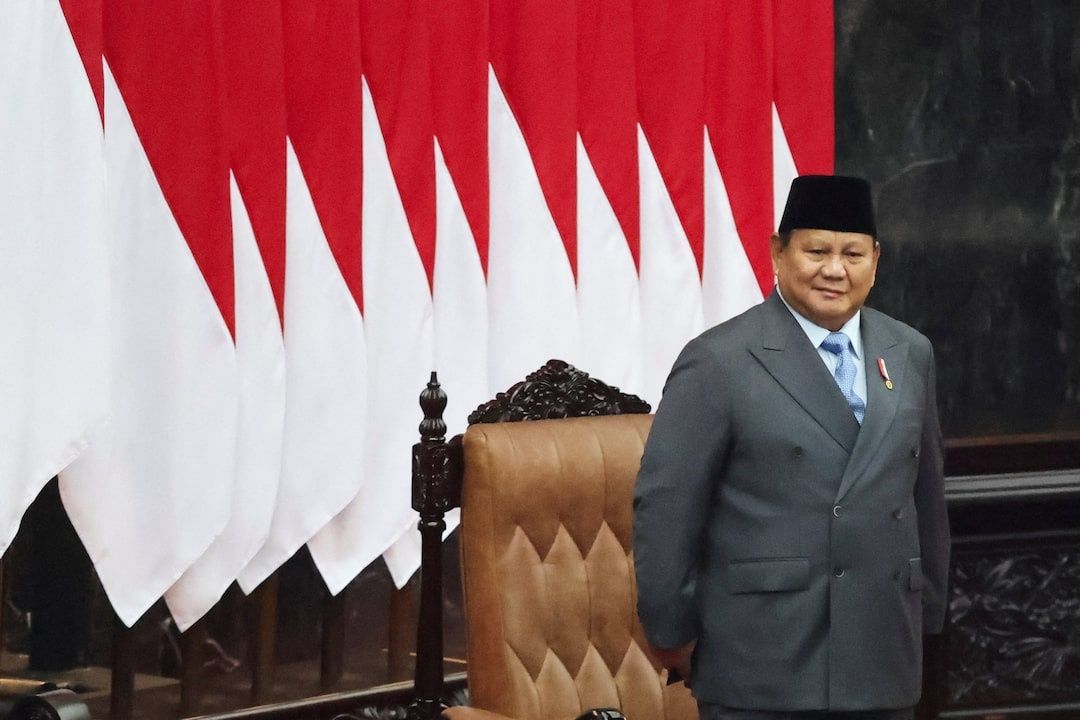
Indonesian President Prabowo Subianto faces one of his most consequential policy announcements since taking office, presenting his 2027 budget proposals on Friday (Aug 14) as both domestic and international confidence in his administration erodes. The moment represents a critical juncture for the former special forces commander, who swept to power in October 2024 with an overwhelming electoral mandate built on pledges to eliminate corruption, accelerate economic growth from 5% to 8%, and introduce a free meal programme for millions of school children. Now, barely ten months into his presidency, Prabowo must demonstrate fiscal credibility and policy direction whilst confronting deteriorating economic conditions and growing scepticism from global investors about his government's commodity export agenda.
The backdrop to Friday's presentation is decidedly less rosy than the triumphant campaign that brought Prabowo to the presidential palace. His administration has grappled with a depreciating rupiah currency and anaemic stock market performance throughout 2024, whilst concerns about government spending levels and questions over the independence of Bank Indonesia have sparked investor anxiety. The flagship free meal initiative, a centrepiece of his anti-poverty agenda, has itself become a source of controversy after implementation challenges forced budget adjustments and triggered allegations of administrative mismanagement. These setbacks have taken a measurable toll on public confidence: Prabowo's approval rating collapsed by 30 percentage points in just eight months, declining from a post-election high to 51% according to recent polling, a stunning reversal attributable primarily to economic deterioration and public dissatisfaction with law enforcement effectiveness.
The budgetary presentation itself will be split into two components. In the morning, Prabowo will deliver a speech marking Indonesia's Independence Day, during which observers expect him to address broader policy ambitions and national priorities. The afternoon session will then shift focus to technical budget details, though given the political context, the policy messaging will likely overshadow fiscal specifics. For economists and investors monitoring Indonesia's trajectory, this presentation constitutes what Bank Danamon analyst Irman Faiz describes as "one of the most important credibility checkpoints for global investors in recent years," particularly after the market has absorbed numerous unexpected policy announcements over the previous two years.
Central to investor concerns is Indonesia's fiscal position and what the 2027 budget reveals about the government's spending discipline. The nation's fiscal deficit currently hovers around 2.8% of gross domestic product for 2025, putting it dangerously close to the 3% constitutional ceiling that cannot legally be exceeded. If current trends persist, Indonesia will reach that maximum threshold again this year, signalling limited room for expansionary spending or major new initiatives. Faiz emphasised that the market's patience for policy surprises has worn thin, meaning that any signals of fiscal profligacy or continued uncertainty could trigger sharper capital outflows and further currency depreciation. The combination of mounting public scepticism and tightening external constraints leaves Prabowo with limited flexibility in crafting a budget that simultaneously addresses domestic demands and reassures foreign investors.
The most significant source of market anxiety stems from Prabowo's May announcement concerning a sweeping reconfiguration of Indonesia's commodity export structure. In that controversial parliamentary address, the president unveiled plans to consolidate the marketing and export of all critical natural resources—potentially including palm oil, tin, and other strategic commodities—under a new state-owned holding company called Danantara Sumberdaya Indonesia. The move sent shockwaves through international commodity markets and investment circles, raising questions about Indonesia's openness to foreign investment and the potential for the government to manipulate or restrict supplies for political or financial gain. Such centralised control threatened the competitive export structures that have long underpinned Indonesia's commodity revenues.
Since that May bombshell, however, the administration has sent contradictory signals. Multiple officials have suggested that Danantara Sumberdaya Indonesia would function primarily as a supervisory body rather than a direct operator or exporter of commodities, implying a much narrower mandate than the original announcement suggested. Yet this clarification remains ambiguous, and no official documentation has definitively established the entity's scope and authority. Investors and commodity traders remain deeply uncertain, and many analysts anticipate that Prabowo will use Friday's address to provide clarity on the extent to which the state will actually intervene in commodity export markets. Such clarity is crucial: palm oil traders and other commodity specialists will be listening intently for any signals about how aggressively the government intends to regulate or control natural resource sales, as these policies directly affect trading flows, price expectations, and investment risk assessments across Southeast Asia's agricultural and extractive industries.
Yose Rizal Damuri, executive director of the Center for Strategic and International Studies think tank, underscored that investor appetite for ambiguity has essentially evaporated. Markets now demand concrete policy frameworks rather than broad aspirational announcements followed by unclear implementation. The Danantara Sumberdaya Indonesia initiative exemplifies this frustration: investors need to know whether the entity will be a rubber-stamp regulatory body with minimal market interference or an aggressive state actor that determines export volumes and pricing. The latter scenario would represent a fundamental departure from the market-oriented frameworks that have attracted foreign capital to Indonesia and could necessitate significant reassessment of investment strategies across the region.
Arya Fernandes, head of politics and social change at CSIS Jakarta, noted that Prabowo confronts an extraordinarily difficult communicative task. The president must somehow address mounting anxieties about economic management and the viability of his administration's signature programmes whilst simultaneously defending ambitious policy initiatives that international investors view with scepticism. He must rebuild eroding public confidence without making commitments that contradict his government's developmental vision. He must clarify commodity export policies in ways that satisfy both nationalist constituencies demanding state control of natural resources and international investors requiring predictability and market access. As Fernandes emphasised, accomplishing all three simultaneously "is certainly no easy task" for any political leader, let alone one whose approval ratings have already suffered such a dramatic decline.
The outcome of Friday's presentation will likely reverberate across Southeast Asia's investment and policy circles. If Prabowo articulates a coherent, investor-friendly budget framework and definitively clarifies Indonesia's commodity export intentions, he may succeed in stabilising confidence and arresting currency depreciation. If instead he delivers vague assurances without substantive detail, or signals further fiscal expansion without demonstrable revenue sources, markets will probably punish the rupiah further and withdraw capital flows. For Malaysia and other Southeast Asian economies with exposure to Indonesian markets and regional commodity chains, the outcome carries implications for regional financial stability and the broader investment climate. Prabowo's budget moment thus represents not merely an Indonesian domestic affair but a barometer for investor confidence throughout the region.

