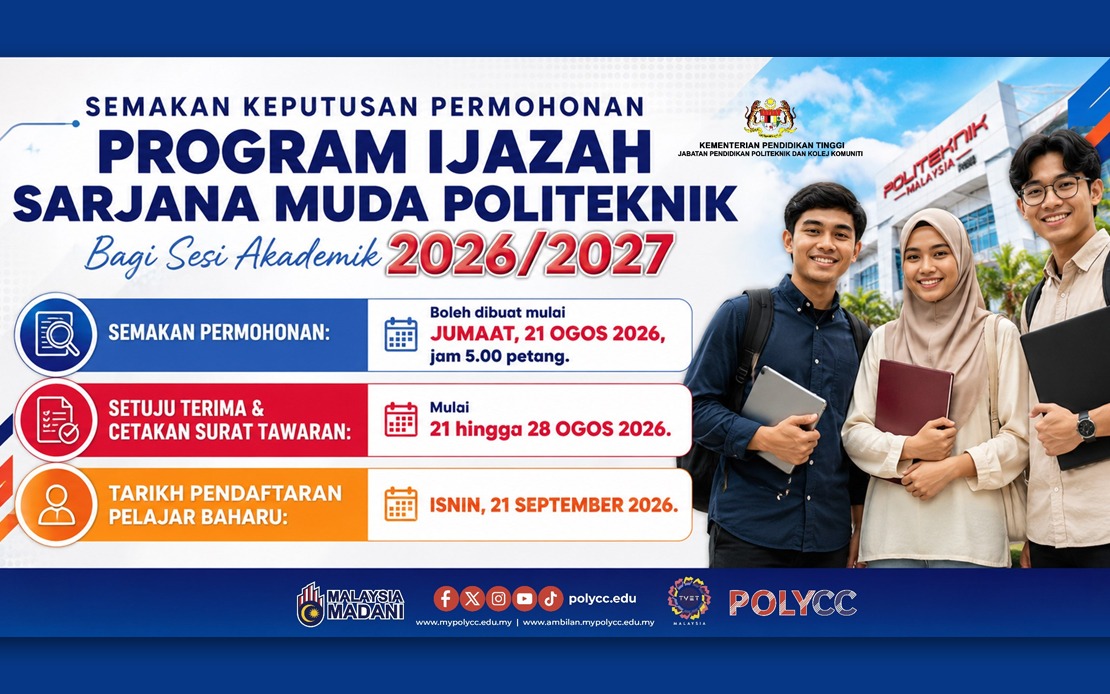
Prospective students who applied for Bachelor's Degree programmes at Malaysian polytechnics can now view their application outcomes, marking an important milestone in the higher education intake cycle. The results became accessible from today, giving applicants the opportunity to learn whether they have secured a place in their desired programme. Those who have successfully received offers must act swiftly, as the Ministry of Higher Education has set a firm deadline of August 28 for all candidates to formally confirm their acceptance.
This intake round encompasses 12 distinct Bachelor's Degree offerings spread across four polytechnic institutions throughout the country. The programmes span a diverse range of technical and professional fields, including Mechanical Engineering Technology, Civil Engineering Technology and Built Environment, Electrical and Electronic Engineering Technology, Visual Communication and Design, and Tourism and Hospitality. This variety reflects Malaysia's polytechnic system's commitment to producing graduates equipped for multiple economic sectors, from manufacturing and construction to creative industries and service provision.
The four participating polytechnics represent a geographic spread across the nation's major industrial and urban centres. Politeknik Ungku Omar in Ipoh, Perak has long been recognised as a leading technical institution in the northern region. Politeknik Sultan Salahuddin Abdul Aziz Shah in Shah Alam, Selangor serves the crucial Klang Valley and western corridor. Politeknik Ibrahim Sultan in Pasir Gudang, Johor positions itself within Malaysia's major petrochemical and manufacturing hub. Finally, Politeknik Sultan Azlan Shah in Behrang, Perak contributes to skills development in the central region. This distribution ensures that geographically dispersed applicants have access to quality polytechnic education without excessive relocation.
The total allocation stands at 534 places across all programmes and institutions. For applicants assessing their opportunities, this figure provides context regarding competition levels across the various fields. Engineering-related disciplines traditionally command significant demand within polytechnic systems, reflecting both employer recruitment patterns and government priority in developing the nation's technical workforce. The inclusion of Visual Communication and Design alongside traditional engineering disciplines signals the polytechnic sector's recognition that creative and design-oriented skills are increasingly integral to modern economic competitiveness.
For those who have received offers, the acceptance window is notably brief—running from today until August 28. This compressed timeframe requires families to make swift decisions, potentially involving financial planning discussions and logistical arrangements. Successful applicants should not delay confirmation, as failure to respond within the deadline may result in forfeiture of their places. The system prioritises rapid decision-making to allow the institutions to plan intake cohorts and adjust accommodation, facilities, and teaching resource allocation accordingly.
Students who have not received an offer can pursue an appeal through an online mechanism that remains open until September 4. This provision represents an important safety valve within the intake system, acknowledging that initial allocation does not necessarily represent the final word on admission. Appeal candidates should prepare detailed justifications for their applications and monitor the process carefully. The first follow-up offer results for appeal applicants will be announced on September 8, allowing institutions approximately one week to process appeals before communicating outcomes.
For those admitted, the academic calendar moves swiftly forward. New student registration commences on September 21, which means admitted students must complete pre-enrolment procedures and potentially undertake placement tests or orientation activities within that timeframe. Polytechnic Bachelor's Degree programmes typically span three years at the diploma level, equipping graduates with both theoretical knowledge and practical competency in their chosen fields. The programmes emphasise work-integrated learning, with many incorporating internship or apprenticeship components that connect classroom instruction to real-world industrial practice.
The availability of polytechnic degree options reflects broader policy evolution within Malaysia's higher education landscape. Historically, polytechnics focused primarily on diploma qualifications. The introduction of Bachelor's Degree pathways acknowledges several considerations: first, that employers increasingly expect graduates to hold bachelor-level qualifications even in technical fields; second, that polytechnic graduates pursuing further studies need transparent progression pathways; and third, that Malaysia's skills ecosystem benefits from diverse higher education providers offering different pedagogical approaches and specialist expertise.
Applicants requiring additional information or encountering technical difficulties accessing results can contact the Student Intake and Development Division within the Department of Polytechnic Education and Community Colleges. This support infrastructure exists to ensure that eligible candidates can navigate the system effectively. Clear communication from institutions during intake periods is essential, particularly for first-generation higher education applicants or those from less-resourced communities who may lack family experience with tertiary education processes.
The announcement underscores Malaysia's ongoing commitment to expanding technical and vocational education pathways. Polytechnic Bachelor's Degrees offer an alternative to university-based engineering and technology programmes, often featuring more applied curricula and stronger industry connections. For many Malaysian students, polytechnic pathways represent an optimal balance between academic rigour and practical relevance. Successful programme completion opens pathways to professional registration, employment, or further postgraduate study, providing graduates with multiple options for career progression and specialisation.

