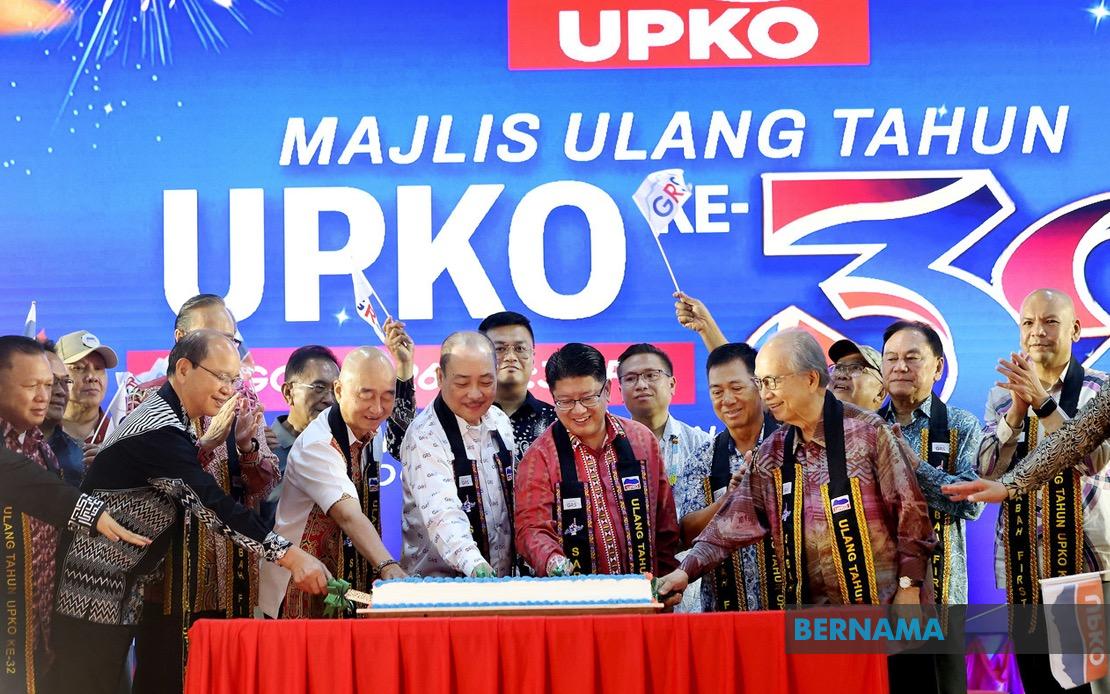
Sabah's development trajectory depends critically on maintaining political stability within the state government, according to Chief Minister Datuk Seri Hajiji Noor, who argues that a consolidated political environment enables effective governance and resource allocation toward growth initiatives. Speaking at the 32nd United Progressive Kinabalu Organisation (UPKO) anniversary celebration and the opening of the party's 17th Triennial Delegates Conference in Kota Kinabalu, Hajiji articulated how internal cohesion among coalition members directly translates into tangible benefits for citizens through improved economic conditions and enhanced physical infrastructure.
The Sabah Chief Minister addressed a persistent tension in regional politics: maintaining unity despite significant ideological and organisational differences. He acknowledged that the six parties now comprising Gabungan Rakyat Sabah bring distinct historical backgrounds and political philosophies to the coalition partnership. Rather than viewing this diversity as a liability, Hajiji framed it as a source of collective strength when harnessed through shared commitment to state-level objectives. This framing reflects the pragmatic approach required in East Malaysian politics, where ethnic representation, regional interests, and historical party allegiances often create natural friction points requiring active management.
Hajiji employed evocative language to describe the coalition's nature, characterizing GRS as a collective home sheltering different political families under one umbrella for the common good. This metaphor resonates in Sabah's context, where party-hopping and coalition instability have historically disrupted governance and delayed development projects. By emphasising shared purpose over partisan identity, the Chief Minister sought to reinforce the psychological contract binding coalition members, particularly important given the recent addition of new parties seeking legitimacy within the broader grouping.
UPKO's formal integration into GRS on June 18 represents a significant consolidation moment for Sabah's ruling coalition. The party's entry expands the coalition from five to six component parties, which now include Parti Gagasan Rakyat Sabah, Parti Bersatu Sabah, Liberal Democratic Party, Parti Harapan Rakyat Sabah, and Parti Cinta Sabah alongside the newly incorporated UPKO. This expansion theoretically strengthens GRS by broadening its organisational reach and deepening representation among different constituencies, though it simultaneously increases the number of stakeholders requiring accommodation within coalition decision-making structures.
UPKO's participation carries particular significance given the party's historical prominence in Sabah politics and its continued institutional capacity. With UPKO president Datuk Ewon Benedick holding the position of Sabah Deputy Chief Minister III and overseeing the Industrial Development, Entrepreneurship and Transportation portfolio, the party maintains meaningful influence over policy implementation and resource distribution. This senior representation provides incentive for UPKO members to maintain coalition discipline, as withdrawal would entail forfeiting cabinet positions and attendant influence over government direction.
The timing of Hajiji's address reflects ongoing efforts to consolidate GRS's political dominance following the coalition's formation and electoral successes. By publicly calling on UPKO leaders and members to continue collaborative efforts toward the stated vision—Sabah First, Sabah United, Sabah Forward and Sabah Prosper—the Chief Minister was simultaneously reinforcing internal cohesion and projecting stability to external audiences including investors, development partners, and ordinary citizens who benefit from predictable governance environments.
For Malaysia's broader political context, the Sabah coalition model demonstrates how regional parties can aggregate power through pragmatic alliance-building. Unlike Peninsular Malaysia, where Umno traditionally dominated coalition frameworks, Sabah's GRS represents more genuinely equal partnership among local parties, each commanding distinct electoral bases and institutional resources. This distributional model may prove more stable than hierarchical arrangements if managed carefully, as participating parties retain sufficient autonomy and reward to justify continued cooperation.
The emphasis on infrastructure development and economic prosperity as coalition objectives reflects legitimate public priorities in Sabah, a state that has historically received lower per-capita federal development allocations compared to some Peninsular counterparts. Political stability enabling sustained project execution—from transportation networks to industrial zones to utility systems—carries material significance for residents and businesses. Infrastructure delays resulting from political uncertainty impose real economic costs, deterring investment and limiting growth opportunities in a state seeking to diversify beyond traditional sectors.
Hajiji's framing of political stability as a prerequisite rather than a consequence of development acknowledges that Sabah voters increasingly measure government performance through concrete delivery rather than rhetorical promises. The Chief Minister's implicit message to GRS coalition partners is that defection or coalition breakdown would undermine everyone's credibility and electoral prospects by preventing the government from demonstrating competence through completed projects and improved services. This mutual interest in coalition survival creates structural incentives for cooperation even when day-to-day disagreements arise.
Looking forward, maintaining GRS cohesion will require managing centrifugal pressures inherent in multi-party coalitions. Cabinet positions, state development fund allocations, candidate selections for future elections, and responses to federal policy initiatives all present potential friction points. The Chief Minister's emphasis on shared vision and common purpose represents the rhetorical foundation for managing these inevitable tensions, supplemented by institutional mechanisms and resource-sharing arrangements negotiated among coalition partners.

