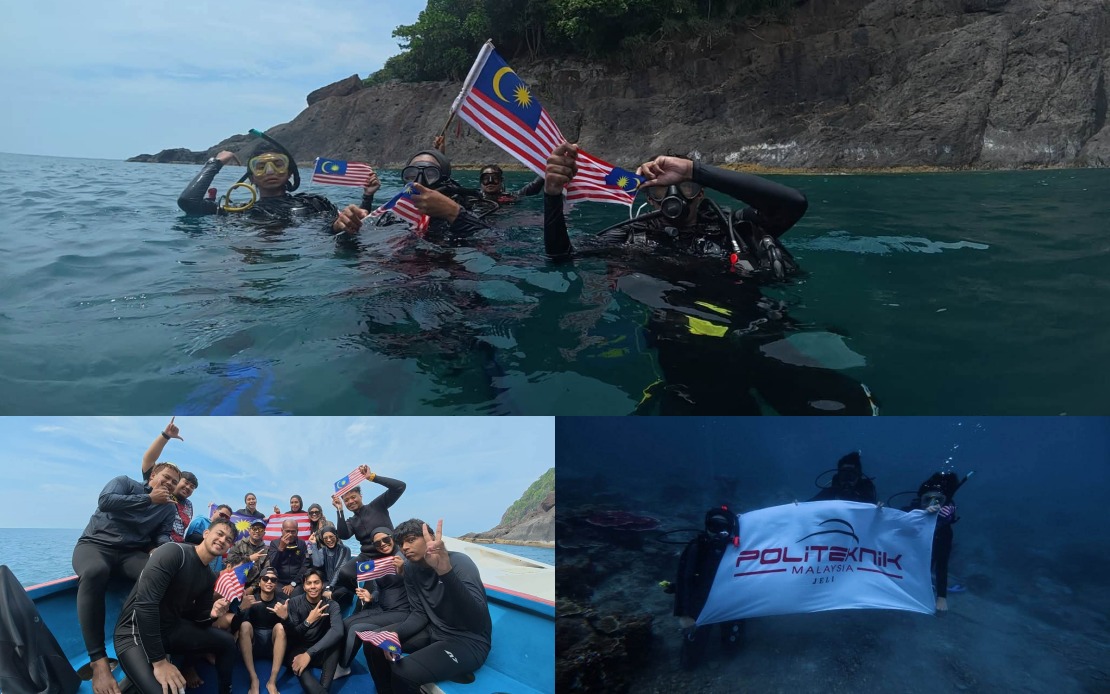
Politeknik Jeli Kelantan (PJK) in Kota Bharu approached this year's National Day festivities with uncommon flair, conducting what amounts to a novel civic expression beneath the waves. Staff members and students of the aquaculture-focused polytechnic planted the Jalur Gemilang at a depth of 18 metres off Pulau Tenggol in Terengganu on August 31, transforming a routine patriotic gesture into a tangible display of technical capability and institutional pride.
The underwater flag deployment served dual purposes that extend well beyond symbolism. According to Mohd Adam Nashriq Bani Yamin, an aquaculture lecturer at PJK, the initiative represented far more than a creative way to celebrate Malaysia's 69th National Day. Rather, it functioned as a practical demonstration of the competencies that the institution cultivates in its students, particularly those pursuing qualifications in aquaculture technology. The initiative allowed educators to illustrate real-world applications of classroom learning in a manner that captures student imagination and reinforces professional relevance.
The undertaking formed part of a structured scuba diving training and certification programme that ran from August 27 to 30 at Dive Buddy Dungun, involving PJK's Aquaculture Technology Unit alongside the Department of Agrotechnology and Bio-Industry. This four-day intensive immersion represented considerably more than recreational diving instruction. The curriculum encompassed water safety protocols and emergency response procedures, exposing participants to hazard recognition and management protocols they would encounter professionally upon graduation. Such exposure proves invaluable for students destined to work in marine environments, where sudden complications can arise with minimal warning.
Two lecturers and two fifth-semester diploma students participated in the scuba diving training, with instruction delivered by Dr Nabila Talib of Dive Buddy Malaysia. The programme culminated in formal PADI (Professional Association of Diving Instructors) Open Water Diver certification, a credential with recognized value throughout the international marine industry. Beyond the standard certification pathway, participants also engaged with PADI Divemaster-level instruction, providing advanced competencies that distinguish graduates in competitive job markets. For aquaculture students, such qualifications can prove transformative, opening career pathways that might otherwise remain inaccessible.
The decision to plant not merely the Jalur Gemilang but also the PJK institutional flag at the seabed reflected careful symbolic planning. This dual-flag deployment communicated simultaneous messages of national patriotism and institutional identity, suggesting that PJK sees its students as ambassadors bridging academic excellence with civic responsibility. The choice of depth and location required logistical coordination and safety planning, reinforcing that meaningful celebrations demand competence and preparation.
For Malaysia's growing aquaculture and marine biotechnology sectors, developing a skilled workforce equipped with both theoretical knowledge and practical capabilities remains strategically vital. As global food security pressures intensify and coastal nations increasingly look toward marine farming solutions, technicians capable of operating safely in aquatic environments become increasingly scarce and valuable. PJK's approach acknowledges this labour market reality while instilling graduates with confidence and competence.
The diving skills developed through such programmes extend application beyond routine marine farm operations. Students gain foundational capabilities applicable to marine research expeditions, monitoring and maintenance of offshore aquaculture installations, ecosystem assessment initiatives, and conservation work. These competencies position graduates as versatile professionals capable of responding to diverse industry demands. Furthermore, the water safety training component addresses occupational risks systematically, potentially preventing workplace accidents that claim lives in maritime sectors across Southeast Asia.
Institutional investment in such experiential learning contrasts sharply with conventional classroom-based technical education. By integrating certification programmes with holiday celebrations and patriotic observances, PJK demonstrates pedagogical innovation that engages students emotionally while advancing professional development. This approach recognizes that learning proves most durable when students perceive direct relevance and when instructional contexts carry meaningful cultural significance.
For Terengganu and Malaysia's broader marine economy, initiatives of this character signal growing sophistication in technical education delivery. Politeknik Jeli's willingness to conduct training in actual working environments rather than classroom laboratories reflects confidence in student capabilities and commitment to preparing graduates for authentic occupational demands. This orientation toward practical competence aligns with industry expectations, where employers consistently report skill gaps between academic credentials and workplace performance requirements.
The integration of patriotic observance with professional development also suggests evolving perspectives on civic responsibility within technical education. Rather than treating National Day as distraction from academic calendars, PJK positioned the commemoration as occasion for demonstrating how individual skill development contributes to national capability-building. This framing empowers students to recognize their professional aspirations as contributing to broader national interests in food security, economic development, and environmental stewardship.

