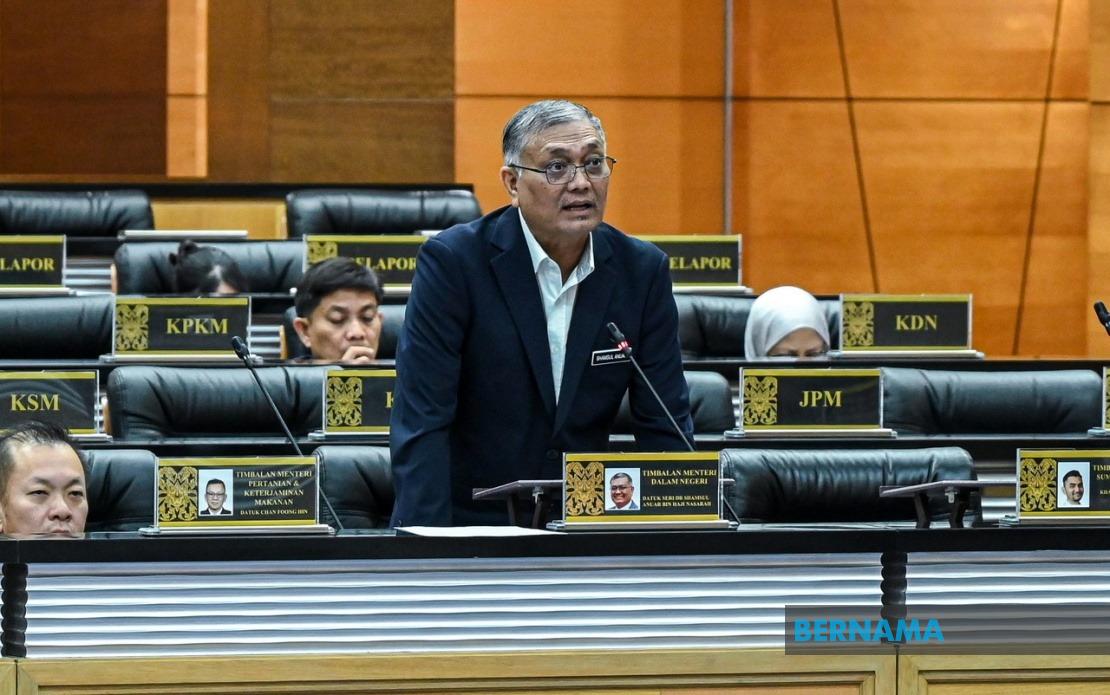
Malaysia's law enforcement agencies operate with complete neutrality when handling prominent investigations, according to Deputy Home Minister Datuk Seri Dr Shamsul Anuar Nasarah, who spoke before Parliament in Kuala Lumpur on July 15. His statement came in response to parliamentary queries regarding the status of several sensitive cases that have attracted significant public and political attention, signalling the government's commitment to ensuring that power and influence do not shield individuals from the criminal justice system.
The Deputy Home Minister's remarks focused particularly on the ongoing investigation into an intimate video recording that circulated widely on social media in 2019, which became associated with a prominent former member of the Cabinet. According to Shamsul Anuar, police are continuing efforts to locate the original recording and identify all devices and equipment involved in its creation and distribution. The investigation represents a technically complex undertaking, requiring forensic analysis and digital tracing across multiple platforms, which explains the extended timeline for resolution despite the case's high public profile.
The investigation into the 2019 video operates under multiple legislative frameworks, including Section 292, Section 377B and Section 504 of the Penal Code, as well as Section 233 of the Communications and Multimedia Act 1998. This multi-statutory approach demonstrates how contemporary cases involving digital content and alleged crimes of morality require authorities to apply both traditional criminal provisions and modern telecommunications legislation. The breadth of applicable laws reflects Parliament's attempts to address the challenges posed by rapidly evolving technology and online conduct.
Shamsul Anuar's statement carries particular significance given Malaysia's political climate, where questions frequently arise about whether the vast apparatus of law enforcement remains insulated from partisan pressures. By explicitly emphasising that investigations proceed "professionally, transparently and fairly without considering the position or political affiliation of any party," the Deputy Home Minister addressed widespread concerns about potential political interference in sensitive cases. Such reassurance matters considerably in a nation where public confidence in institutional impartiality has faced periodic tests.
The Parliamentary exchange itself, triggered by a question from Datuk Wan Saifulruddin Wan Jan representing Tasek Gelugor under the Perikatan Nasional coalition, demonstrates how high-profile investigations remain subjects of legitimate legislative scrutiny. The fact that opposition and coalition-aligned lawmakers alike seek progress updates on such matters underscores their significance beyond party lines and reflects genuine public interest in seeing investigations conclude fairly and thoroughly.
On a separate matter involving the son-in-law of former Prime Minister Tan Sri Muhyiddin Yassin, Shamsul Anuar confirmed that the Malaysian Anti-Corruption Commission (MACC) has taken charge of the investigation and issued an arrest warrant against the individual. The Deputy Home Minister's deliberate refusal to elaborate further—citing the MACC's independent jurisdiction—itself sends a message about institutional separation and the police's respect for other agencies' mandates. This demarcation of responsibilities reflects Malaysia's multi-agency approach to combating corruption and financial crimes.
The involvement of the MACC in investigating a matter connected to a former premier's family represents the kind of impartial institutional action that builds or restores public confidence. Regardless of which political coalition a former leader belonged to, corruption investigations must proceed with the same rigour and commitment to evidence-based conclusions. The existence of an active arrest warrant demonstrates that investigative bodies have gathered sufficient preliminary evidence to justify compulsory appearance before a court.
Beyond individual cases, Shamsul Anuar addressed Malaysia's broader international cooperation framework on extradition matters. The Deputy Home Minister noted that Malaysia currently maintains extradition treaties with 11 nations and has become a signatory to the ASEAN Extradition Treaty, positioning the country within a regional legal architecture designed to prevent fugitives from evading justice across borders. For Malaysian readers, this context matters because transnational financial crimes, money laundering, and corruption frequently involve suspects attempting to relocate assets and themselves to foreign jurisdictions.
The government's openness to negotiating additional extradition agreements with foreign countries reflects recognition that modern criminal networks operate globally, requiring law enforcement responses that transcend national boundaries. A Malaysian executive implicated in fraud might attempt to flee to a non-treaty nation, or conversely, foreign criminals might harbour assets or seek refuge in Malaysia. Strengthening these legal arrangements serves both to protect Malaysian interests and to fulfil international obligations to combat organised crime and corruption.
For Southeast Asian readers specifically, Malaysia's position within regional extradition frameworks carries implications beyond its borders. As one of the region's more developed economies with sophisticated financial services, Malaysia features in transnational schemes involving the other ASEAN nations. The ASEAN Extradition Treaty establishes a baseline commitment across the bloc to mutual legal assistance, though individual bilateral agreements often provide more expeditious processes and broader coverage than multilateral instruments.
The Deputy Home Minister's parliamentary statement, while addressing immediate political questions, reflects deeper institutional considerations about how democracies maintain public trust in law enforcement. When citizens observe that investigations proceed regardless of a suspect's former official status or political connections, confidence in the system strengthens. Conversely, perceptions of selective enforcement based on political alignment erode institutional legitimacy. Malaysia's recent history includes instances where such concerns have surfaced, making explicit reaffirmations of impartial investigation particularly important.
Looking forward, the resolution of these high-profile cases will serve as practical tests of the principles Shamsul Anuar articulated. The outcomes of the 2019 video investigation, the MACC's case against the former premier's son-in-law, and any future high-profile prosecutions will either validate his assurances or undermine them. For Malaysian society, the stakes extend beyond individual cases to fundamental questions about whether institutions function as designed or respond to political pressures.

