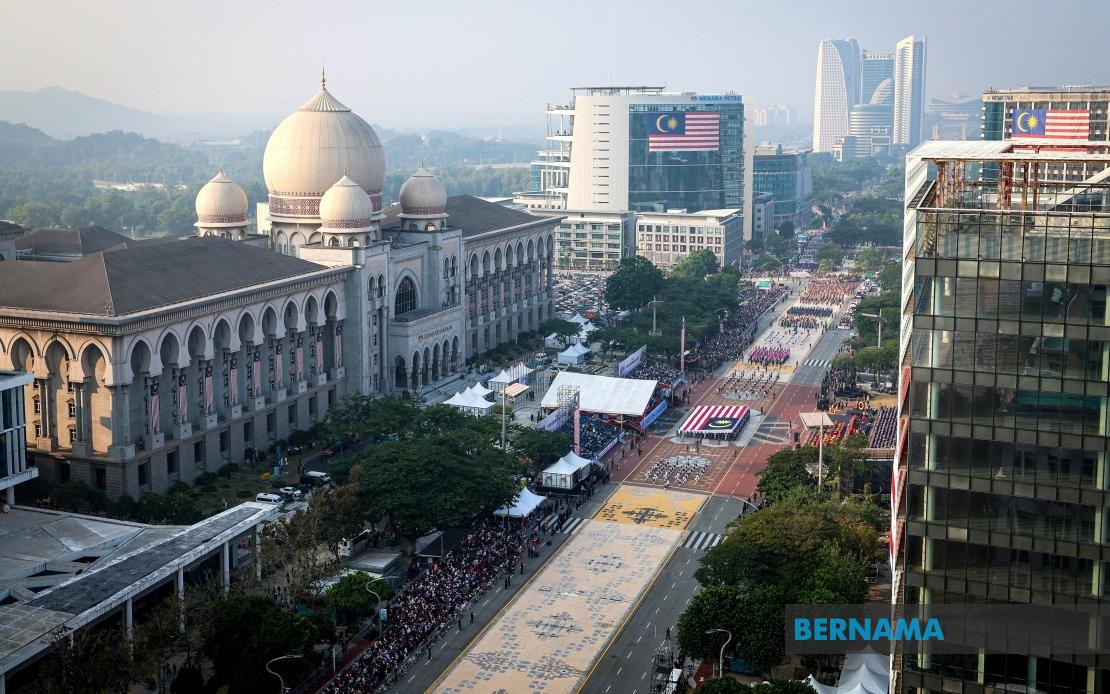
Security preparations for Malaysia's 69th National Day celebration have reached an advanced stage, with the Royal Malaysia Police (PDRM) committing a substantial force of 2,354 personnel to oversee the festivities at Dataran Putrajaya on August 31. The comprehensive deployment reflects the authorities' commitment to maintaining public safety whilst enabling citizens to celebrate this significant national occasion without disruption or concern. Putrajaya district police chief ACP Aidi Sham Mohamed outlined the scope of the operation following a full-scale rehearsal attended by Communications Minister Datuk Seri Fahmi Fadzil, signalling that detailed coordination between various government agencies has already commenced.
The policing strategy encompasses both static and mobile control measures positioned at key intersection points and strategic zones within the Dataran Putrajaya precinct. Static units will maintain fixed positions at entry points and crowd-gathering areas, whilst mobile patrols will monitor traffic flow and respond to emerging situations. This layered approach acknowledges the complexity of managing large public events in a confined urban space, where the simultaneous movement of tens of thousands of people can create bottlenecks and safety hazards if left unmanaged. The deployment demonstrates how contemporary event security balances public accessibility with protective measures.
Communications Minister Datuk Seri Fahmi Fadzil confirmed that the 2026 National Day celebration will proceed as planned, with event organisers adopting the theme "Malaysia MADANI: Kesejahteraan Dinikmati" (Malaysia MADANI: Prosperity Enjoyed). This thematic focus reflects the government's messaging around shared prosperity and inclusive development, positioning the National Day ceremony as more than ceremonial pageantry but as an affirmation of the nation's developmental trajectory. The theme's emphasis on collective wellbeing serves as a unifying message during a period when socio-economic concerns often dominate public discourse across the region.
Projections indicate that more than 80,000 visitors will gather at Dataran Putrajaya to witness the proceedings, a figure that underscores the symbolic importance Malaysians attach to National Day observances. For a venue of this scale, managing crowd safety, circulation, and emergency response capabilities requires precise coordination among police, traffic authorities, and venue management teams. The police deployment must account for entry surges, peak congestion periods during the main ceremony, and orderly dispersal afterwards—each phase presenting distinct security challenges that properly positioned personnel can address swiftly.
ACP Aidi Sham Mohamed directed several explicit guidance points toward attendees, reflecting common management concerns at mass gatherings. He urged visitors to arrive sufficiently early to avoid last-minute congestion and to familiarise themselves with venue protocols and restricted areas. The advice against parking in unauthorised locations speaks to a frequently encountered problem at public events, where individual convenience clashes with collective mobility, resulting in street blockages that impede both emergency vehicle access and general traffic flow. Similarly, his emphasis on vehicle owners maintaining awareness of designated parking zones reflects practical experience from previous celebrations.
Safety messaging extended beyond traffic management to encompass personal security. ACP Aidi Sham Mohamed advised attendees to exercise heightened vigilance regarding personal belongings and to maintain close supervision of accompanying children, recognising that large crowds create environments where theft and child separation incidents occur at elevated rates. By making these concerns explicit in pre-event communications, authorities demonstrate proactive risk awareness and distribute responsibility for personal safety between institutional actors and individual participants. This shared accountability model reflects evolving best practices in public safety management.
A critical component of the security briefing addressed the prohibition against bringing dangerous weapons to the celebration venue. This directive carries particular weight in the Malaysian context, where authorities maintain strict weapons regulations and remain vigilant against potential threats to large public gatherings. The specificity of the warning—framing it as a measure to preserve the celebratory atmosphere rather than mere regulatory compliance—aims to reframe security measures as protective rather than restrictive. Such messaging is important for maintaining public confidence in the authorities' intent and capacity to create safe environments for national observances.
The comprehensive rehearsal preceding the actual event demonstrates institutional commitment to operational readiness. Police conduct full-scale practice runs to identify procedural gaps, train personnel in assigned roles, and test communication protocols and coordination mechanisms. These rehearsals often reveal unforeseen challenges that tabletop planning cannot anticipate—bottlenecks in crowd flow, radio communication blind spots, or gaps between different agency responsibilities. The presence of Communications Minister Datuk Seri Fahmi Fadzil at the rehearsal signals high-level governmental attention to the event's success, ensuring that any institutional coordination problems identified during drills receive senior-level attention and resources.
For Malaysian residents, particularly those in the Klang Valley region, the August 31 National Day celebration represents a significant civic occasion where national identity is publicly reaffirmed and celebrated. The visible security presence—2,354 uniformed officers—may create an impression of heightened alertness, yet this transparency about police deployment levels actually serves a reassuring function, demonstrating preparedness without suggesting imminent threats. The authorities' detailed communication about security measures, attendance expectations, and public conduct guidelines reflects a communication philosophy that treats citizens as informed participants in collective security rather than passive subjects requiring control.
The 80,000-visitor projection places considerable demand on Dataran Putrajaya's infrastructure and immediate surroundings. Transportation networks feeding into the venue, parking facilities, and public facilities such as rest areas and medical stations must all function seamlessly. Police coordination with traffic authorities becomes crucial for managing vehicle flows on approaches to the venue and managing egress patterns afterwards. The 2,354-strong police contingent likely includes specialists in crowd management, traffic control, and crisis response, reflecting the sophistication required for contemporary public safety work at large events. This professionalism distinguishes organised national celebrations from spontaneous mass gatherings, where institutional coordination may be minimal.
From a broader Southeast Asian perspective, Malaysia's approach to securing large public events offers instructive lessons in balancing security imperatives with public accessibility. The willingness to welcome 80,000 visitors to a central government precinct whilst maintaining security reflects confidence in policing capacity and public compliance with safety protocols. Comparable events across the region sometimes impose more restrictive entry measures or cordoned zones, reflecting different threat assessments or security philosophies. The Malaysian model suggests institutional confidence in managing large, diverse crowds through visible police presence and public communication rather than through exclusionary barriers.
The successful execution of the 2026 National Day celebration depends not solely on police performance but on public cooperation with announced guidelines and regulations. The advance communications from police leadership—published in media reports and likely distributed through official channels—serve as public contracts specifying mutual obligations. Visitors who arrive early, respect parking regulations, secure their belongings, and refrain from bringing weapons fulfil their role in the implicit social agreement that enables safe, orderly celebrations. Similarly, the 2,354 deployed officers commit to protecting public safety and facilitating celebration rather than merely enforcing restrictions, establishing police-public relations grounded in shared interest in successful, meaningful commemoration.

