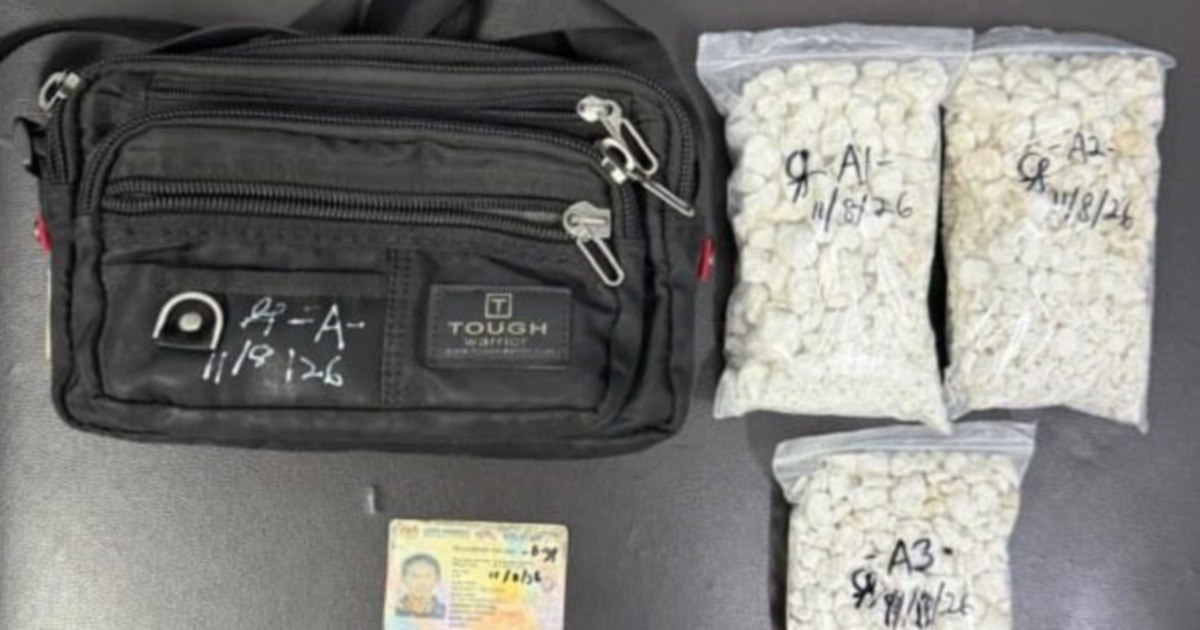
A significant drug seizure operation has resulted in the arrest of a 42-year-old man and the confiscation of 1.055kg of heroin during an early morning police raid in Simpang Renggam. The narcotics, valued at RM10,128, were discovered during a routine interdiction effort that reflects ongoing enforcement efforts by law enforcement agencies across Johor in tackling the persistent drug trafficking problem in the region.
The bust, which took place in the Simpang Renggam area under the Kluang police jurisdiction, highlights the systematic approach authorities are adopting to dismantle drug networks operating across the state. The timing of the operation—conducted in the early hours of the morning—is consistent with police strategies that target suspected distribution points when traffickers are most likely to be found in possession of larger quantities for street-level sales.
The recovered substance represents a significant street-level cache. At the estimated street value of RM10,128, the heroin would have yielded hundreds of individual doses for distribution through local networks, making this particular seizure a meaningful blow to supply chains feeding addiction in the broader Kluang and surrounding districts. The volume suggests this may have been an intermediate supply point rather than a retail operation, indicating that law enforcement may have disrupted a logistics link in a larger trafficking hierarchy.
Heroin remains one of the most problematic drugs driving addiction and crime across Malaysia. The opioid epidemic continues to place significant strain on rehabilitation services, law enforcement, and social welfare systems throughout the country. Johor, as one of the nation's most populous states and a key transit point for regional trafficking due to its proximity to Singapore and Thailand, faces particular challenges in managing drug-related crime and public health crises stemming from opioid abuse.
The arrest of the 42-year-old individual follows a pattern observed by Malaysian authorities, where narcotics operations frequently target middle-aged distributors who serve as key nodes in local supply networks. These individuals often operate from residential areas or shophouses and maintain connections to both upstream suppliers and street-level dealers, making their apprehension strategically valuable for disrupting organized supply operations.
This operation forms part of the broader commitment by Johor police to implement sustained anti-narcotics campaigns across their jurisdiction. Such enforcement activities are essential in deterring trafficking and demonstrating that the consequences of drug distribution remain substantial. The visibility of regular seizures and arrests serves an important deterrent function, particularly within communities where trafficking has become entrenched.
The implications of this seizure extend beyond the immediate arrest and confiscation. It provides law enforcement with an opportunity to gather intelligence regarding supply routes, upstream suppliers, and downstream distribution networks. Interrogation of the suspect may yield valuable information that could lead to further arrests and dismantling of related criminal operations feeding the local drug trade.
The RM10,128 valuation reflects current street-level pricing for heroin in Malaysia, where the drug commands premium prices due to enforcement pressures and supply constraints. This pricing underscores the profitability of trafficking operations and the economic incentives driving individuals to engage in the high-risk business of narcotics distribution. For context, such quantities seized regularly across Malaysian police jurisdictions, yet the aggregate impact of consistent enforcement efforts gradually constrains supply availability and increases consumer prices, theoretically reducing accessibility.
For residents of Simpang Renggam and surrounding communities, this operation represents tangible evidence of police responsiveness to drug-related threats. Public confidence in law enforcement's capacity to address narcotics problems depends partly on visible enforcement activity, and such early morning raids signal that authorities maintain surveillance capabilities and operational readiness around the clock.
The Simpang Renggam raid also reflects operational coordination between various police units and intelligence divisions, which typically precedes major enforcement actions. Prior intelligence gathering, surveillance, and information sharing among different police branches enable targeted operations that maximize the probability of locating significant drug caches. This investigative groundwork, while often invisible to the public, represents the foundation upon which successful seizures are built.
Moving forward, the case will proceed through Malaysia's judicial system, where sentencing guidelines for heroin trafficking carry severe penalties. Conviction under the Dangerous Drugs Act provisions applicable to this quantity would typically result in substantial custodial sentences, reflecting the severity with which Malaysian law treats large-scale narcotics offences. Such penalties serve both as punishment and deterrent messaging to potential offenders contemplating entry into the trafficking trade.
The broader context of this seizure reflects a persistent challenge facing Malaysia's law enforcement agencies: the continuing flow of heroin and other opioids through regional trafficking networks supplied from opium-producing regions in Southeast Asia and beyond. While individual seizures make important contributions to disrupting supply, comprehensive responses to the narcotics problem require sustained investment in rehabilitation infrastructure, community-based prevention initiatives, and international cooperation to address the source of supply flows entering Malaysian markets.

