When Ewa Lutka-Krawczyk received her diagnosis of gallbladder cancer, the 70-year-old's immediate worry was not for herself but for Gaja, the shelter dog she had rescued three years prior. She pleaded with her physician for reassurance that she would have enough time remaining to spare Gaja from abandonment. That hope dimmed when the medical reality became clear: the cancer was terminal, and within weeks Lutka-Krawczyk found herself in the palliative ward of a Warsaw hospital. Back home, Gaja deteriorated rapidly in her owner's absence, refusing meals and displaying clear signs of distress.
Poland's parliament is now considering groundbreaking legislation that would grant patients like Lutka-Krawczyk an explicit legal right to receive visits from their pets during end-of-life care. Though some hospitals already permit such visits on an informal basis, no national legal framework currently exists to guarantee this right across all hospices and palliative wards. The proposed bill, introduced by Katarzyna Piekarska from Prime Minister Donald Tusk's centrist coalition, represents a recognition that animal companionship serves a therapeutic function for dying patients and their families.
The impetus behind this legislative effort comes from Dr Tomasz Dzierzanowski, director of the Palliative Medicine Clinic at the Medical University of Warsaw, who treats Lutka-Krawczyk herself. Dzierzanowski has witnessed firsthand how profoundly the presence of an animal companion can transform the final chapter of a patient's life. He articulates a compelling diagnosis of contemporary society: an epidemic of loneliness that claims its toll even among those facing their final days. His clinic has already begun permitting pet visits when circumstances permit, a practice that may soon become a legal obligation across the country.
Dzierzanowski's commitment to this cause crystallised through a single patient encounter. A terminally ill cancer patient named Waldemar arrived at his ward consumed not by fear of his own mortality but by anxiety about the fate of his two cats. Moved by the man's distress, Dzierzanowski arranged for the animals to be brought into the hospital. The moment of reunion proved transformative: Waldemar wept with joy, the cats responded with visible emotion, and the scene left an indelible impression on all witnesses, including staff members. That single encounter convinced Dzierzanowski that addressing animal companionship in palliative care represented an urgent medical and ethical imperative.
The experience illuminates a deeper crisis affecting terminal patients across demographics. Dzierzanowski observes that elderly patients frequently arrive at palliative wards profoundly isolated, having outlived their peers and social networks. Simultaneously, younger patients increasingly experience unprecedented loneliness despite living in an age of digital connectivity. The paradox reflects a societal failure: while technology promises constant connection, it has paradoxically eroded the formation of deep, sustaining friendships. In this context, the consistent, non-judgmental companionship offered by animals assumes almost spiritual significance for those approaching death.
Lutka-Krawczyk's situation embodies these dynamics. When hospital staff informed her of the possibility that Gaja could visit, her visible relief signalled what research on pet therapy has long documented: the psychological and physiological benefits of human-animal bonds, particularly for vulnerable populations. For her part, Piekarska emphasises that legalisation represents not innovation but rather the formalisation of existing practice. Animals are already present in many Polish hospitals; the legislation simply seeks to establish clear protocols and guarantee rights that currently exist at the discretion of individual medical directors.
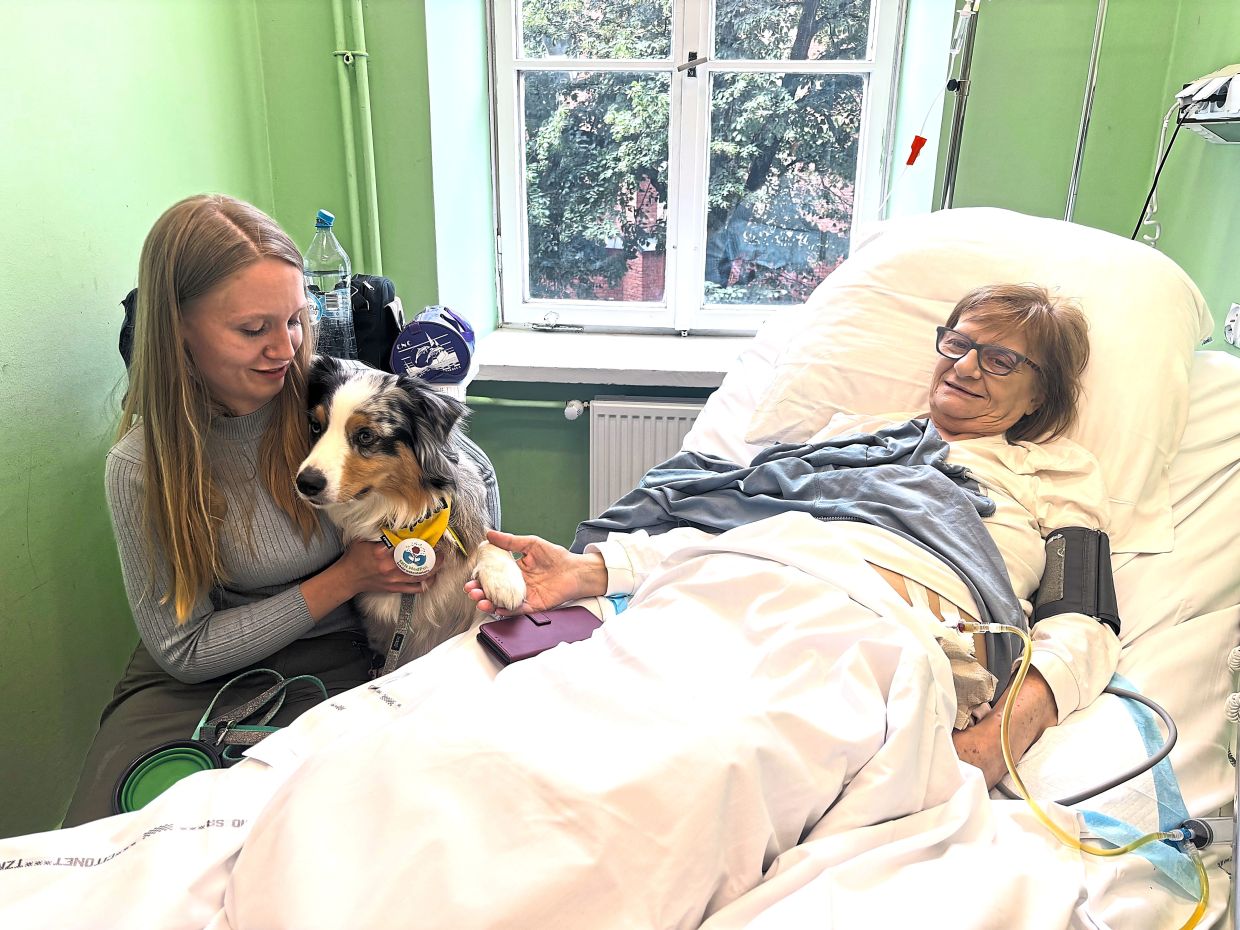
Therapy animals already operate within Dzierzanowski's clinic, with mixed-breed and specialised dogs like Kluska, an Australian shepherd, making regular rounds. During a recent visit, Kluska moved through the ward performing tricks and accepting affection from patients ranging from Lutka-Krawczyk, who gently held the dog's paw while smiling despite her physical decline, to Wojciech Zelik, a 58-year-old with a newly diagnosed tumour who summoned his remaining strength to sit upright and marvel at the animal's silken coat. The interactions, seemingly simple, represent genuine moments of human dignity and engagement for people confronting mortality.
The benefits of animal presence extend beyond patients themselves. Malgorzata Brzozowska, a medical student who volunteers as a therapy dog handler, notes that Kluska's visits substantially reduce stress among nursing staff, cooks, and other hospital workers who bear the emotional weight of caring for dying patients. Hospital workers crouched in corridors to pet Kluska, their burdens visibly lightened by brief moments of warmth and unconditional affection. Brzozowska emphasises that the therapeutic gains multiply exponentially when patients receive visits specifically from their own beloved companions rather than unfamiliar therapy animals.
When animals encounter their long-separated owners in hospital settings, the animals themselves demonstrate profound recognition and relief. Brzozowska interprets this canine response not as mere conditioning but as genuine awareness: the animal understands that its familiar human, who vanished from daily routine, has reappeared in an alien environment. The dog's reduced anxiety when reunited with its owner signals what ethologists increasingly confirm—animals possess emotional capacities and relational awareness that extend beyond simple stimulus-response. For patients, witnessing their pet's joy at reunion provides reassurance that the bond they have nurtured remains intact despite the machinery of medical intervention and institutional care.
The Polish legislative proposal carries implications that extend beyond individual hospital practices or national borders. As developed nations grapple with demographic ageing, social fragmentation, and the psychological consequences of institutional end-of-life care, the question of how to preserve human dignity and emotional sustenance becomes increasingly urgent. Pet ownership rates remain high across Europe and beyond, making animal companionship in final illness a relevant concern affecting millions. The Polish initiative suggests a broader recognition that palliative care must address not merely physical symptom management but the full spectrum of human and emotional needs as life concludes.
For Lutka-Krawczyk, the prospect of Gaja's visit represents more than a moment of therapeutic contact. It provides an anchor to her identity as a caregiver and nurturer, roles that persist even as her body fails. It affirms that the love she has invested in her animal companion remains meaningful and reciprocated. As the palliative medicine field increasingly embraces holistic approaches to end-of-life care, recognising the legitimacy of human-animal bonds appears less sentimental gesture than essential medical practice. Poland's proposed legislation codifies what Dzierzanowski has learned through practice: that ensuring no one dies alone sometimes requires opening hospital doors to the creatures that provide company when human companionship fails.

