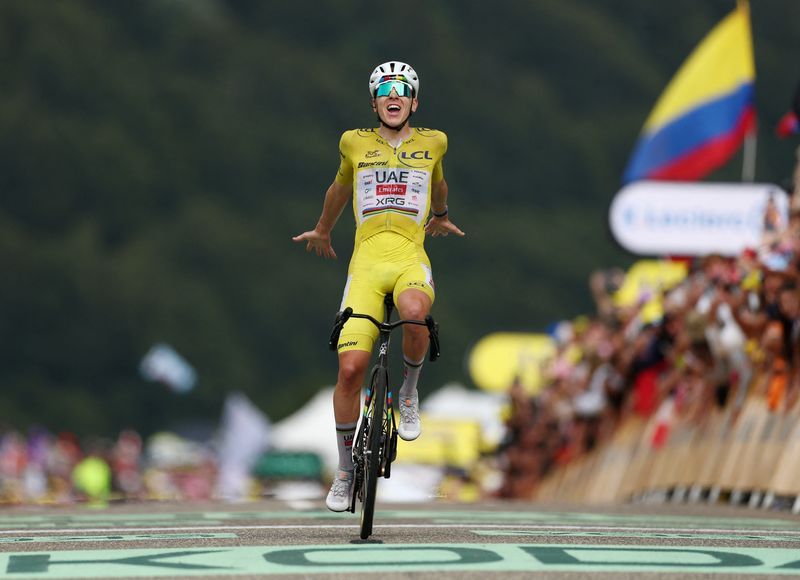
The 27-year-old Slovenian cyclist Tadej Pogacar delivered a masterclass in mountain riding on the 14th stage of the Tour de France, attacking decisively on the steepest section of the Col du Haag to claim a commanding solo victory on Saturday. The performance leaves Pogacar within touching distance of his third consecutive title, having built a commanding advantage of four minutes and 30 seconds over second-placed Jonas Vingegaard. Pogacar's fourth stage win this year underscores his dominance in this year's race and suggests that while the gruelling Alpine stages continue, the Slovenian's rivals face an increasingly uphill task to challenge his supremacy.
The 155.3-kilometre stage from Mulhouse to Le Markstein Fellering proved a crucible for endurance and tactical acumen, with three category one climbs testing the peloton's reserves across a mountain-heavy route that included treacherous wet conditions. Rainy weather descended on the descent from Col du Page, forcing riders to navigate slippery roads with heightened caution. These conditions, combined with the unforgiving gradients, separated the strongest climbers from the rest and created the environment in which Pogacar thrives.
Early in the stage, Frenchman Valentin Paret-Peintre of Soudal Quick-Step made his mark by reaching the summit of Grand Ballon first, narrowly ahead of Richard Carapaz, while the main peloton trailed by nearly two minutes. The initial breakaway swelled to include five riders, a threatening formation that prompted Pogacar's UAE Team Emirates squad to increase the pace and close the gap. However, the breaking riders proved persistent, building a three-minute advantage even as EF Education–EasyPost's Carapaz and Ben Healy recovered from a navigational error on the approach to Ballon d'Alsace.
The balance of power shifted decisively during the final and most decisive climb of the day. Paret-Peintre and Carapaz again crested Ballon d'Alsace first, but by the time the field embarked on the 11.2-kilometre ascent to Col du Haag, Pogacar's teammates had steadily whittled the break's advantage down to just 80 seconds. Carapaz launched an ambitious attack as the gradient intensified, with Norwegian Tobias Johannessen following, but the general classification contenders soon reeled them in as Pogacar positioned himself for the decisive move.
When the road steepened to a brutal 16 per cent gradient in the final two kilometres, Pogacar struck with the precision of an athlete operating at a different level. His acceleration proved immediately decisive, and he crested the summit with a 30-second buffer over his nearest rival. The Slovenian's performance over the final five kilometres to the finish line demonstrated his superior fitness, extending his advantage over second-place finisher Isaac del Toro to 38 seconds. Del Toro, Pogacar's own teammate, nonetheless consolidated a strong showing by passing compatriot Juan Ayuso to move fourth in the general classification.
Paul Seixas, the French favourite who benefited from home crowd support throughout the stage, rounded out the podium in third place, a creditable performance on terrain that demands both climbing prowess and mental fortitude. The presence of multiple riders from different teams on the stage honours reflects the competitive depth of this Tour, even as Pogacar's consistency at the front grows ever more apparent.
Pogacar's assessment of his own performance conveyed the confidence of a rider in command of the race. "A really perfect day, we marked this stage since the beginning. I know it very well, it is beautiful and an incredible place for cycling," he said, suggesting that his team's preparation and his own reconnaissance had paid dividends. The comment reflects the meticulous preparation required to succeed at cycling's highest level, where fractional gains in understanding course conditions and optimal pacing strategies compound into meaningful advantages.
Looking ahead, Pogacar acknowledged that Sunday's 15th stage from Champagnole to Plateau de Solaison presents a fresh examination of his rivals' resolve. The stage, another mountain-heavy challenge in the high Alps, could theoretically offer Jonas Vingegaard and other contenders an opportunity to trim Pogacar's lead, though the Slovenian's dominant display of climbing power and tactical acumen suggests he will prove difficult to dislodge. "Will be a hard day for us, but we will be ready to fight and see what will happen," Pogacar cautioned, indicating his respect for the challenge ahead while maintaining the bearing of a leader who expects to extend his advantage further.
For Southeast Asian cycling enthusiasts and Malaysian sports fans, Pogacar's Tour de France dominance mirrors the growing global appeal of cycling as a sport demanding extraordinary endurance, strategy, and individual resilience. The Tour remains one of sport's most demanding spectacles, and Pogacar's trajectory toward his third straight title positions him among the sport's all-time greats. His continued success invites comparison with historical champions and underscores the value of sustained excellence in professional sport, themes that resonate across all athletic disciplines and cultures.
With six stages remaining after Sunday's mountain test, Pogacar's lead appears commanding, though cycling history offers cautionary tales about overconfidence in the mountains. Vingegaard and others will search for opportunities to crack the Slovenian's armour, but Saturday's display suggested that such opportunities may remain elusive. The race continues, yet Pogacar's fourth stage victory and expanding overall advantage suggest that the question of this year's champion has been substantially answered, barring unforeseen mechanical misfortune or loss of form.

