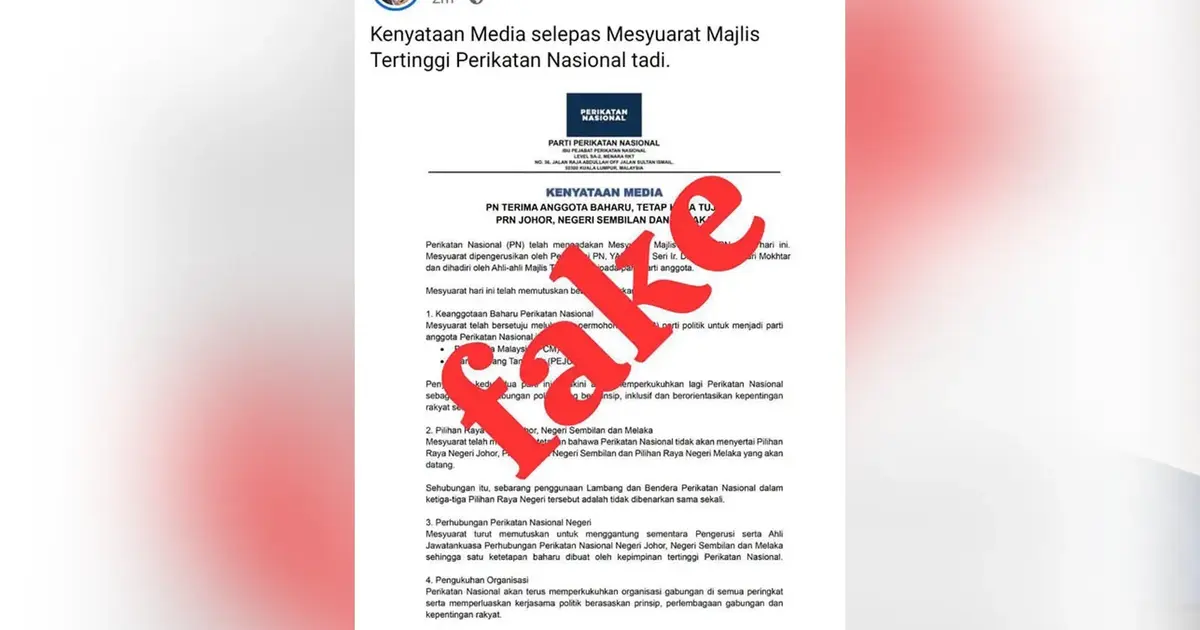
Perikatan Nasional has moved swiftly to refute a statement circulating widely suggesting the opposition coalition plans to abstain from participating in three forthcoming state elections. The coalition's leadership has characterised these allegations as entirely inaccurate and urged the public to disregard what they describe as deliberate misinformation designed to undermine their political standing.
The emergence of such claims underscores the intensifying information warfare that has become a defining feature of Malaysian electoral politics. With state polls potentially approaching and national elections on the horizon, opposition coalitions face mounting pressure from accusations regarding their electoral strategies and commitment to democratic participation. For PN, which has been rebuilding its political base following electoral setbacks and internal reorganisation, such allegations strike at the heart of its credibility as a viable governing alternative.
The denial carries particular weight given Malaysia's complex political landscape, where voter confidence in coalition stability and unity remains critical to electoral performance. PN's swift and unambiguous response indicates the coalition views such misinformation as a significant threat that demands immediate correction. The incident demonstrates how rapidly false narratives can spread through digital channels, potentially influencing voter perception before facts can be established.
For Malaysian voters attempting to navigate claims and counterclaims, the proliferation of unverified political statements creates genuine challenges in assessing the authenticity of information. The anonymous or poorly-sourced nature of such allegations makes verification difficult, yet their circulation on social media platforms can generate substantial reach before being addressed. This dynamic has become increasingly problematic during election cycles, when accurate information about candidates' positions and party strategies becomes essential to informed voting.
The broader context reveals how opposition coalitions like PN operate under heightened scrutiny regarding their electoral intentions. Electoral boycotts carry significant political implications—they can signal weakness, internal division, or strategic miscalculation. Conversely, full participation demonstrates commitment to democratic competition and suggests confidence in electoral prospects. PN's categorical rejection of boycott allegations thus represents an effort to project unity and determination heading into potentially decisive electoral contests.
For Southeast Asian observers tracking Malaysian politics, such incidents reflect wider regional patterns of intensifying political competition and contested information environments. Across the region, opposition movements frequently contend with allegations designed to question their viability and commitment to democratic processes. PN's experience mirrors broader challenges facing opposition coalitions attempting to establish themselves as credible alternatives to incumbent governments while managing communications in an increasingly fragmented media landscape.
The timing of such claims also warrants attention, as they emerge within a calendar year that may see multiple state elections occurring in succession. Multiple state ballots could significantly reshape the political landscape, redistributing legislative power and potentially strengthening whichever coalition demonstrates superior organisation and voter appeal. For PN, which entered recent state elections with mixed results, the stakes surrounding participation and performance in upcoming contests remain genuinely high.
Political analysts note that PN has made deliberate efforts to consolidate its position as a unified opposition force capable of offering clear policy alternatives. Allegations of boycott plans contradict this messaging and potentially sow doubt among supporters regarding the coalition's seriousness. The coalition's vigorous denial therefore serves multiple purposes: clarifying electoral intentions, reaffirming commitment to democratic participation, and countering what PN characterises as hostile misinformation.
The incident also raises questions about information governance and the responsibility of platforms distributing political content. As false statements spread increasingly rapidly, mechanisms for rapid clarification and fact-checking become more essential. Malaysian voters deserve reliable information about parties' genuine positions and intentions, yet distinguishing authoritative statements from fabrications grows progressively more challenging.
Moving forward, PN faces the ongoing challenge of communicating directly with voters while managing digital communications environments where misinformation circulates prolifically. The coalition's response to this particular set of allegations demonstrates awareness of reputation management's importance during electoral periods. Whether such denials sufficiently counter false narratives remains uncertain, however, as social media dynamics often favour sensational claims over careful corrections.
For Malaysian politics more broadly, incidents like this underscore the necessity for clearer standards around political communication and greater transparency regarding coalition strategies and electoral intentions. As multiple elections potentially loom, establishing factual baselines about which parties genuinely intend to participate becomes increasingly important. Voters navigating electoral choices deserve clarity based on demonstrable facts rather than unverified allegations that may be designed primarily to confuse and mislead.