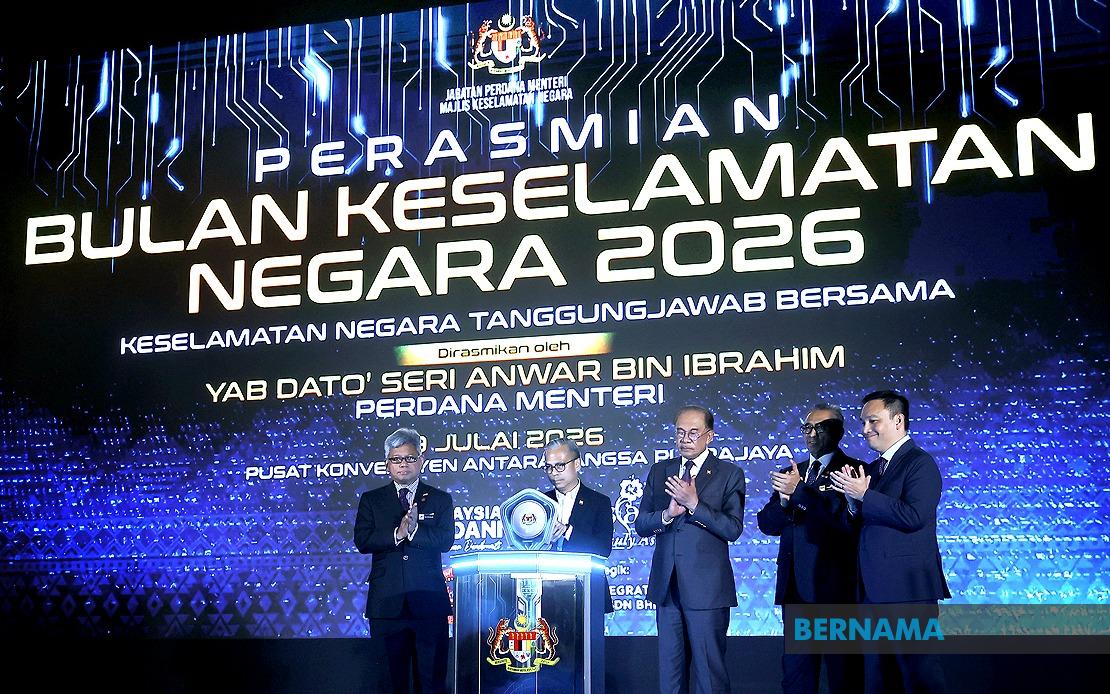
Prime Minister Datuk Seri Anwar Ibrahim has sounded an alarm over the continued weaponization of identity politics in Malaysia, cautioning that preoccupation with divisive narratives risks undermining the country's security posture at a time when threats have become far more sophisticated and multifaceted. Speaking at the launch of National Security Month 2026 in Putrajaya on July 9, Anwar expressed frustration that political discourse continues to revolve around traditional fault lines—race, religion, and regional interests—rather than confronting the complex security challenges that pose tangible risks to Malaysian citizens and national stability.
The Prime Minister's remarks reflect a broader strategic concern that domestic political divisions are creating vulnerabilities precisely when the country faces mounting external and internal security pressures. Anwar pointedly noted that colleagues in parliamentary debates persist in revisiting longstanding identity-based grievances, a pattern he views as counterproductive given the magnitude of emerging threats. This observation carries particular weight given Malaysia's position in Southeast Asia, where transnational security challenges, including organized crime, terrorism, and cyber-enabled extremism, operate across borders and exploit social fractures.
Among the security challenges Anwar highlighted are technological and digital threats, categories that have grown exponentially in scope and sophistication over the past decade. Malaysia has experienced increasing incidents of state-sponsored cyberattacks, ransomware targeting critical infrastructure, and coordinated disinformation campaigns designed to amplify social divisions. The emphasis on digital threats suggests the government views the information ecosystem as a strategic battleground where adversaries can exploit existing societal tensions to destabilize the nation without resorting to conventional military or security operations.
Anwar's intervention also underscores a leadership position that prioritizes national cohesion and institutional capability over sectarian advantage. By framing identity politics as a distraction from genuine security imperatives, the Prime Minister is attempting to reorient the political conversation toward problems that transcend traditional demographic or ideological boundaries. This approach, however, carries its own political risks, as it may be perceived by some constituencies as marginalizing their concerns or suggesting that efforts to address historical injustices are secondary to technocratic governance.
The gathering in Putrajaya included senior government figures such as Communications Minister Datuk Fahmi Fadzil, Chief Secretary to the Government Tan Sri Shamsul Azri Abu Bakar, and National Security director-general Datuk Raja Nurshirwan Zainal Abidin, signalling that the security focus commands high-level institutional attention. The presence of the Communications Minister is particularly noteworthy, suggesting that information management and counter-narratives are viewed as integral to the government's security strategy, particularly in countering disinformation and managing public perception during crises.
Anwar stressed that leaders across government departments, agencies, and ministries must adopt a proactive rather than reactive posture toward emerging security challenges. This call for institutional agility reflects recognition that bureaucratic procedures designed for conventional governance may be inadequate for threats that evolve rapidly and exploit technological change. The implicit criticism is that waiting for threats to fully materialize before responding is strategically unwise; instead, governments must anticipate threats, develop adaptive capacity, and equip personnel with knowledge of emerging technologies and their security implications.
The characterization of security management as a leadership responsibility distinct from routine administration is significant. Anwar's statement that this "is not routine bureaucracy" suggests frustration with institutional inertia and departmental silos that may hinder coordinated responses to cross-cutting security challenges. For Malaysia, where security threats increasingly involve cyber-enabled operations, transnational criminal networks, and information warfare, such institutional barriers can significantly degrade the country's defensive capability.
For Malaysian readers and regional observers, Anwar's remarks reflect a tension inherent in contemporary governance: the need to maintain social cohesion and address historical grievances while simultaneously mobilizing resources to counter threats that operate at unprecedented speed and scale. Southeast Asia as a region faces similar challenges, with competing powers vying for influence, non-state actors exploiting ungoverned spaces, and digital technologies enabling asymmetric forms of attack. The Prime Minister's message that sectarian distraction weakens collective defence resonates across the region.
The broader implication of Anwar's intervention is that Malaysia's security strategy must evolve beyond traditional approaches centered on military capability and law enforcement. Success requires a whole-of-society response in which political leaders, business, civil society, and the public recognize shared vulnerability and act in concert. This demands a level of political consensus that can be difficult to achieve in democracies where contestation over identity and representation is deeply embedded in electoral competition and historical memory.
Anwar's framing also carries an implicit critique of opposition political movements and media actors who may leverage identity-based narratives for partisan gain. By positioning such rhetoric as objectively harmful to national security, the Prime Minister is attempting to delegitimize opposition strategies while simultaneously elevating his government's focus on institutional modernization and forward-looking governance. Whether this rhetorical strategy succeeds in reorienting political discourse remains uncertain, particularly given the deep roots of identity-based politics in Malaysia's history and the legitimate interests various communities have in ensuring their voices are heard in the political process.

