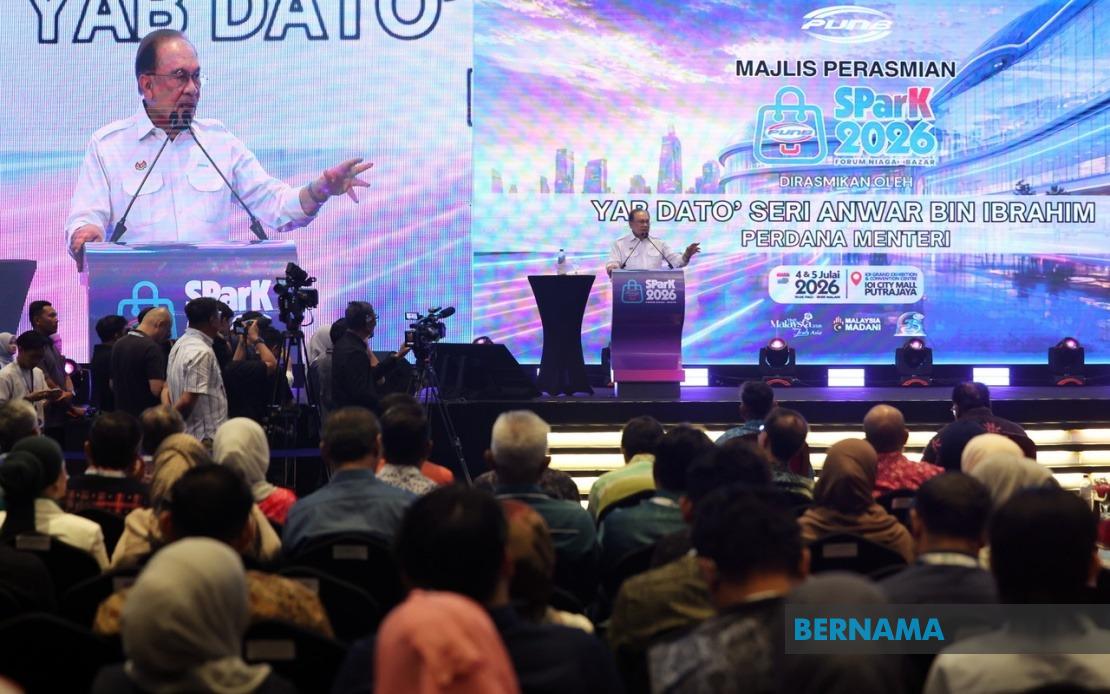
Prime Minister Datuk Seri Anwar Ibrahim has launched a forceful push to dismantle what he characterises as a deeply entrenched culture of favouritism in government-backed business financing. Speaking at the SPaRK 2026 entrepreneurship initiative organised by Perbadanan Ushahan Nasional Bhd (PUNB) in Putrajaya, Anwar, who concurrently holds the Finance portfolio, declared that the reliance on support letters, personal connections, and political patronage to secure loans must cease immediately.
The Prime Minister's intervention signals mounting frustration with systemic inefficiencies that have plagued Malaysia's business support ecosystem for decades. He characterised the existing apparatus as a mechanism that protects poorly-performing government bodies rather than genuinely nurturing entrepreneurship. The practice of awarding financing based on political alignment—what Anwar dismissively described as "yellow, green, blue letters"—represents a fundamental misallocation of public resources that directly contradicts the government's stated objectives of economic development and poverty alleviation.
Anwar acknowledged that some business failures are inevitable given shifting market conditions and broader economic headwinds beyond any entrepreneur's control. However, he drew a sharp distinction between failures stemming from external economic forces and those resulting from a lack of genuine commitment or capability. What the government refuses to accept, he emphasised, are instances where public funds fail to achieve their intended purpose due to mismanagement or misuse by recipients who view government assistance as a lifestyle upgrade rather than a business catalyst.
Documented cases have emerged of entrepreneurs who diverted government loans toward personal consumption rather than genuine business investment. Some recipients have relocated to premium office spaces and acquired expensive vehicles shortly after receiving disbursements, only to see their ventures collapse within months. Such outcomes represent not merely poor investment decisions but a fundamental breach of the implicit contract between government agencies and loan recipients—that public money will be deployed with transparency and serious intent toward sustainable enterprise creation.
The Prime Minister's remarks underscore a broader governance challenge facing Malaysia's administration. The machinery for distributing business financing has, over successive decades, accumulated layers of bureaucratic procedure and informal decision-making networks that often prioritise political calculations over economic merit. Breaking these entrenched patterns requires not just rhetorical commitment but concrete institutional reform, including revised assessment criteria, independent evaluation mechanisms, and accountability frameworks that punish both corrupt officials and duplicitous recipients.
For Malaysian entrepreneurs seeking financing through official channels, Anwar's statement carries significant implications. It signals that the government intends to tighten approval processes and emphasise substantive business plans over political credentials. This shift could disadvantage well-connected applicants who previously relied on informal networks but may ultimately benefit genuinely capable entrepreneurs whose proposals were previously overlooked due to lack of political patronage. The recalibration represents a potential democratisation of access to government-backed capital.
The SPaRK 2026 initiative itself reflects this reorientation. The Perbadanan Ushahan Nasional Bhd initiative aims to cultivate a new generation of entrepreneurs equipped with modern business acumen and realistic growth prospects. By coupling such capacity-building programmes with stricter lending criteria, the government theoretically creates conditions where only serious, well-prepared entrepreneurs advance to the financing stage—reducing default rates and improving the overall return on public investment.
Southeast Asian observers will recognise these challenges as endemic across the region. Many developing economies struggle with balancing political imperatives against economic efficiency in state-directed lending programmes. Malaysia's particular problem—the institutionalisation of cronyism through ostensibly legitimate support letter mechanisms—represents a sophisticated version of patronage that masks its political nature within bureaucratic language. Anwar's explicit naming of this practice as destructive marks a departure from previous administrations' tendency toward opacity on such matters.
Implementing change will require sustained pressure from the Finance Ministry on lending agencies, training of loan officers in merit-based assessment, and potentially, public reporting of approval criteria and success metrics. Without such mechanisms, the Prime Minister's declaration risks remaining aspirational rhetoric rather than catalysing genuine structural reform. The test will lie in whether government financing approvals for small and medium-sized enterprises genuinely shift toward evidence-based decision-making or revert to familiar patterns of accommodation and favour once media attention fades.
For Malaysia's broader economic trajectory, the stakes are substantial. Small business creation drives employment and distributes economic opportunities beyond major urban centres and established corporate networks. When financing for these ventures flows based on political connection rather than business viability, the economy loses potentially valuable enterprises while propping up doomed ventures connected to politically favoured individuals. Conversely, a transparent, merit-based system could unlock latent entrepreneurial talent currently locked out of formal financing channels, potentially accelerating employment growth and income distribution improvements across the country.

