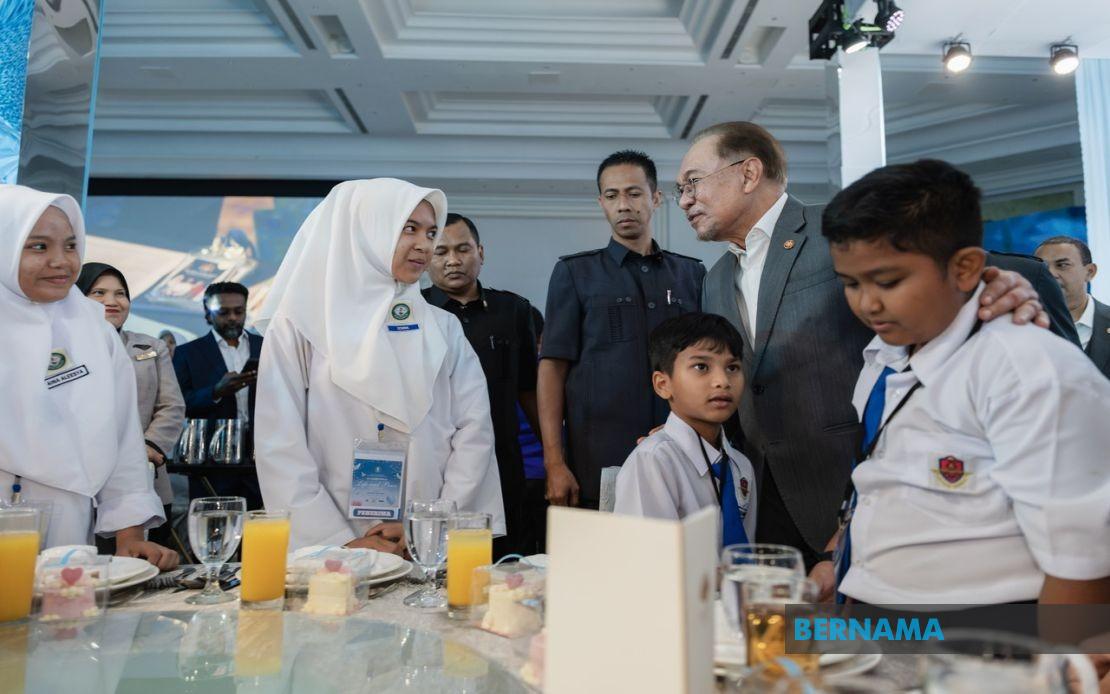
Prime Minister Datuk Seri Anwar Ibrahim has underscored a fundamental message about education and childhood development: that intellectual prowess divorced from moral virtue represents an incomplete and potentially dangerous foundation for young lives. Speaking before 700 pupils representing 47 schools across Kuala Lumpur and Putrajaya at a "Celebration of Life and Peace" event, Anwar challenged conventional notions that academic success alone should be the primary measure of a child's development.
The Prime Minister's remarks reflected growing concern about the trajectory of youth behaviour in Malaysian schools. Anwar drew a stark contrast between two possible outcomes: students who excel academically yet engage in destructive conduct, versus those who balance intellectual growth with emotional maturity and social responsibility. He posed a direct question to the assembled children about the true purpose of schooling, suggesting it extends far beyond the acquisition of knowledge or the pursuit of grades. Instead, he framed education as a transformative process aimed at developing individuals who contribute positively to their communities and treat others with dignity.
Bullying emerged as a particular focus of the Prime Minister's message, identified as a behaviour pattern that threatens to undermine not only the immediate well-being of victims but also the long-term prospects of perpetrators. Rather than treating bullying as a minor disciplinary matter, Anwar positioned it as a serious concern that could jeopardise the futures of those involved. This framing resonates with international research demonstrating the lasting psychological and developmental consequences of both experiencing and perpetrating bullying behaviour during formative years.
Anwar's call to action extended beyond children themselves to encompass parents and educators as critical stakeholders in character formation. He explicitly invited parents and teachers to recognise their roles as architects of a generation's values and behaviour patterns. This shared responsibility model acknowledges that schooling outcomes depend not solely on institutional policies but on a collaborative ecosystem where home, school, and community reinforce common principles. The emphasis on parental involvement reflects recognition that children spend substantial portions of their lives outside classrooms, where family influence shapes attitudes and choices.
The emotional appeal to children directly—addressing them as "grandpa"—attempted to establish personal connection and authenticity rather than relying on authoritarian diktat. Anwar's request for a promise to study hard, respect teachers, and care for parents represented a holistic vision of personal development that integrates academic pursuits with filial duty and institutional respect. This multidimensional approach to character contrasts with narrower frameworks focused exclusively on examination results or workforce readiness.
The event itself, organised by the ERM Foundation, provided an opportunity to celebrate childhood while drawing attention to inequities in access to such celebrations. Foundation founder Xin'er highlighted that not all children enjoy comparable birthday experiences, with some facing illness, poverty, or other challenges that constrain opportunities for joyful acknowledgment of milestones. By bringing together schoolchildren from diverse backgrounds and providing tangible support—each child received RM500 in cash assistance alongside meals and entertainment—the programme embodied the values of compassion and inclusivity that Anwar had articulated.
Attendance by Anwar's wife, Datuk Seri Dr Wan Azizah Wan Ismail, and political secretary Datuk Azman Abidin signalled high-level commitment to the occasion, suggesting the government views such initiatives as integral to its social agenda rather than peripheral feel-good exercises. The presence of multiple senior figures reinforced the message that character development and child welfare command attention at the highest echelons of leadership.
Xin'er's vision of children growing up "peacefully, without war or illness, and to always have happy birthdays while receiving more than just presents" articulated an aspirational but achievable goal: creating conditions where material security combines with emotional nourishment. This framing acknowledges that childhood flourishing requires both tangible support and intangible elements like peace, security, and affirmation. The insistence that celebrations should transcend commercial gift-giving signals resistance to materialistic values that increasingly dominate childhood experiences in urbanising societies.
For Malaysia specifically, where concerns about youth delinquency, academic pressure, and mental health challenges have intensified in recent years, the Prime Minister's emphasis carries particular relevance. The nation has documented rising incidents of school violence and bullying, often amplified through social media platforms that expand both reach and consequences. Policy discussions have focused increasingly on preventative approaches that address root causes rather than purely punitive responses to misconduct.
The multi-school representation at the event—drawing participants from 47 institutions across two federal territories—suggests an attempt to disseminate these messages broadly across socioeconomically diverse student populations. This inclusive approach recognises that bullying and character deficits transcend class boundaries and that dialogue about values requires engagement across educational and demographic divides.
Anwar's remarks also implicitly address concerns among Malaysian educators and parents about tensions between competitive academic systems and holistic child development. The globalised economy creates pressure on students to achieve measurable academic metrics, yet growing evidence indicates that emotional intelligence, resilience, and interpersonal skills prove equally determinative of life outcomes. By publicly elevating the importance of kindness and respectfulness alongside intellectual achievement, Anwar provided political cover for educators seeking to rebalance curricula and assessment approaches.
Moving forward, the challenge lies in translating rhetorical commitment into systemic change. While statements by national leaders set tone and priorities, sustained improvement in school culture requires comprehensive approaches incorporating teacher training, anti-bullying programmes with enforcement mechanisms, mental health support systems, and parental education initiatives. The celebration event demonstrated symbolic commitment, but lasting impact depends on whether such rhetoric translates into resource allocation and policy implementation across Malaysia's diverse school system.

