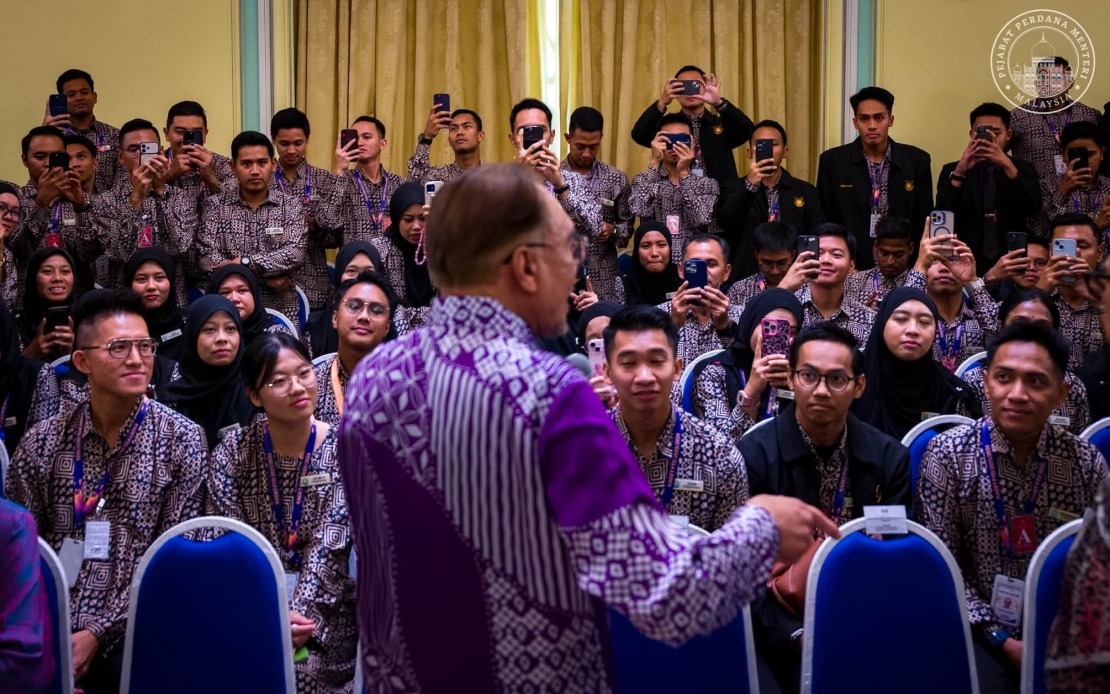
Prime Minister Datuk Seri Anwar Ibrahim has stressed that Malaysia's civil service faces a critical juncture requiring leaders who can navigate modernisation while maintaining the moral compass that defines public duty. Speaking at his Putrajaya office during a meeting with Administrative and Diplomatic Service (PTD) officer cadets undertaking the Postgraduate Diploma in Public Management programme, Anwar outlined a vision of public service rooted in integrity, operational excellence, and a genuine commitment to national interests over institutional or personal advancement.
The gathering represented a significant moment for the nation's emerging administrative elite. PTD officers form the backbone of Malaysia's federal bureaucracy, occupying senior positions across government departments and agencies. Anwar's direct engagement with this cohort signals recognition that foundational attitudes adopted early in a civil servant's career often shape their entire professional trajectory and influence the institutions they subsequently lead. By addressing these cadets before they assume substantive postings, the Prime Minister sought to imprint a leadership philosophy on those who will shape policy implementation and departmental culture for decades.
Anwar's emphasis on embracing change reflects broader tensions within Malaysia's public service. The civil service, despite its institutional strengths, has faced criticism for resistance to innovation, siloed thinking, and adherence to outdated operational models. Digital transformation, management flexibility, and responsive decision-making remain areas where Malaysian government agencies lag comparable regional peers. The Prime Minister's message acknowledges that structural and procedural reform cannot succeed without personnel willing to challenge established conventions and experiment with fresh approaches to persistent problems.
The integrity dimension carries particular weight in Malaysia's current political context. Public confidence in governmental institutions, though recovering, remains fragile following years of scandal and institutional mismanagement. Anwar's repeated invocation of ethical standards serves both as practical instruction and as a corrective statement about expected conduct. For PTD officers who will handle sensitive policy matters, manage substantial budgets, and influence regulatory decisions, the message reinforces that professional advancement depends fundamentally on uncompromising honesty rather than political loyalty or patronage networks.
Efficiency, the third pillar of Anwar's address, represents an often-overlooked dimension of public sector reform. Malaysian civil servants frequently operate within institutional frameworks designed decades ago, with procedural redundancies, unclear accountability lines, and communication bottlenecks that frustrate both public and private interactions with government. The Prime Minister's emphasis suggests that capability extends beyond technical competence to encompass streamlined processes, resource management discipline, and outcomes-focused planning that increasingly characterises higher-performing public administrations in the region.
Anwar's articulation of putting national and popular interests above institutional or personal advancement constitutes a deliberate reframing of public service motivation. Traditional Malaysian civil service culture sometimes emphasised departmental loyalty, hierarchical deference, and career progression within specialised silos. This framework, while producing stability, sometimes produced decisions that prioritised bureaucratic convenience over citizen welfare. By explicitly centering national interest in his remarks, Anwar repositioned public service as fundamentally a social contract wherein officials exercise power on behalf of the populace, not in pursuit of institutional aggrandisement.
The connection between capable, principled leadership in the civil service and Malaysia's broader developmental goals forms the conceptual through-line of Anwar's message. Democratic governance ultimately depends on non-partisan institutions staffed by professionals committed to implementing policy fairly regardless of which political party holds executive power. A civil service captured by partisan interests, riddled with corruption, or resistant to necessary reform becomes a drag on national progress regardless of political leadership quality. Conversely, professional bureaucrats with ethical anchors enable policy continuity and institutional stability.
For Malaysia specifically, the timing of such emphasis carries significance. The country faces multiple simultaneous challenges requiring sophisticated policy responses: economic competitiveness pressures as regional manufacturing bases shift, demographic changes requiring recalibrated social provision, climate adaptation demands, and digital infrastructure development. These challenges demand a civil service capable of evidence-based analysis, cross-sectoral collaboration, and implementation flexibility. Officers shaped by Anwar's articulated values would presumably bring such capabilities.
The message also resonates with Southeast Asian governance trends more broadly. Across the region, administrations grapple with how to modernise public sectors while maintaining institutional integrity and avoiding the personalisation of power that has destabilised governance in some jurisdictions. Malaysia's experience, including periods of institutional capture, offers cautionary context. Anwar's emphasis on embedding integrity and change-capacity into emerging leadership cohorts represents an attempt to institutionalise governance improvements rather than relying on individual leaders' virtue.
PTD cadets themselves represent a filtered cohort selected through competitive national recruitment. That they undergo postgraduate training in public management before assuming substantive roles reflects recognition that technical expertise and educational credentials require supplementation through exposure to contemporary management philosophy and ethical frameworks. Anwar's direct address to this cohort complements their formal training, providing explicit endorsement of values that shape how academic learning translates into professional practice.
The broader institutional implication of Anwar's remarks extends to departmental cultures and management systems. Individual integrity and capacity, though essential, function most effectively within organisations structured to reward ethical behaviour, facilitate adaptation, and align individual advancement with institutional effectiveness. Whether Malaysia's civil service possesses such enabling structures remains an ongoing question, particularly regarding whistleblower protections, merit-based promotion systems, and management frameworks that encourage calculated risk-taking rather than defensive caution.
Looking forward, the test of such messaging lies in implementation. Inspiring words from political leadership require translation into concrete policies affecting recruitment, training, promotion, accountability, and resource allocation. Whether the PTD cadets addressed by Anwar encounter institutional environments that genuinely reward the integrity and reform-mindedness he advocates will largely determine whether such exhortations catalyse substantive change or remain rhetorical flourishes.

