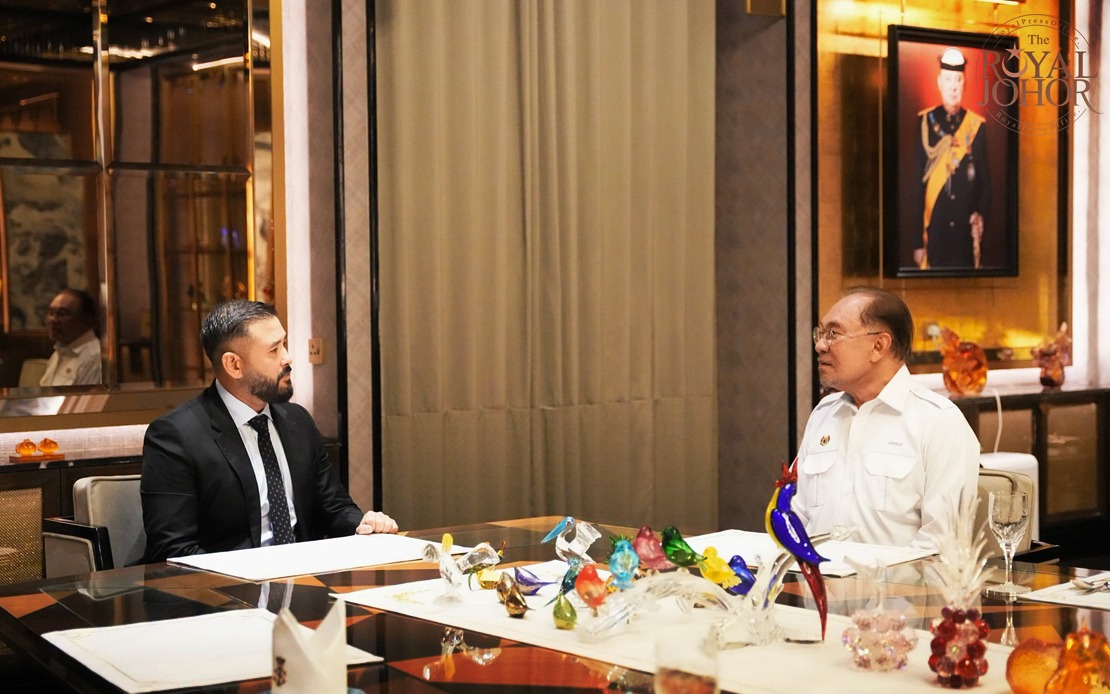
Prime Minister Datuk Seri Anwar Ibrahim has conveyed his appreciation to the Regent of Johor, Tunku Mahkota Ismail, for receiving him in Kuala Lumpur and extending a gesture of goodwill. The remarks came during an event in Tangkak where the federal administration unveiled its slate of candidates for the 16th Johor state election, signalling a broader message about the appropriate boundaries between the monarchy and electoral politics in Malaysia's constitutional framework.
Anwar used the occasion to emphasise a principle he considers fundamental to Malaysia's stability: political parties must refrain from entangling the royal institution in campaign activities. The Prime Minister's comments appeared directed at rivals who, he suggested, invoke the names of the Agong and state rulers while shying away from direct political confrontation. This observation underscores a longstanding tension in Malaysian politics between respect for constitutional monarchy and the sometimes-blurred lines during competitive electoral periods, when all sides seek legitimacy and popular support.
During his audience with Tunku Mahkota Ismail, Anwar seized the opportunity to brief the Regent on federal development initiatives benefiting Johor's population. Such engagements serve multiple purposes in Malaysia's political culture: they reaffirm the government's commitment to consulting the Rulers on matters of state, demonstrate respect for traditional authority structures, and provide a platform for explaining policy directions to stakeholders who command significant public deference. The fact that Anwar accepted the invitation and publicised the meeting signals confidence in his relationship with Johor's leadership hierarchy.
The Prime Minister articulated a broader governing philosophy regarding his administration's relationship with Malaysia's nine Rulers and the constitutional monarchy. Pakatan Harapan, as the party controlling the federal government, has committed itself to fostering robust partnerships with the Malay Rulers while remaining receptive to their counsel, criticism, and direction. This stance reflects a recognition that, despite the government's electoral mandate, the Rulers occupy a separate constitutional sphere commanding respect and consultation on matters touching on Islam, Malay rights, and state interests.
Anwar elaborated on the nature of these interactions, acknowledging that dialogue with the Rulers does not always result in unanimous positions. He explained that officials and the Rulers sometimes hold differing viewpoints, exchange counterarguments, and engage in principled disagreement. However, the crucial distinction lies in how such differences are managed: through respectful consultation, formal audience-seeking, and transparent explanation rather than public confrontation or political manipulation. This approach aims to preserve institutional harmony while allowing the government operational space to implement its agenda.
The same deference applies to His Majesty Sultan Ibrahim, the King of Malaysia, whose constitutional role encompasses national oversight and advisory functions. Anwar indicated that his administration welcomes royal perspectives, presents its own counter-views when warranted, and takes royal counsel seriously. This pattern of mutual engagement, he suggested, characterises the mature relationship between a democratically elected government and a constitutional monarchy—one in which both institutions acknowledge the other's legitimacy and sphere of authority.
Anwar's insistence on maintaining clear separation between the monarchy and partisan electoral campaigns reflects concerns about the weaponisation of royal institutions in competitive politics. When parties invoke the names of Rulers or the Agong without substantive policy grounding, they risk diminishing the monarchy's neutral constitutional standing and dragging it into the divisive arena of electoral contest. Malaysia's stability, he implied, depends on preserving the monarchy as a unifying rather than divisive symbol—a position transcending particular governments or coalitions.
The Pakatan Harapan leadership delegation present at the Tangkak event, including DAP secretary-general Anthony Loke Siew Fook and Amanah president Datuk Seri Mohamad Sabu, underscored the coalition's united messaging on this issue. The diverse political composition of Pakatan Harapan means that coordination on matters touching the monarchy becomes even more critical, as it spans secular and Islamist-oriented parties that must nonetheless present unified respect for constitutional institutions.
For Johor specifically, maintaining harmonious relations with the Regent and Sultan assumes particular importance given the state's political competitiveness and its historical significance as a traditional Malay heartland. The 16th Johor state election remains a closely watched contest, with the federal government eager to consolidate support in what has traditionally been contested territory. Anwar's public acknowledgement of his meeting with Tunku Mahkota Ismail serves partly to signal that Pakatan Harapan enjoys royal confidence and operates within the boundaries of constitutional propriety.
The broader implication of Anwar's remarks extends to other Malaysian states where provincial rulers wield considerable influence. Penang, Selangor, and Pahang—among others—house strong sultanates whose relationships with the federal government significantly shape political dynamics. By articulating a philosophy of consultation, respect for royal prerogatives, and principled separation from electoral contests, the Prime Minister attempts to set a standard that other parties, too, should follow during campaign periods.
Malaysia's constitutional balance hinges partly on unwritten conventions about how elected officials interact with hereditary institutions. Anwar's emphasis on these conventions—accepting audiences, seeking counsel, consulting on policy, and resisting the temptation to exploit royal prestige for partisan gain—reflects a mature understanding of how constitutional monarchy and democratic governance can coexist. His gratitude toward Tunku Mahkota Ismail was thus more than a courtesy; it exemplified the mode of engagement he believes should define Malaysian politics during competitive electoral phases.