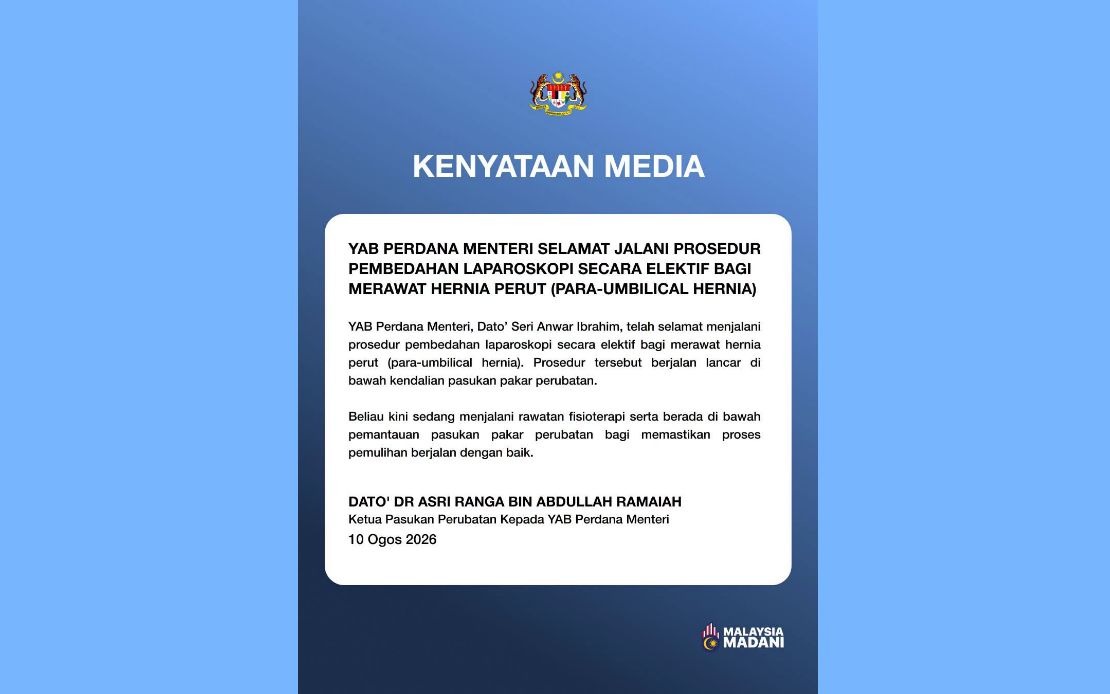
Prime Minister Datuk Seri Anwar Ibrahim has successfully completed an elective laparoscopic surgical procedure to address a para-umbilical abdominal hernia, with his medical team confirming the operation proceeded without complications on August 10. The minimally invasive intervention marks a routine medical intervention for the nation's leader, who continues to maintain his governing responsibilities despite the scheduled procedure. The surgical team's decision to employ laparoscopic techniques reflects contemporary medical practice, reducing recovery time and post-operative discomfort compared to traditional open surgery approaches.
According to Datuk Dr Asri Ranga Abdullah Ramaiah, who leads the Prime Minister's Medical Team, the operation unfolded smoothly under the direction of multiple medical specialists coordinating their expertise throughout the procedure. The coordinated approach to Anwar's care demonstrates the comprehensive medical infrastructure available to the Prime Minister, encompassing various surgical and post-operative disciplines. Such medical oversight remains standard practice for heads of government worldwide, ensuring continuity of leadership and rapid response to any unforeseen complications.
Following the surgical intervention, Anwar has embarked upon a structured physiotherapy regimen designed to facilitate optimal recovery and restore his full functional capacity. The post-operative rehabilitation process represents a critical phase in his recuperation, with targeted exercises and supervised activities accelerating his return to normal activities. Medical specialists continue monitoring his progress through regular assessments, documenting his advancement through established recovery benchmarks that typically follow laparoscopic procedures of this nature.
The Prime Minister remains hospitalised under the intensive observation of his specialist medical team, with official communications indicating an anticipated two-day monitoring period. This observation window allows physicians to detect any delayed complications and adjust pain management or rehabilitation protocols as necessary. During this period, routine vital sign checks, imaging assessments, and wound inspections occur at regular intervals to ensure optimal healing and identify any deviation from expected recovery trajectories.
The public announcement regarding Anwar's medical condition represents a significant aspect of governmental transparency, particularly concerning the health and operational capacity of the nation's chief executive. In contemporary governance, periodic disclosure of leaders' medical statuses maintains public confidence in institutional continuity and demonstrates commitment to democratic principles of informed citizenry. The measured communication from the Prime Minister's office balances legitimate public interest with appropriate privacy considerations regarding personal medical information.
Tunku Nashrul Abaidah, serving as the Prime Minister's senior press secretary, characterised the upcoming procedures and examinations as prescribed components of the specialist medical team's comprehensive care protocol. The carefully coordinated messaging emanating from the Prime Minister's office sought to assure Malaysians of Anwar's medical competence while avoiding unnecessary speculation or concern regarding his fitness for office. Such communications exemplify the delicate equilibrium between transparency and maintaining public confidence during a leader's temporary medical incapacity.
The invitation for public prayers on behalf of the Prime Minister's recovery reflects the substantial role faith plays within Malaysian society, cutting across demographic and religious boundaries. This acknowledgment of spiritual dimensions to healing incorporates cultural values deeply embedded within Malaysian identity and demonstrates governmental respect for citizens' diverse approaches to supporting their leader's wellbeing. The framing of medical recovery within broader spiritual contexts resonates with Malaysian traditions of collective concern for national figures during vulnerable periods.
The para-umbilical hernia, which medical specialists identified and scheduled for elective intervention, represents a relatively common abdominal condition affecting individuals across age groups and occupational backgrounds. Unlike emergency hernia presentations requiring urgent intervention, the elective classification of Anwar's procedure allowed comprehensive pre-operative planning and optimal timing from both medical and governmental continuity perspectives. The choice of elective over emergency surgery typically results in superior outcomes and significantly reduced complication rates, reflecting the early detection and appropriate medical management of his condition.
For Malaysia and the broader Southeast Asian region, Anwar's medical situation underscores the importance of maintaining robust leadership succession frameworks and contingency planning during periods when heads of government undergo medical treatment. Democratic institutions function most effectively when established protocols address temporary leadership absences, ensuring governmental operations continue seamlessly while primary executives recover. This episode reinforces conversations within Malaysian governance structures about institutional resilience and the mechanisms supporting continuity during foreseeable but temporary disruptions to executive leadership.
The laparoscopic surgical technique employed in Anwar's procedure represents modern medical practice increasingly adopted throughout Malaysian healthcare systems, including both public and private facilities. The minimally invasive approach, requiring only small incisions through which specialised instruments and cameras access the surgical field, contrasts with traditional open surgery methods demanding larger incisions and extended recovery periods. This advancement in surgical technology demonstrates Malaysia's integration into global medical progress, with trained specialists applying sophisticated techniques to improve patient outcomes regardless of professional status.
Anwar's anticipated resumption of full prime ministerial duties in the near future reflects confidence within medical circles regarding successful hernia repair and expedited recovery trajectories associated with laparoscopic interventions. The governmental continuity implied by this timeline suggests minimal disruption to Malaysia's administrative apparatus, with the Prime Minister expected to return to active decision-making responsibilities shortly following his hospitalisation conclusion. This rapid reintegration into leadership positions characterises modern governmental resilience, contrasting sharply with historical periods when leaders' medical conditions produced prolonged uncertainties regarding executive authority.

