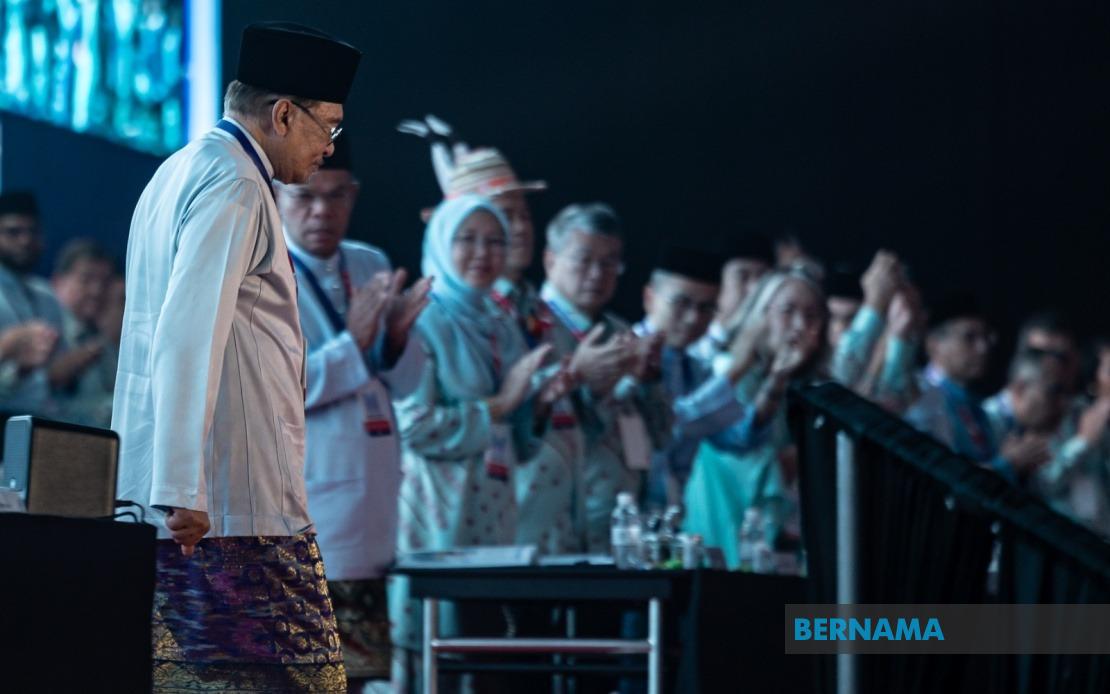
Prime Minister Datuk Seri Anwar Ibrahim has moved to counter growing perceptions of regional disparity in the MADANI government's resource distribution, arguing that federal allocations have not only continued but accelerated since his administration took office. Speaking at the 2026 PKR National Congress in Melaka on August 15, Anwar emphasised that differences in funding levels between states reflect genuine policy priorities rather than deliberate marginalisation, a distinction that carries important implications for inter-state relations and the government's electoral prospects in key regions.
The Prime Minister's defence came during his Presidential Policy Speech delivered at the Melaka International Trade Centre, where he presented a detailed breakdown of expenditure increases across multiple states. His remarks suggest that criticism of unequal distribution has reached a level warranting a direct rebuttal from the highest office, reflecting the political sensitivity surrounding regional development and the distribution of public resources—perennial concerns in a federation as geographically and economically diverse as Malaysia.
According to Anwar's figures, Sabah has experienced a 35 per cent increase in federal expenditure over the three-year period following the MADANI government's formation, with allocations rising from RM13 billion in 2022 to RM17.6 billion in 2026. This represents the most substantial percentage increase mentioned, suggesting that the state's development remains a priority despite persistent economic challenges and competition with other regions for infrastructure investment. The significant boost to Sabah's budget signals the government's attempt to maintain political support in a crucial electoral state with its own distinct governance history and development requirements.
Sarawak, another state with considerable political and economic importance, has similarly benefited from expanded federal support. The state's allocation grew from RM10.2 billion in 2022 to RM15.1 billion, representing a 48 per cent increase. This substantial growth underscores the government's recognition of Sarawak's strategic importance and its significant land area and population concentration, while also reflecting the need to strengthen federal-state relationships in a region where local political dynamics carry considerable weight at the national level.
Anwar drew particular attention to non-Peninsular states by juxtaposing their improved funding with the performance of Peninsular counterparts. Terengganu's allocation increased from RM6 billion in 2022 to RM8.1 billion in the current fiscal year, while Johor experienced growth from RM10.2 billion in 2022 to RM14.6 billion projected for 2026. These figures demonstrate a pattern of expansion across geographically and politically diverse states, suggesting an attempt to build broad-based support through tangible fiscal commitments rather than concentrated investment in particular regions.
The Prime Minister's remarks included reference to increases benefiting Kedah, Kelantan, and Perlis, though without providing specific numerical comparisons. This broader enumeration of states receiving enhanced allocations appears designed to convey universality in the distribution benefits, countering suggestions that the government favours certain states while neglecting others. However, the selective provision of detailed figures for larger or strategically significant states may itself signal where the government views its greatest political challenges or opportunities.
Anwar's rhetorical approach—questioning whether previous state governments had raised concerns about allocation inequities—attempts to reframe the debate by suggesting that current complaints represent either political opportunism or a failure to acknowledge genuine improvements. This counter-narrative seeks to establish that expectations for development funding have historically been lower and that the MADANI government deserves credit for raising baseline investment across multiple jurisdictions. The argument implicitly challenges opposition figures or state governments to explain why they did not advocate for higher allocations during earlier administrations.
For Malaysian and Southeast Asian observers, the debate over state allocations reflects broader patterns of centre-periphery tensions present in federal systems throughout the region. The Prime Minister's detailed financial defence suggests that managing regional disparities remains a central concern for federal governments seeking to maintain political legitimacy and social cohesion. In Malaysia's context, where concerns about equity between Peninsular Malaysia and East Malaysian states, or between developed and less developed regions, carry historical and political weight, explicit commitments to increased investment carry both practical and symbolic significance.
The allocations cited by Anwar encompass essential infrastructure, public services, and development projects that directly affect citizens' daily lives and economic opportunities. Increased federal funding to Sabah and Sarawak particularly addresses longstanding grievances about resource distribution and development pace relative to Peninsular states. Similarly, enhancements to allocations for smaller states like Perlis and Terengganu acknowledge the political necessity of demonstrating that even less economically dominant regions receive government attention and investment.
The government's case, as presented by the Prime Minister, rests substantially on absolute increases in funding rather than detailed analysis of how these allocations translate into measurable improvements in living standards, employment, or infrastructure quality. Sceptical observers might note that rising budget allocations do not necessarily correlate with effective service delivery or appropriate targeting of funds toward high-impact projects. The distinction between budget allocation and actual resource utilisation remains an area where government claims require independent verification through transparent reporting on project implementation and outcomes.
Looking forward, the challenge for the MADANI government lies not merely in defending historical allocation decisions but in demonstrating that funding increases produce visible, equitable improvements across all regions. Regional political leaders, particularly those in opposition-governed states or states with mixed political representation, will likely scrutinise the government's budget execution to determine whether announced allocations translate into promised development on the ground. The Prime Minister's early articulation of the government's resource distribution philosophy suggests awareness that managing regional expectations and perceptions remains essential to maintaining the political coalition supporting the administration.

