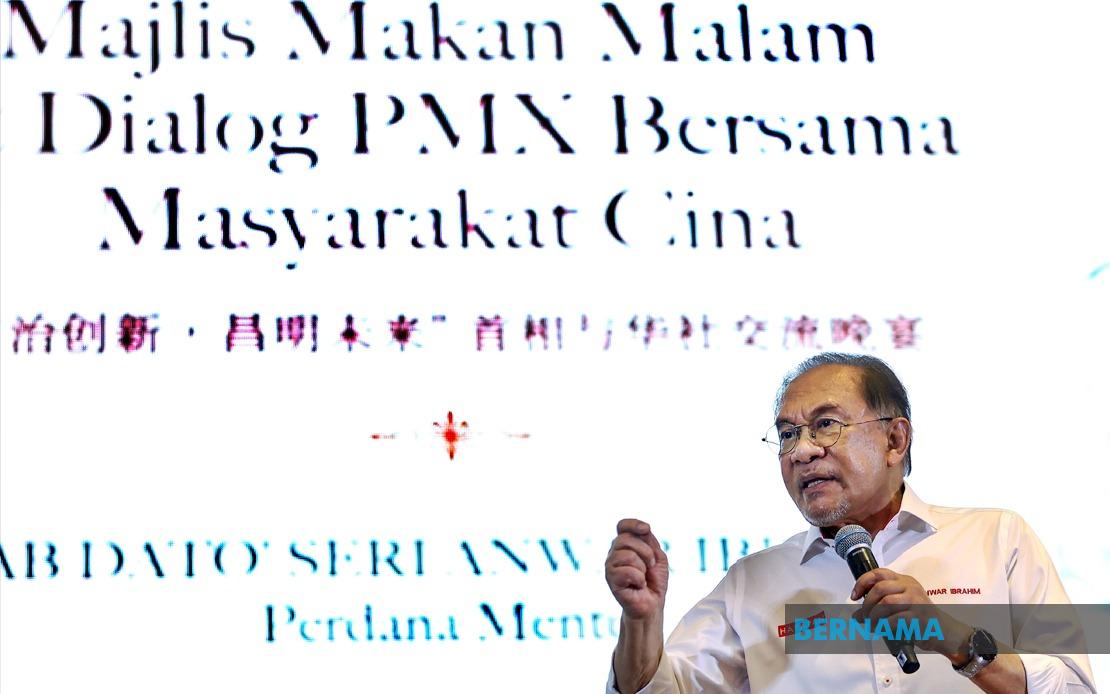
Prime Minister Datuk Seri Anwar Ibrahim has renewed his pledge to guide Malaysia towards prosperity and greatness, framing his leadership journey as fundamentally centred on establishing an enduring legacy rooted in ethical governance and inclusive representation. Speaking during an engagement with the Chinese community in Johor Bahru on July 4, the Prime Minister articulated a vision that transcends conventional political boundaries, positioning himself as a leader committed to bridging societal divides through sustained dialogue and genuine concern for all citizens.
At this juncture in his political career, Anwar appears increasingly focused on the intangible dimensions of leadership—the manner in which his tenure will be remembered long after he departs high office. The emphasis on legacy reflects a maturation in perspective that prioritizes nation-building over transactional politics. By anchoring his remarks to the theme of fairness and cleanliness in governance, the Prime Minister signals his awareness that Malaysia's social cohesion depends fundamentally on institutions that function impartially and transparently, free from the corrupting influence of factional interests.
The Prime Minister's insistence that every citizen holds equal importance within the national fabric addresses a persistent tension in Malaysian public discourse. Historical grievances stemming from communal divisions have periodically threatened social stability, and Anwar's explicit commitment to serving all communities—irrespective of ethnicity—represents an attempt to establish governance principles that supersede identity-based allegiances. This approach carries particular significance given Malaysia's multicultural composition and the delicate equilibrium required to sustain peaceful coexistence among diverse populations with distinct interests and historical experiences.
Anwar's reflection on advancing age and the proximity of eventual retirement introduces a philosophical dimension often absent from contemporary political rhetoric. By acknowledging human mortality and the transient nature of political power, the Prime Minister frames his work not as a personal achievement to be jealously guarded but as stewardship of national institutions and values that must outlive individual tenure. This perspective potentially depoliticizes governance by emphasizing continuity and institutional integrity over the personality-driven dynamics that sometimes characterize Malaysian politics.
The specific formulation of his desired legacy—being remembered as someone who genuinely cared for the people and earned reciprocal affection—suggests an understanding that legitimacy in democratic systems ultimately derives from perceived alignment between leader and citizenry. Rather than measuring success solely through policy implementation or economic indicators, Anwar appears to be staking his historical judgment on qualitative measures of human connection and mutual regard. This sentiment resonates particularly within Asian contexts where relationship-based trust often determines political efficacy more profoundly than institutional mechanisms alone.
The Prime Minister's emphasis on collective responsibility—framing national development as a shared enterprise requiring unified effort—carries implications for how Malaysia addresses contemporary challenges. Economic uncertainties, climate pressures, and regional geopolitical shifts demand coordinated responses that transcend narrow factional or communal interests. By invoking language of shared ownership and collective stewardship, Anwar attempts to mobilize a broader coalition oriented toward common objectives rather than competing zero-sum interests.
The presence of Selangor Menteri Besar Datuk Seri Amirudin Shari at the gathering underscores the state-level dimensions of governance that complement federal initiatives. The participation of PKR leadership, alongside direct community engagement, illustrates an attempt to demonstrate coherence between national vision and subnational implementation. For Malaysian readers, such coordination between federal and state authorities proves crucial for translating rhetorical commitments into tangible improvements in service delivery and institutional performance.
Anwar's engagement with the Chinese community specifically merits consideration within Malaysia's broader communal dynamics. Direct outreach to established communities signals recognition that inclusive governance requires deliberate relationship-building beyond ceremonial occasions. The Chinese business and professional classes wield considerable influence over national economic trajectories and social stability, making their perception of governmental fairness and competence strategically significant for broader national consensus-building.
The temporal framing embedded in Anwar's remarks—distinguishing between his current responsibilities and his legacy aspirations—creates rhetorical space for evaluating his stewardship against explicit benchmarks he has now publicly established. This represents a form of voluntary accountability, as citizens and observers can subsequently assess whether his governance record aligns with declared principles of fairness, cleanliness, and inclusive service delivery. For Malaysian media and civil society, such clearly articulated standards provide analytical frameworks for ongoing scrutiny of governmental performance.
Looking forward, Anwar's leadership philosophy as articulated at this engagement carries implications for how Malaysian governance might evolve during and beyond his tenure. Should these principles guide institutional development and policy formation, they could contribute to a political culture increasingly defined by accountability, transparency, and cross-communal cooperation. Conversely, any significant divergence between these stated values and actual governance patterns would create tension that political opponents and civil society organizations would inevitably highlight, potentially complicating the legacy-building endeavour the Prime Minister has articulated.
For Southeast Asian observers, Anwar's emphasis on ethical, inclusive leadership resonates within regional contexts where governance capacity and social cohesion remain persistent challenges. Malaysia's experience in maintaining multicultural stability, despite periodic tensions, offers lessons potentially relevant to similarly diverse societies throughout the region grappling with questions of national identity and equitable representation.

