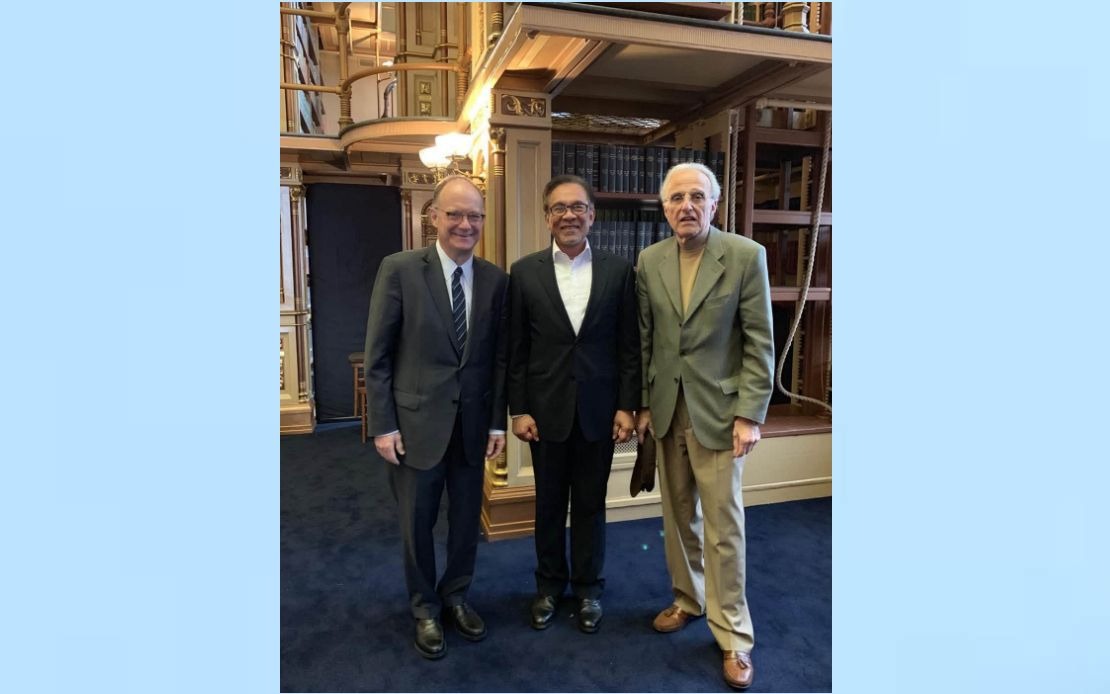
Prime Minister Datuk Seri Anwar Ibrahim has extended his deepest condolences following the death of Professor John L. Esposito, one of the world's most influential scholars of Islamic studies. In a tribute posted on social media, Anwar reflected on a remarkable friendship that began in the early 1970s and spanned more than five decades, underscoring the personal and intellectual bond that connected the two men across vastly different geographies and roles.
Esposito's significance to the global study of Islam cannot be overstated, particularly in how he shaped Western perceptions of the faith during a critical period in modern history. As an American academic of immense standing, he dedicated his career to constructing frameworks for understanding Islam that moved beyond stereotypes and sensationalism. His influence extended far beyond academic circles, reaching policymakers, educators, and the general public through accessible yet rigorous scholarship. For Malaysia and the broader Muslim world, his work represented a counterbalance to narratives that often misrepresented Islamic civilization and practice to Western audiences.
Central to Esposito's legacy was his founding of the Centre for Muslim-Christian Understanding at Georgetown University, an institution that became a beacon for interfaith scholarship and dialogue. This establishment was particularly groundbreaking in its time, creating dedicated spaces where scholars from different faith traditions could engage in meaningful intellectual exchange. Such initiatives proved invaluable in building what Anwar described as bridges between civilizations at moments when barriers were being reinforced rather than dismantled. His collaborative works, including Makers of Contemporary Islam, demonstrated his commitment to presenting diverse Muslim voices and experiences rather than monolithic interpretations.
Anwar's characterization of Esposito's contribution to post-9/11 discourse illuminates why the scholar remained relevant and necessary in turbulent times. Following the September 2001 attacks, global media narratives about Islam became increasingly polarized, with sensationalism often overwhelming nuance. Esposito's publications, particularly What Everyone Needs to Know About Islam and Who Speaks for Islam?, provided accessible yet intellectually sound alternatives to this reductive coverage. By making rigorous scholarship available to wider audiences, he empowered ordinary readers to form informed opinions independent of politically motivated misrepresentations. For Muslim-majority nations and Western countries alike, his work served as a corrective tool against mutual misunderstanding.
The Prime Minister's personal recollection of their relationship reveals dimensions of Esposito that extended beyond his public intellectual contributions. Anwar emphasized that Esposito was "as generous in private conversation as he was rigorous on the page," suggesting a consistency of character that bridged his scholarly output and personal interactions. Their connection presumably provided Anwar with wisdom and guidance during Malaysia's own journey of navigating complex questions about Islamic identity, modernization, and interfaith coexistence. The fact that Anwar specifically noted Esposito's steadfast friendship "through thick and thin" indicates the scholar was not merely a distant intellectual contact but someone who engaged meaningfully with the Malaysian leader during both celebrated and challenging periods.
From a Southeast Asian perspective, Esposito's work held particular relevance given the region's religious pluralism and the persistent need to counter extremist narratives. Malaysia, as a constitutionally Islamic nation that simultaneously protects religious minorities and maintains secular governance, benefited from scholarship that demonstrated Islam's compatibility with democratic institutions and diverse societies. Esposito's academic legitimacy in Western institutions meant that his work carried weight in global policy discussions affecting the Muslim world, including issues that directly concerned Malaysia's strategic interests and diplomatic relationships.
The scholarly legacy Esposito leaves encompasses not merely published volumes but an entire intellectual tradition of treating Islamic studies with the same scholarly rigor applied to Western religions and civilizations. He challenged orientalist frameworks that had long dominated Western academia, insisting instead on contextualized, historically informed analysis of Islamic thought and practice. His career demonstrated that genuine understanding requires sustained engagement rather than snapshot observations, and that dialogue cannot proceed from positions of assumed superiority. These methodological innovations influenced generations of scholars working in Islamic studies, religious history, and Middle Eastern studies across universities worldwide.
Anwar's invocation of Esposito's work "bearing fruit" in continued dialogue reflects an understanding that intellectual contributions outlive their creators. The frameworks Esposito established, the conversations he initiated, and the scholars he trained will continue shaping how Islam is understood and discussed globally. His commitment to presenting diverse Muslim perspectives, particularly through works that amplified contemporary Muslim voices, created space for Muslims themselves to shape narratives about their own faith rather than passively accepting external interpretations. This represented a fundamental shift in academic power dynamics that remains consequential today.
For Malaysia specifically, maintaining the spirit of Esposito's interfaith work appears particularly timely given current regional tensions and global geopolitical realignments. As the nation navigates questions about religious harmony, secular governance, and Islamic identity in an increasingly polarized world, the intellectual tools Esposito provided remain valuable. His insistence on nuance, historical context, and good-faith engagement across religious lines offers a template for addressing contemporary challenges that persist in blending theological questions with political agendas. Anwar's public acknowledgment of this relationship and Esposito's contributions serves as a reminder that such bridge-building, whether through scholarship or diplomacy, remains essential work.
The Prime Minister's tribute, extended on behalf of Malaysia as a nation, elevates this personal loss to a matter of national and international significance. By publicly mourning Esposito, Anwar positioned Malaysia among those societies that value the kind of intellectual work Esposito performed. The condolences extended to Esposito's wife Jean and his family, colleagues, and students acknowledge that his influence extended through institutional and personal networks that will continue his work. His passing marks the end of an era in Islamic scholarship, yet the foundations he built remain solid and available for successive generations to develop further.

