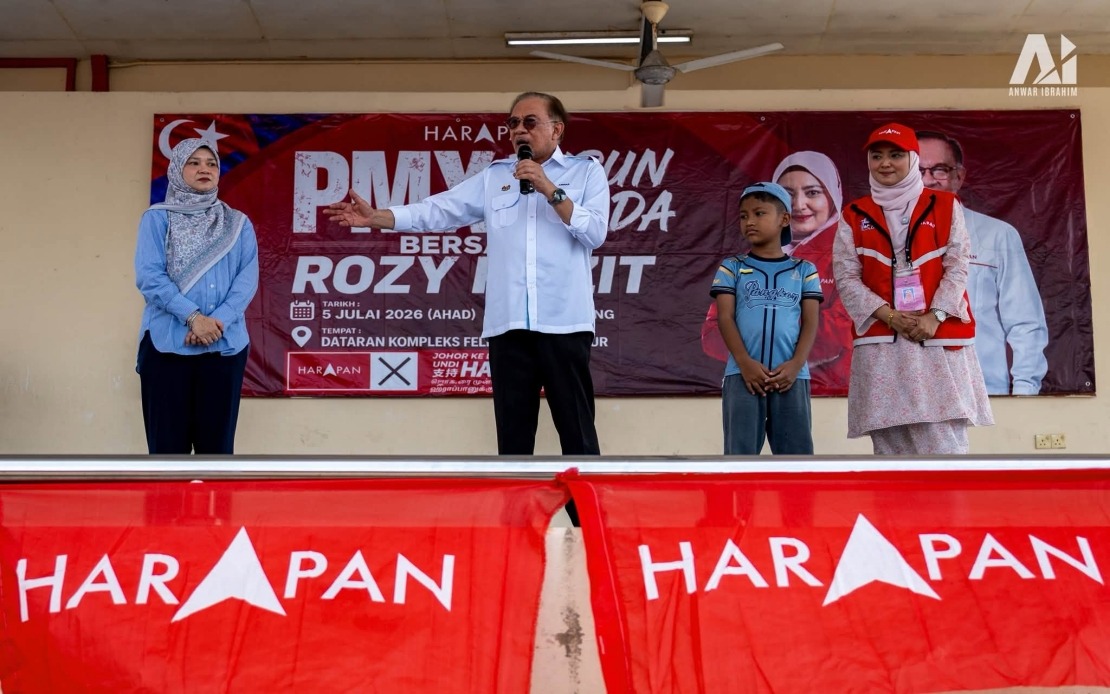
Prime Minister Datuk Seri Anwar Ibrahim has recounted a touching encounter with Muhammad Afif Ikhwan, a nine-year-old boy from Kampung Pudu in Segamat, whose determination to meet the nation's leader left a lasting impression on the premier. The brief but meaningful interaction took place during a programme at Felda Palong Timur in Segamat, where the child managed to reach through the crowd and shake hands with Anwar before being invited onto the stage. The spontaneity of the moment belied its emotional weight, with Anwar reflecting on the occasion through a Facebook post that underscored the human dimensions of leadership beyond the machinery of government.
What makes the episode particularly poignant is the extraordinary effort undertaken by Muhammad Afif's 58-year-old grandmother, Rosimah Mohammad, to make her grandson's wish a reality. Traversing the treacherous tracks of an oil palm plantation on a motorcycle, Rosimah demonstrated a level of devotion that speaks to the deep bonds within families across rural Malaysia. This is not a journey of mere convenience—navigating plantation terrain on two wheels presents genuine physical challenges, yet the grandmother prioritised fulfilling her grandson's dream above the practical difficulties involved.
Anwar's response reveals something important about how he views the responsibilities of high office. Rather than treating the encounter as a fleeting moment of public relations value, he made a deliberate effort to follow up. The Prime Minister arranged for an emissary to visit Muhammad Afif at home and present him with a bicycle, transforming what could have been a momentary handshake into a sustained gesture of recognition and encouragement. This approach—moving beyond the ceremonial aspects of leadership to acknowledge individual lives—carries particular resonance in the Malaysian context, where rural communities often feel disconnected from the corridors of power.
The symbolism embedded in Anwar's commentary reflects a broader philosophy of governance. He emphasised that what appeared to outsiders as a modest childhood ambition—simply seeing the Prime Minister in person—was significant enough to mobilise his grandmother into action. This perspective acknowledges the psychological and emotional weight that such encounters carry for ordinary Malaysians, particularly those in rural areas where access to national leaders remains limited. The fact that a grandmother would navigate difficult terrain to grant her grandson this experience speaks to how meaningful such moments can be within family and community contexts.
Anwar's reflection on maintaining compassion amidst the demands of managing national affairs strikes at a tension within modern governance. As governments grow larger and more complex, leaders often become insulated from the human realities that drive citizen engagement. By publicly acknowledging that no matter how preoccupied one becomes with managing the country's challenges, the capacity for empathy and human connection must be preserved, Anwar articulated a principle that extends beyond his administration. This message has particular resonance for Malaysian policymakers and officials at all levels, suggesting that governance effectiveness is partly measured by the ability to remain accessible and emotionally attuned to the populations being served.
The Felda context deserves attention as well. Felda, or Federal Land Development Authority settlements, have historically served as critical agricultural communities in Malaysia, though they have often experienced economic volatility and infrastructure challenges. That Anwar chose to engage directly with constituents at Felda Palong Timur demonstrates an effort to maintain visibility in these sometimes-overlooked communities. The encounter with Muhammad Afif and his grandmother becomes emblematic of a leader attempting to bridge the gap between federal governance and the lived realities of Malaysians working in extractive industries and agricultural production.
For Muhammad Afif himself, the implications extend beyond the novelty of meeting a prime minister or receiving a bicycle. Anwar explicitly articulated his hope that the encounter would inspire the young boy to persist with his studies and recognise his potential to contribute meaningfully to his family, community, and nation. This represents an investment in the aspirational dimension of leadership—the ability to encourage younger generations to envision themselves as active participants in national development. In rural Malaysia, where educational outcomes sometimes lag urban counterparts, such moments of recognition from national leadership can carry disproportionate psychological weight in shaping a child's sense of possibility.
The narrative also illuminates the intergenerational dynamics within Malaysian families. Rosimah's actions reflect values of family solidarity and the willingness to sacrifice for the advancement of younger family members' opportunities and happiness. This is deeply rooted in Malaysian cultural traditions, particularly within Malay Muslim contexts emphasising collective family responsibility. The story becomes, in effect, a celebration of these values while simultaneously connecting them to the possibility of national advancement and personal achievement.
From a broader political perspective, Anwar's public sharing of this encounter serves multiple functions. It humanises the Prime Minister, presenting him as emotionally responsive to ordinary citizens' experiences. It simultaneously reinforces a particular vision of governance in which leaders maintain accessibility and regard for individual lives rather than operating purely at the level of policy abstraction. In an era when political trust in Malaysia has faced periodic challenges, such narrative moments—whether spontaneous or carefully calibrated—contribute to the affective dimensions through which citizens relate to government leaders.
The bicycle presented to Muhammad Afif carries its own symbolic weight within this narrative arc. It represents not merely a gift but a tangible bridge between the encounter and the boy's future mobility—both literal and metaphorical. A bicycle in rural contexts like Kampung Pudu facilitates independent movement and access to educational institutions, suggesting that the gift carries practical value beyond its ceremonial significance. This small but concrete gesture demonstrates that the Prime Minister's compassion extended beyond rhetorical affirmation to material support for the child's circumstances.
As Malaysia continues to navigate complex economic and social transitions, stories like Muhammad Afif's journey acquire particular resonance. They remind policymakers and citizens alike that national development encompasses not merely macro-economic indicators or infrastructure projects, but the accumulation of individual aspirations, family sacrifices, and moments of human connection. Whether such encounters catalyse broader structural improvements in rural communities or remain isolated incidents speaks to the gap between individual compassion and systemic change—a tension that will likely define political discourse across Malaysia and the broader Southeast Asian region.

