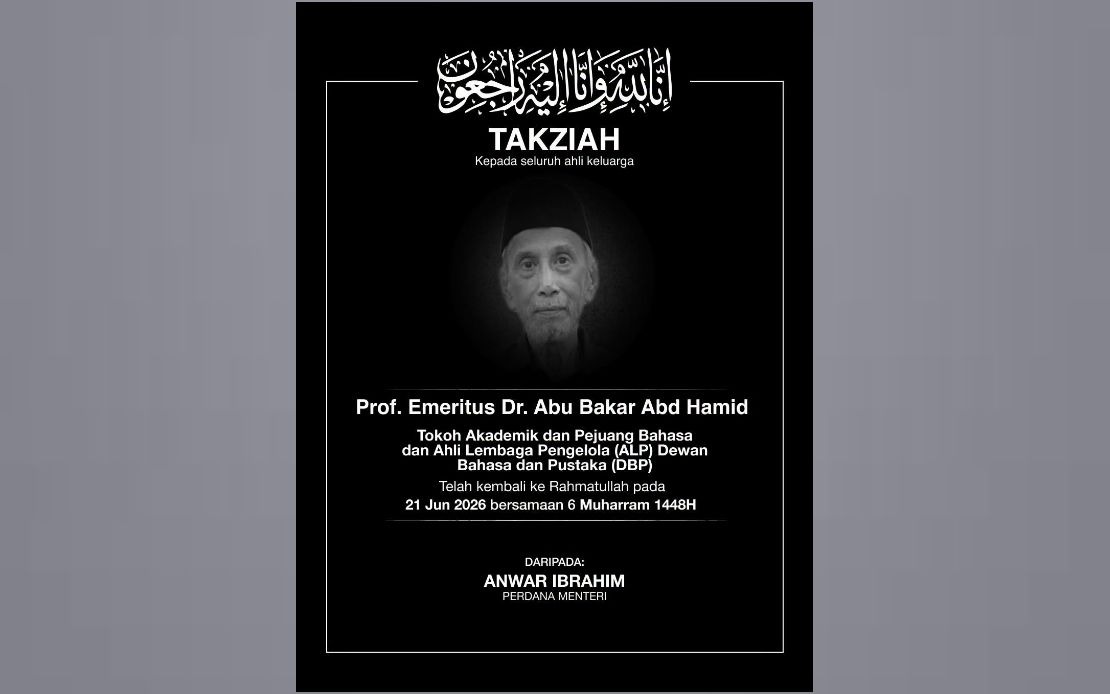
Prime Minister Datuk Seri Anwar Ibrahim has conveyed his deep grief following the death of Professor Emeritus Datuk Abu Bakar Abd Hamid, one of Malaysia's most respected figures in Malay literature and higher education. The distinguished academic, who passed away on June 21 at his Petaling Jaya home, left behind a legacy spanning decades of scholarly work, institutional leadership, and mentorship that shaped generations of Malaysian intellectuals.
Anwar's tribute, shared through social media on June 24, reflected not only his role as a national leader but also his personal connection to the departed academic. Having studied under Abu Bakar during his university years, the Prime Minister spoke of the profound loss felt by those who benefited from the scholar's guidance and wisdom. Anwar characterised Abu Bakar as someone whose influence extended far beyond the classroom, describing him as an embodiment of intellectual curiosity and an unwavering commitment to advancing knowledge across Malaysian society.
Abu Bakar's contributions to Malaysia's academic landscape were both foundational and extensive. He served as deputy vice-chancellor of Universiti Malaya in 1987, a position from which he helped steer one of the nation's oldest and most prestigious institutions during a critical period of higher education development. Beyond his administrative responsibilities at UM, Abu Bakar played a crucial role in the establishment of Universiti Kebangsaan Malaysia, serving as joint secretary of the committee tasked with creating what would become a flagship institution for Malay-language scholarship and research. His involvement in UKM's founding reflected his broader vision of advancing higher education rooted in the Malaysian context and national aspirations.
During the mid-1990s, Abu Bakar extended his influence into the media landscape, serving as chairman of the Board of Governors of Bernama from 1996 to 2000. This appointment underscored his standing as a trusted public intellectual capable of guiding major national institutions. His tenure coincided with a period when Malaysia's news agency was navigating evolving media dynamics, and his scholarly approach to governance likely contributed to institutional stability during this transformative era.
The academic's recognition throughout his life reflected the esteem in which he was held by peers and institutions alike. Abu Bakar accumulated numerous awards and accolades in recognition of his scholarly contributions to Malay literature, a field in which he was considered a seminal figure. These honours documented not only his intellectual achievements but also his lasting impact on literary scholarship in Malaysia and the broader Malay-speaking world.
According to reports, Abu Bakar's death came unexpectedly when he experienced acute respiratory distress at approximately 10:30 pm on June 21 at his residence in Petaling Jaya. The sudden nature of his passing shocked the academic and literary communities, which had regarded him as an active and engaged intellectual well into his later years. A native of Johor, Abu Bakar maintained strong ties to his home state throughout his life while building a career that carried him across Malaysia's major educational institutions.
His funeral rites were conducted on Monday with his burial at Bukit Kiara Muslim Cemetery, a final resting place befitting a figure of his stature within Malaysian society. The timing and manner of his interment allowed colleagues, students, and admirers to pay their respects, though many would have been processing the sudden loss of someone whose influence on Malaysian intellectual life remained substantial even in recent years.
For Malaysian readers, Abu Bakar's passing represents the loss of a bridge-builder between classical Malay literary traditions and modern academic scholarship. His work in establishing and developing universities demonstrated his belief that higher education could be a vehicle for deepening the nation's cultural and intellectual foundations. The fact that a serving Prime Minister took time to publicly mourn his death underscores the significance of Abu Bakar's contributions beyond academia into the realm of national institution-building and intellectual leadership.
Anwar's invocation of religious prayers for Abu Bakar's soul—asking for divine forgiveness and peace in the afterlife—reflected the Islamic values that both men shared and that animated much of Abu Bakar's scholarly work on Malay literature, a field deeply intertwined with Islamic thought and expression. This spiritual dimension to the tribute highlighted how Abu Bakar's scholarship was never merely academic but was infused with a sense of national and spiritual purpose that resonated across generations.
The passing of figures like Abu Bakar Abd Hamid raises important questions about knowledge preservation and institutional memory in Malaysia. As one generation of institution-builders and scholars departs, the challenge of documenting and transmitting their intellectual legacy becomes increasingly urgent. The contributions made by Abu Bakar to universities, literary scholarship, and media governance represent a form of intellectual inheritance that contemporary leaders must actively work to understand and build upon, ensuring that the vision and values he embodied continue to guide Malaysian higher education and cultural development.