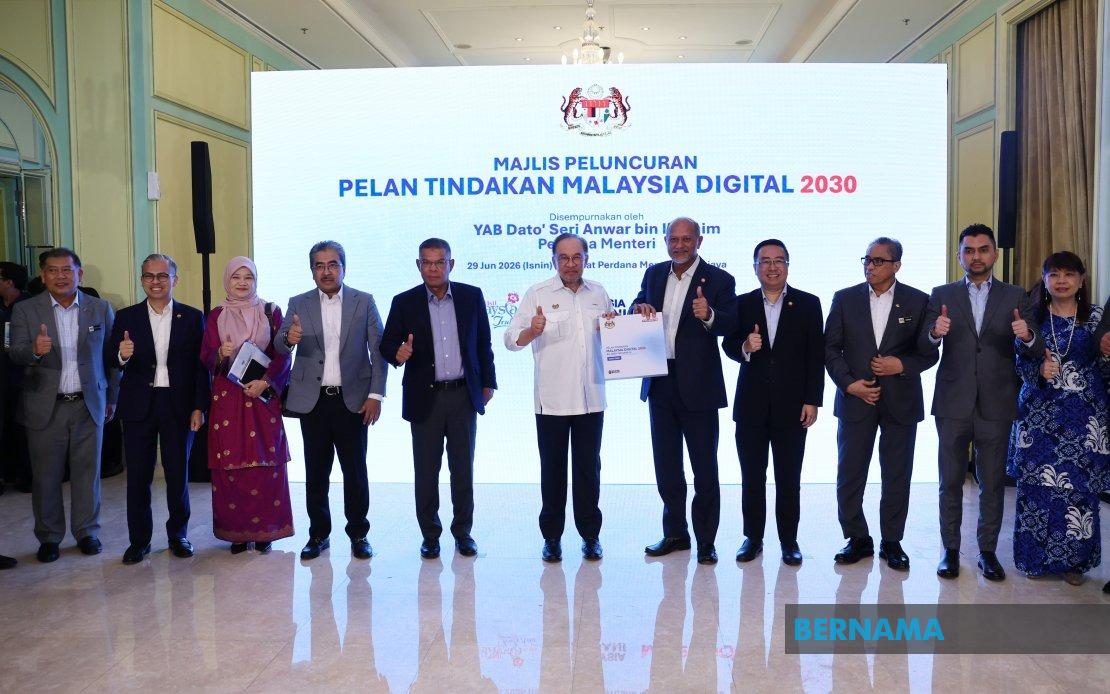
Prime Minister Datuk Seri Anwar Ibrahim has unveiled Malaysia Digital 2030 (MD2030), an ambitious five-year action plan that signals a fundamental reimagining of the nation's digital ambitions. Launched today in Putrajaya with Digital Minister Gobind Singh Deo, Communications Minister Datuk Fahmi Fadzil, and Chief Secretary Tan Sri Shamsul Azri Abu Bakar in attendance, the initiative marks a decisive pivot from Malaysia's traditional role as a consumer of foreign technology toward developing and exporting home-grown digital innovations. This shift reflects growing recognition that the nation's economic future depends on cultivating indigenous technology capabilities rather than relying solely on imported solutions.
The scope of MD2030 is deliberately expansive, establishing targets that will reshape multiple dimensions of the Malaysian economy and public sector. By 2030, the government aims to lift the digital economy's share of GDP to 30 per cent, a substantial increase that underscores digitalisation's centrality to future growth. Equally significant is the creation of 500,000 high-value digital jobs, which would substantially expand professional opportunities in technology sectors and reduce dependence on lower-value service employment. The public sector modernisation target—generating RM4.5 billion in savings through digitalisation—demonstrates commitment to efficiency gains that could free resources for other priorities. Meanwhile, delivering 95 per cent of government services fully online represents a dramatic acceleration in digital-first public administration, positioning Malaysia among the region's most digitally advanced governments.
The plan's architecture reflects sophisticated governance thinking through its seven strategic pillars, each assigned to a relevant ministry under a coordinated whole-of-government structure. Chief Secretary Tan Sri Shamsul Azri leads the Government pillar, focusing on enhancing public service delivery via GovTech Malaysia, a dedicated technology entity. Investment, Trade and Industry Minister Datuk Seri Johari Abdul Ghani oversees the Economy pillar, tasked with repositioning Malaysia as a regional digital and innovation hub by promoting "Made by Malaysia" products and accelerating technology adoption across High Growth High Value sectors. Communications Minister Fahmi manages Infrastructure, prioritising nationwide broadband connectivity and sustainable digital infrastructure including data centres and smart cities. Human Resources Minister Datuk Seri R. Ramanan leads Talent development, recognising that technological transformation requires workforce upskilling and positioning Malaysia as a regional digital talent destination.
The remaining three pillars address equally critical success factors. Women, Family and Community Development Minister Datuk Seri Nancy Shukri directs the Society pillar, which institutionalises digital inclusion through mechanisms like the Malaysian Digital Inclusion Index and targeted rural community empowerment. Digital Minister Gobind Singh Deo personally leads Trust and Security, balancing innovation with data protection through the National Data Commission and a dedicated National Digital Trust and Data Security Strategy. Science, Technology and Innovation Minister Datuk Chang Lih Kang leads Innovation, building a robust Research, Development, Commercialisation, Innovation and Economy ecosystem designed to convert research into commercially viable digital products.
The Economy pillar carries particular significance for Malaysian business stakeholders. By unlocking the potential of data, digital assets, and intellectual property, the strategy acknowledges that Malaysia's future competitive advantage lies in data-driven decision-making and homegrown digital products rather than traditional manufacturing. The emphasis on promoting "Made by Malaysia" products signals intent to build global recognition for Malaysian digital brands and solutions, particularly across Southeast Asia where the nation already has cultural and linguistic advantages. This represents a meaningful departure from previous approaches that often treated technology adoption as a means to improve existing sectors rather than as a sector in itself.
The Talent pillar reflects pragmatic recognition that technological transformation cannot succeed without workforce readiness. Rather than assuming current skill levels suffice, the strategy encompasses agile workforce transition initiatives that acknowledge the disruptive nature of digital technology on employment patterns. By positioning Malaysia as a regional digital talent hub, the government implicitly competes with Singapore, Indonesia, and Vietnam for technology professionals, requiring competitive compensation, working conditions, and innovation ecosystems that nurture entrepreneurship. For Malaysian tech workers, this agenda potentially creates unprecedented domestic opportunity to remain in Malaysia while participating in globally competitive digital enterprises.
The Society pillar's emphasis on digital inclusion addresses a critical implementation risk: transformation that enriches urban, educated populations while leaving rural and lower-income Malaysians behind would deepen inequality rather than advance shared prosperity. The institutionalisation of the Malaysian Digital Inclusion Index creates accountability mechanisms for measuring whether digital benefits reach all communities. Rural community empowerment initiatives recognise that digital infrastructure and access mean little without supporting capacity-building, digital literacy programmes, and identification of locally relevant digital solutions. This holistic approach distinguishes MD2030 from technology plans that treat connectivity as an end rather than a means.
The Trust and Security pillar represents essential recognition that digital innovation and data protection need not conflict. By operationalising the National Data Commission and developing a dedicated National Digital Trust and Data Security Strategy, the government signals that robust privacy protections and cybersecurity will accompany technological advancement. For regional companies considering Malaysia as a technology hub, clear data governance frameworks provide legal certainty. For citizens, this approach signals that economic transformation will not occur at the cost of personal data exploitation. This represents sophisticated policy-making that acknowledges consumer and business confidence requires institutional safeguards alongside innovation freedom.
Implementation responsibility rests with an ecosystem of specialised agencies working under Digital Ministry coordination. The National AI Office brings focus to artificial intelligence deployment across sectors. GovTech Malaysia will lead public sector digital transformation. The Malaysia Digital Economy Corporation supports private sector digitalisation. CyberSecurity Malaysia provides security infrastructure. MyDIGITAL Corporation drives broader digital adoption initiatives. The Malaysia Centre for the Fourth Industrial Revolution conducts research and convenes stakeholders. This distributed implementation model recognises that digital transformation requires expertise spanning government operations, business systems, security, research, and skills development—no single entity can effectively lead such multifaceted change.
For regional observers, MD2030 signals Malaysia's determination to leverage its geographic position, multilingual workforce, and political stability to become a Southeast Asian digital powerhouse. The strategy's comprehensiveness—spanning infrastructure, talent, innovation, security, and social inclusion—distinguishes it from narrower technology initiatives that often founder through incomplete implementation. By explicitly committing to inclusive transformation and data security alongside innovation, the government attempts to address common objections to technology-led development. The five-year timeframe proves ambitious but achievable if execution matches ambition and inter-ministerial coordination functions effectively.
Digital Minister Gobind Singh Deo's statement emphasised that MD2030 demonstrates Malaysia's readiness to transition from technology consumer to respected innovation producer, with the Digital Ministry ensuring holistic implementation through coordinated whole-of-government execution. This framing implicitly acknowledges Malaysia's historical challenge: adopting foreign technologies effectively but creating limited indigenous innovation. Success requires not merely excellent governance and infrastructure, but also cultivating entrepreneurial culture, venture capital ecosystems, intellectual property protections, and university-industry linkages that nurture home-grown technology companies. Whether MD2030 proves transformative depends ultimately on whether these ecosystem foundations receive equal emphasis alongside the quantified targets.

