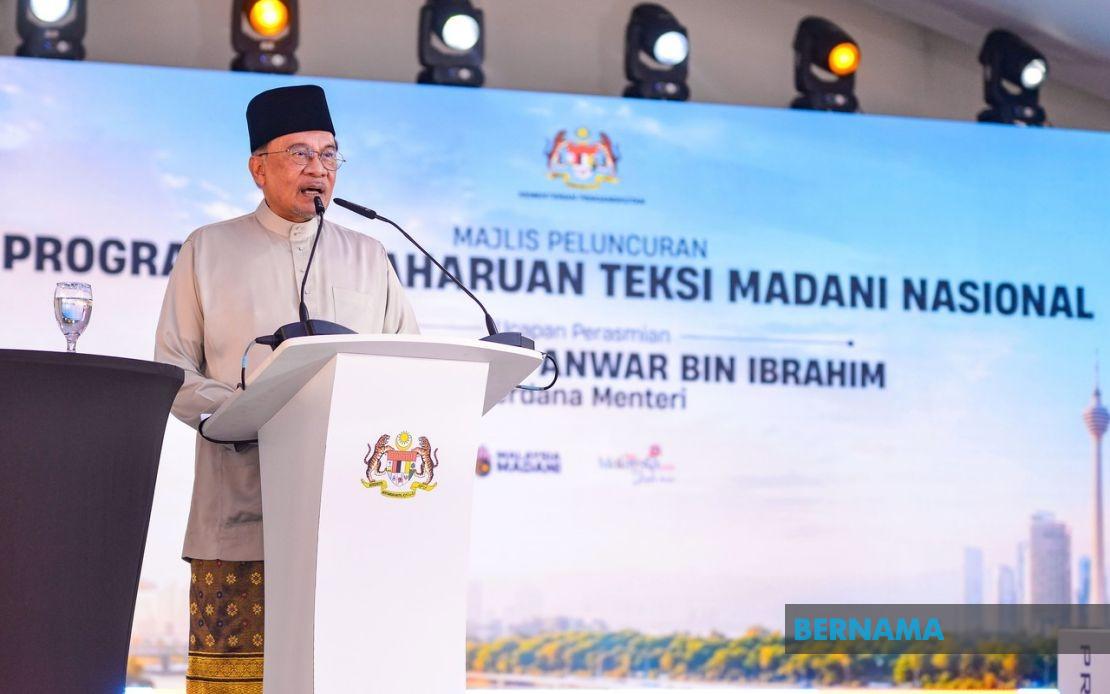
Prime Minister Datuk Seri Anwar Ibrahim has unveiled an additional RM10 million in government funding for the Vehicle Replacement Matching Grant Programme, reinforcing the administration's commitment to transforming Malaysia's taxi sector. The fresh allocation, announced at the launch of the National MADANI Taxi Reform Programme at Dataran Merdeka on July 3, comes as the government recognises the taxi industry's critical role in the country's transport ecosystem and the pressing need to retire ageing vehicles from service.
The decision to inject more capital into the scheme reflects stronger-than-anticipated demand since the initial RM10 million allocation was earmarked in Budget 2026. Anwar, speaking in his dual capacity as Prime Minister and Finance Minister, stressed that the encouraging response from taxi operators justified the accelerated commitment of funds. This rapid scaling up of resources demonstrates the government's responsiveness to industry feedback and its willingness to front-load investment where genuine demand exists, rather than allowing budgeted funds to languish unused.
Central to the modernisation effort is a landmark partnership between the government, automotive manufacturer Proton, and the Transport Ministry to establish a specialised financing scheme that will enable taxi drivers to purchase the Proton S70. This initiative addresses a persistent barrier to vehicle replacement: the prohibitive upfront capital requirements that deter individual drivers from upgrading their transport assets. By negotiating dedicated financing arrangements through Proton, the government has effectively lowered the entry cost for fleet modernisation while simultaneously supporting local automotive manufacturing.
The Proton S70 represents a strategic choice for the taxi sector. As a locally-assembled sedan, it offers Malaysian taxi operators a domestically-manufactured alternative that should deliver better long-term value and serviceability compared to purely imported competitors. The vehicle's fuel efficiency and comfort specifications align with modern passenger expectations for ride-hailing and traditional taxi services, positioning it as a viable middle ground between economy and premium market segments.
For Malaysian taxi drivers, the practical implications are substantial. Many operate ageing vehicles that consume excessive fuel, require frequent repairs, and fail to meet contemporary safety and emissions standards. The combination of government grants and preferential Proton financing means drivers can now access newer, more reliable vehicles with substantially reduced financial burden. This addresses not only quality-of-life concerns for drivers but also passenger safety and environmental objectives, as modern vehicles typically feature superior crash protection and lower emissions profiles.
The National MADANI Taxi Reform Programme represents a broader policy shift recognising that taxi services, despite disruption from ride-hailing platforms, remain essential transport infrastructure in Malaysia. Unlike app-based services that concentrate on urban hotspots, traditional taxis serve peripheral areas and provide crucial last-mile connectivity. By investing in fleet modernisation, the government acknowledges this continued relevance while attempting to enhance competitiveness and service quality.
The programme's high uptake suggests that previous government support mechanisms for the taxi sector may have been underfunded or inaccessible to drivers who needed them most. The decision to increase allocations based on demonstrated demand reflects a data-driven approach to policy implementation, though it also raises questions about whether initial Budget 2026 projections were adequately calibrated to actual driver needs. Going forward, the government may need to assess whether RM20 million in total grants will ultimately prove sufficient or whether additional tranches will be required as more drivers seek replacement vehicles.
Transport Minister Anthony Loke, Minister Hannah Yeoh, and Chief Secretary Tan Sri Shamsul Azri Abu Bakar were present at the July 3 launch, underscoring the cross-government coordination required for transport sector reform. This multi-ministerial engagement suggests the government views taxi modernisation as extending beyond transport policy alone, incorporating elements of social support for self-employed drivers, local manufacturing promotion, and urban mobility strategy.
From a regional perspective, Malaysia's taxi reform initiative may offer instructive lessons for other Southeast Asian economies grappling with similar challenges of ageing taxi fleets and competition from digital platforms. The emphasis on manufacturer partnerships and dedicated financing schemes represents a pragmatic approach that other governments could potentially adapt, though outcomes will ultimately depend on implementation effectiveness and sustained driver participation rates across the coming months.

