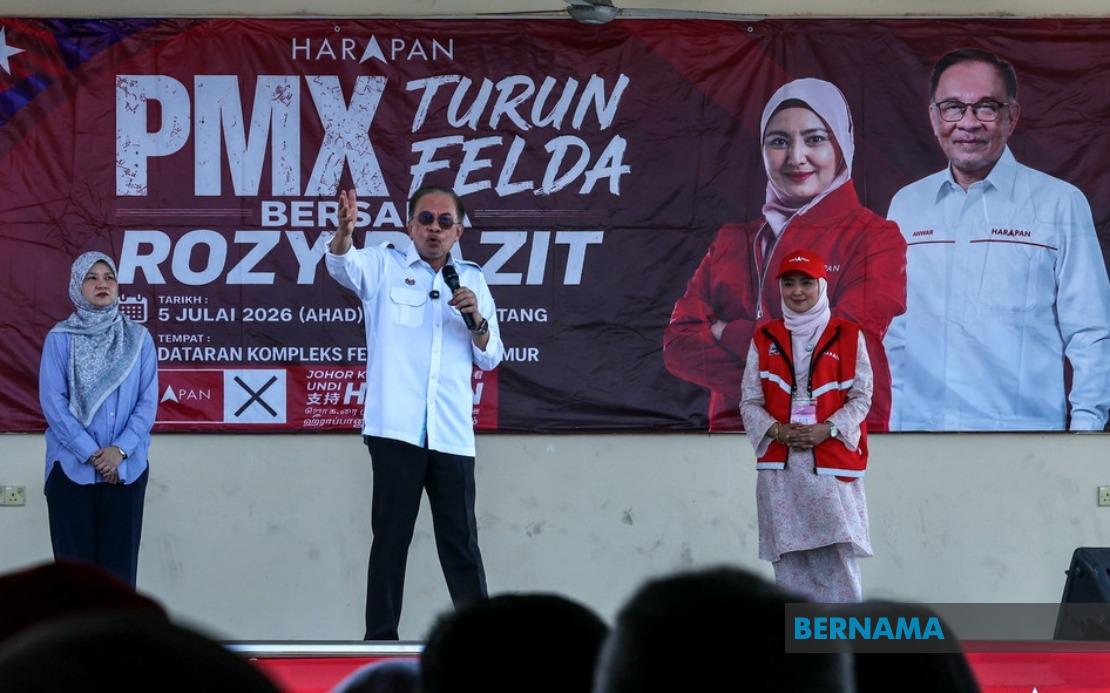
Prime Minister Datuk Seri Anwar Ibrahim has signalled renewed determination to resolve a problem that has plagued Malaysia's agricultural settlement scheme for decades—the lack of housing sites allocated to the children of original FELDA settlers. Speaking at a public engagement session in Segamat, the Prime Minister reaffirmed his administration's policy position to secure housing provisions and guarantees specifically for this disadvantaged cohort, framing the initiative as a priority matter he intends to conclude during his tenure.
The FELDA housing shortfall represents one of the most persistent grievances within Malaysia's rural development landscape. The Federal Land Development Authority, established in 1956 to settle landless Malaysians through agricultural schemes, has long failed to provide comparable opportunities for the next generation of settler families. While the original beneficiaries received plots and housing through coordinated federal schemes, their offspring have largely been excluded from similar allocations, creating a two-tier system that perpetuates inequality within ostensibly egalitarian settlement communities.
Anwar's acknowledgement that resolution hinges on state government cooperation underscores a fundamental constitutional reality often overlooked in public discourse. Land matters in Malaysia remain under state jurisdiction, a provision entrenched in the Federal Constitution. This division of powers has historically complicated federal development initiatives, as states retain discretionary authority over land availability, pricing, and allocation mechanisms. Without alignment between federal policy objectives and state-level implementation capacity, even well-intentioned initiatives risk stalling in bureaucratic gridlock.
The timing of this commitment carries political weight in Segamat, a constituency where agricultural communities and FELDA settlements represent a significant voting bloc. Anwar's presence at the Dataran Putra Felda Palong Timur event, accompanied by Selangor Menteri Besar Datuk Seri Amirudin Shari and other ministerial figures, suggests a coordinated approach to address constituent concerns ahead of anticipated electoral activities. The participation of Education Minister Fadhlina Sidek and Deputy National Unity Minister R. Yuneswaran indicates that the government views this issue through a broader social cohesion lens.
Second-generation FELDA settlers face distinct challenges that distinguish their predicament from broader housing affordability crises affecting urban centres. These individuals grew up within established settlement schemes but lack the asset base their parents accumulated through original allocations. Many have migrated to urban areas seeking employment, yet remain culturally and familially connected to settlement communities. The absence of housing provisions has created a demographic anomaly where young adult children cannot secure land-based livelihoods comparable to their parents' experiences, undermining intergenerational social stability.
The FELDA scheme itself has evolved considerably since its inception. Originally conceived as a poverty alleviation mechanism targeting rural landlessness, FELDA settlements have transformed into established communities with infrastructure, social institutions, and accumulated cultural identity. Yet institutional frameworks governing benefit distribution have largely remained static, failing to adapt to demographic changes or evolving socioeconomic realities. The second-generation crisis exemplifies this policy ossification—governance structures created for a specific historical moment have proved inadequate for contemporary conditions.
State-level cooperation mechanisms will prove decisive in translating Anwar's commitment into tangible outcomes. Selangor, represented at the Segamat event by Menteri Besar Amirudin Shari, sits at the intersection of agricultural heritage and rapid urbanisation. The state government's willingness to identify available land, negotiate pricing mechanisms, and coordinate infrastructure provision will substantially determine whether second-generation settlers can access housing allocations. Similar dynamics will apply across other states hosting significant FELDA settlements, including Pahang, Johor, and Perak.
The financial architecture supporting any resolution remains unclear from the Prime Minister's public statements. Second-generation settlers typically lack the concessional financing terms their parents enjoyed during the original settlement process. Whether the government intends to subsidise housing acquisition, facilitate bank lending through credit guarantee mechanisms, or establish new settlement schemes requires elaboration. Resource allocation frameworks will prove critical—political commitment absent fiscal provision risks becoming merely symbolic gestures.
Regional implications merit consideration as other Southeast Asian nations grapple with similar agricultural-to-urban transition challenges. Malaysia's experience with FELDA, encompassing both successes and contemporary failings, offers instructive lessons for countries pursuing rural development programmes. The second-generation housing crisis demonstrates how well-designed institutional frameworks can become constraints when demographic and economic circumstances shift. Transparent acknowledgement of policy limitations, as Anwar has partially done, represents a prerequisite for systemic reform.
The broader national narrative surrounding FELDA settlements intersects with Malaysia's aspirations toward inclusive development and social equity. These communities represent state-sponsored efforts to distribute economic opportunity beyond market mechanisms, embodying developmental ideals that remain relevant across Malaysia's diverse regional contexts. Allowing second-generation settlers to languish without comparable opportunities contradicts foundational nation-building principles while potentially destabilising rural social cohesion.
Moving forward, implementation mechanisms will determine whether this commitment translates into substantive change. Establishing timelines, defining eligibility criteria, coordinating inter-agency responsibilities, and securing state government buy-in constitutes the operational agenda now facing the Prime Minister's office and the responsible FELDA minister. Success will require sustained political capital investment and institutional coordination capacity that previous administrations arguably failed to marshal. For second-generation FELDA settlers, decades of waiting for resolution suggest cautious optimism rather than confident expectation of imminent change.

